Mississippi Science PHS.5
Standard Cluster
Students will analyze the scientific principles of motion, force, and work. Research the scientific contributions of Newton and use models to communicate Newton’s principles. Design and conduct an investigation to study the motion of an object using properties such as displacement, time of motion, velocity, and acceleration. Collect, organize, and interpret graphical data using correct metric units to determine the average speed of an object. Use mathematical and computational analyses to show the relationships among force, mass, and acceleration (i.e., Newton’s second law). Design and construct an investigation using probe systems and/or online simulations to observe relationships between force, mass, and acceleration (F=ma). Use an engineering design process and mathematical analysis to design and construct models to demonstrate the law of conservation of momentum (e.g., roller coasters, bicycle helmets, bumper systems). Use mathematical and computational representations to create graphs and formulas that describe the relationships between force, work, and energy (i.e., W=F*d, KE=½ mv2, PE=mgh, W=∆KE). Research the efficiency of everyday machines and debate ways to improve their economic impact on society (e.g., electrical appliances, transportation vehicles).
2026 Mississippi College- and Career-Readiness Standards for Science · Newton’s Laws of Motion
Cluster contents
Standards in This Cluster
PHS.5 is a cluster heading. These are the individual standards under it.
- PHS.5.1
Research the scientific contributions of Newton and use models to communicate Newton’s principles.
- PHS.5.2
Design and conduct an investigation to study the motion of an object using properties such as displacement, time of motion, velocity, and acceleration.
- PHS.5.3
Collect, organize, and interpret graphical data using correct metric units to determine the average speed of an object.
- PHS.5.4
Use mathematical and computational analyses to show the relationships among force, mass, and acceleration (i.e., Newton’s second law).
- PHS.5.5
Design and construct an investigation using probe systems and/or online simulations to observe relationships between force, mass, and acceleration (F=ma).
- PHS.5.6
Use an engineering design process and mathematical analysis to design and construct models to demonstrate the law of conservation of momentum (e.g., roller coas...
- PHS.5.7
Use mathematical and computational representations to create graphs and formulas that describe the relationships between force, work, and energy (i.e., W=F*d, K...
- PHS.5.8
Research the efficiency of everyday machines and debate ways to improve their economic impact on society (e.g., electrical appliances, transportation vehicles).
Teacher's field guide
What This Cluster Means
What Students Need to Do
- Students research Newton's ideas and use sketches to explain motion. They measure and graph motion, then test how force and mass affect acceleration. They build a collision model and use calculations to explain momentum, work, energy, and machine efficiency.
What Mastery Looks Like
- Students record distance in meters and time in seconds, graph their data, and calculate average speed. They use force and mass to predict acceleration and compare total momentum before and after a collision. They calculate work and energy, then use energy labels to compare the costs of machines.
Common Misconceptions
- Students may divide displacement by time when asked for average speed, even when an object changes direction. They may think a heavier cart accelerates more under the same force, or that each object's momentum stays the same in a collision. Some call any effort work, even when nothing moves.
How to Assess It
- Exit ticket: A 2 kg cart travels 6 m at a steady speed in 3 s. Then a 4 N net force acts over 2 m. Calculate its average speed, acceleration under the force, and work done, with units. Sketch a position-time graph for the first 3 s.
Lesson moves
Ways to Teach It
Pull a cart with a spring scale at two forces and two masses; use video timestamps to calculate acceleration.
Read a short account of Newton's work, then sketch how his second law predicts a cart's motion under two different pushes.
Give teams two toy cars, foam, and tape to build bumpers; measure speeds before and after impact and compare total momentum.
Compare energy labels for two same-size refrigerators, calculate five-year electricity costs at your local rate, and recommend the more efficient model.
Free download
Printable PHS.5 Worksheet
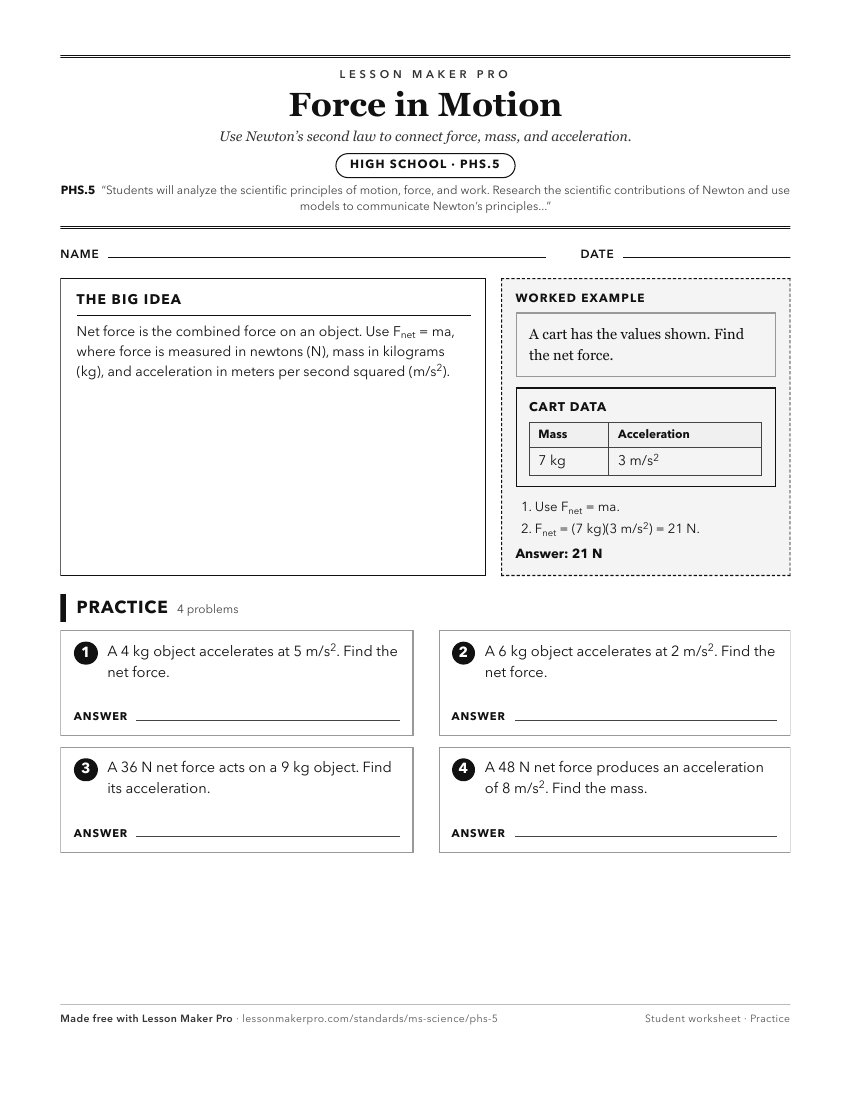
A ready-to-print activity worksheet aligned to PHS.5, with an answer key for the teacher on its own page. No account needed.
PDF, US Letter, prints cleanly in black and white.
Download the worksheetKeep exploring
Related Standards
- PHY.2
Students will develop an understanding of concepts related to Newtonian dynamics.
- P.3.6
Students will demonstrate an understanding of magnets and the effects of pushes, pulls, and friction on the motion of objects.
- P.5.6
Students will demonstrate an understanding of the factors that affect the motion of an object through a study of Newton's Laws of Motion.
- PHY.3
Students will develop an understanding of concepts related to work and energy.
Turn this cluster into a lesson
Grade, subject, topic, and the complete cluster are prefilled. Create one free, no account needed.
Also for this cluster:Make a WorksheetMake a QuizMake a Sub Lesson