Mississippi Science PHS.5.1
The Standard
- PHS.5
- Students will analyze the scientific principles of motion, force, and work.
Research the scientific contributions of Newton and use models to communicate Newton’s principles.
2026 Mississippi College- and Career-Readiness Standards for Science · Newton’s Laws of Motion
Teacher's field guide
What This Standard Means
What Students Need to Do
- Students use sources to learn about Newton’s work on motion, gravity, and light. They build or draw models to explain his three laws of motion.
What Mastery Looks Like
- Students can describe a contribution beyond the laws of motion and cite where they learned about it. Their labeled models explain inertia, acceleration under a net force, and forces on two interacting objects.
Common Misconceptions
- Students may say Newton discovered gravity rather than described how it acts. They may think moving objects need a constant push, or that action and reaction forces cancel on one object.
How to Assess It
- On an exit ticket, sketch a balloon rocket and label how the balloon pushes air backward and the air pushes the balloon forward. Name one other Newton contribution from a source you read.
Lesson moves
Ways to Teach It
Set a toy figure on a cart, roll the cart into a book, and sketch the figure’s path after the cart stops.
Read a textbook paragraph and a museum page on Newton’s prism experiment, then write what he learned and cite both sources.
Match sketches of a stopping bus, an accelerating cart, and a balloon rocket to Newton’s three laws, then explain each match.
Use a seat belt photo to draw what happens to a passenger when a car stops suddenly, and label the belt’s force.
Free download
Printable PHS.5.1 Worksheet
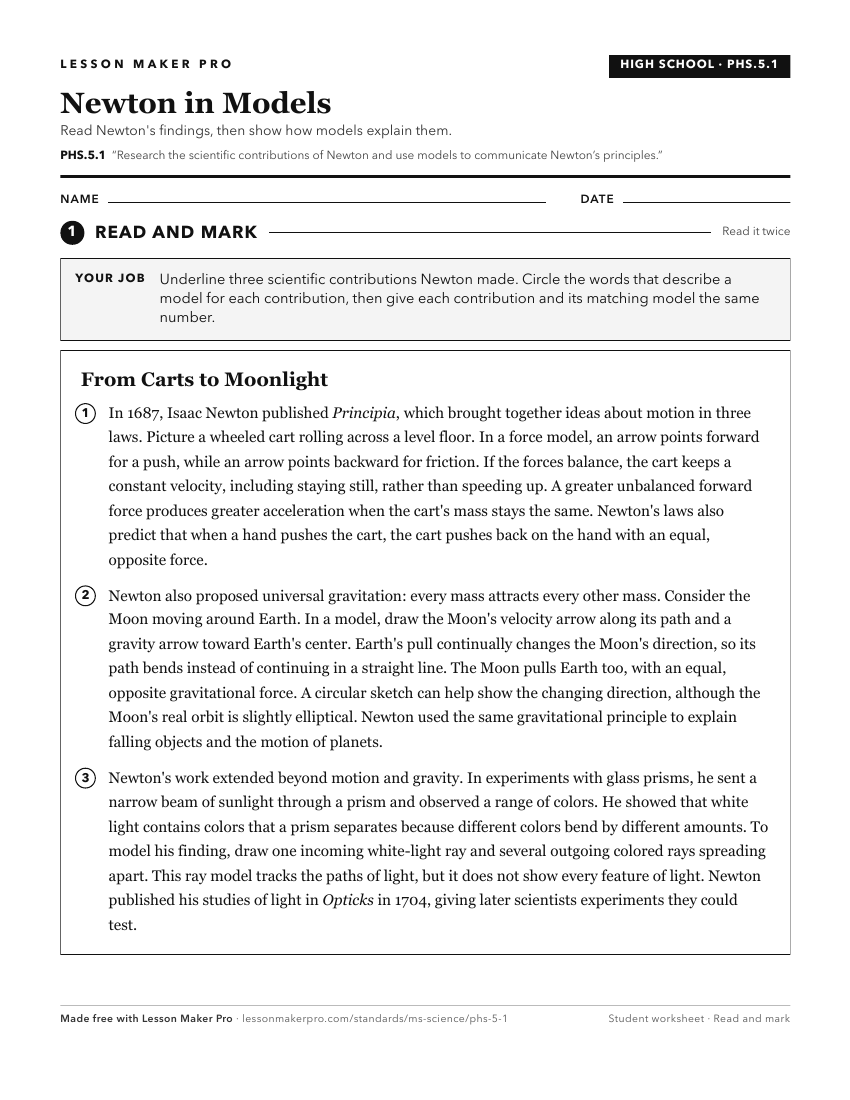
A ready-to-print activity worksheet aligned to PHS.5.1, with an answer key for the teacher on its own page. No account needed.
PDF, US Letter, prints cleanly in black and white.
Download the worksheetKeep exploring
Related Standards
- P.6.6
Students will demonstrate an understanding of Newton’s laws of motion using real world models and examples.
- ESS.1B.3
Design a model (e.g., a gravity simulation using PVC and a neoprene screen) to demonstrate Kepler’s laws and the relationships of the orbits of objects in our s...
- PHY.2.7
Analyze real-world applications to draw conclusions about Newton’s three laws of motion using online simulations, probe systems, and/or laboratory experiences.
- PHY.2.2
Use models such as free-body diagrams to explain and predict the motion of an object according to Newton's law of motion, including circular motion.
Turn this exact standard into a lesson
Grade, subject, topic, and the complete standard are prefilled. Create one free, no account needed.
Also for this standard:Make a WorksheetMake a QuizMake a Sub Lesson