Mississippi Science ESS.1B.3
The Standard
- ESS.1B
- Students will develop an understanding of Earth, the solar system, and the laws that predict the motion of celestial bodies.
Design a model (e.g., a gravity simulation using PVC and a neoprene screen) to demonstrate Kepler’s laws and the relationships of the orbits of objects in our solar system. Relate them to Newton’s law of universal gravitation and laws of motion.
2026 Mississippi College- and Career-Readiness Standards for Science · Earth in the Universe
Teacher's field guide
What This Standard Means
What Students Need to Do
- Students design a model that shows an elliptical orbit, changing speed, and how orbit size relates to orbital period. They use gravity and inertia to explain the planet's path.
What Mastery Looks Like
- Students place the Sun at one focus and show equal areas swept out in equal times. They predict that an orbit with a 4 AU semimajor axis takes 8 years around the Sun, and explain how gravity changes a planet's motion.
Common Misconceptions
- Students may put the Sun at the center of the ellipse instead of at a focus. They may assume a planet moves at a steady speed or that a longer orbital period comes only from a longer path.
How to Assess It
- Exit ticket: Sketch an elliptical orbit with the Sun at a focus, mark two equal-time areas, and predict the period of a 4 AU orbit around the Sun. Add one sentence explaining the roles of gravity and inertia.
Lesson moves
Ways to Teach It
Trace an ellipse with two pins and string, place the Sun at one focus, and add speed arrows using orbit simulation data.
Ask: Why does a planet move faster near the Sun, and what would happen if gravity vanished? Require gravity and inertia in each answer.
Give pairs orbit cards at 1 and 4 AU; students calculate 1- and 8-year periods using P² = a³.
Compare Earth and Mars using NASA orbit distances and periods, then check whether squared periods match cubed distances.
Free download
Printable ESS.1B.3 Worksheet
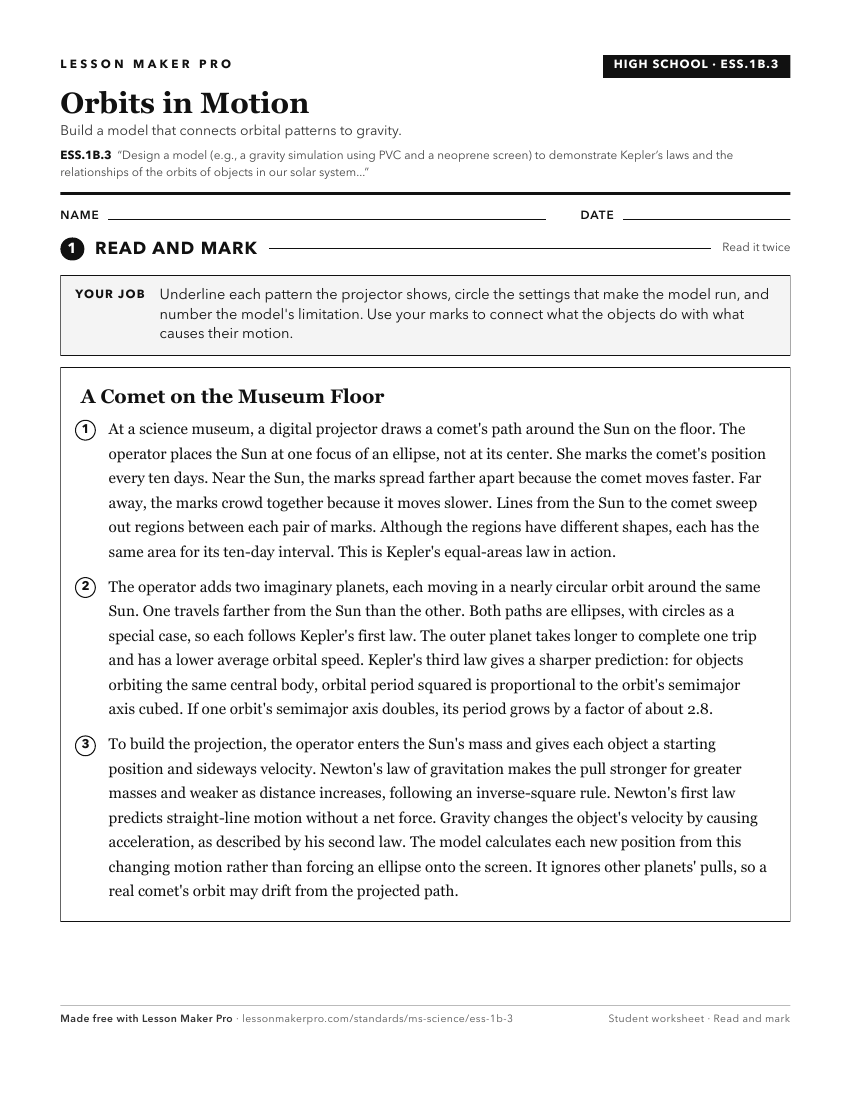
A ready-to-print activity worksheet aligned to ESS.1B.3, with an answer key for the teacher on its own page. No account needed.
PDF, US Letter, prints cleanly in black and white.
Download the worksheetKeep exploring
Related Standards
- E.2.8.6
Create a model that will demonstrate the observable pattern of motion of the Sun or Moon. Use an engineering design process to define the problem, design, const...
- PHY.2.11
Explain centripetal acceleration while undergoing uniform circular motion to explore Kepler’s third law using online simulations, models, and/or probe systems.
- E.5.8A.1
Develop and use scaled models of Earth's solar system to demonstrate the size, composition (i.e., rock or gas), location, and order of the planets as they orbit...
- PHY.2.2
Use models such as free-body diagrams to explain and predict the motion of an object according to Newton's law of motion, including circular motion.
Turn this exact standard into a lesson
Grade, subject, topic, and the complete standard are prefilled. Create one free, no account needed.
Also for this standard:Make a WorksheetMake a QuizMake a Sub Lesson