Mississippi Science PHY.2.11
The Standard
- PHY.2
- Students will develop an understanding of concepts related to Newtonian dynamics.
Explain centripetal acceleration while undergoing uniform circular motion to explore Kepler’s third law using online simulations, models, and/or probe systems.
2026 Mississippi College- and Career-Readiness Standards for Science · Newton’s Laws
Teacher's field guide
What This Standard Means
What Students Need to Do
- Students explain why an object moving at a steady speed around a circle still accelerates: its direction changes. They point that acceleration toward the center and identify gravity as the force that keeps a satellite in orbit. They use orbit data to see how orbital distance relates to the time for one orbit.
What Mastery Looks Like
- Given a circular-orbit sketch, students draw velocity tangent to the path and acceleration toward the center. They use measurements from two orbits around the same body to check that T²/r³ stays about the same. They predict that a more distant satellite takes longer to orbit.
Common Misconceptions
- Students may say there is no acceleration because speed stays constant, or draw acceleration along the path. Some think a satellite needs an outward force to stay in orbit. Others compare orbits around different central bodies as though T²/r³ has the same value for all of them.
How to Assess It
- Exit ticket: One satellite circles Earth at a radius of r in 2 hours; another circles at 4r. Draw velocity and acceleration arrows for the first satellite, then find the second satellite's period using T² proportional to r³. Look for tangent velocity, inward acceleration, and a period of 16 hours.
Lesson moves
Ways to Teach It
Swing a foam ball on a string, then draw inward-force and tangent-velocity arrows at four marked positions on an orbit sketch.
Ask, 'If a satellite's speed stays steady, why is it accelerating?' Have pairs explain using velocity arrows at two points on a circle.
In PhET Gravity and Orbits, drag a planet to three orbital distances, time one orbit at each, and compare T²/r³.
Give students diagrams of a low-Earth-orbit satellite and a geostationary satellite; have them predict which takes longer to orbit using distance from Earth's center.
Free download
Printable PHY.2.11 Worksheet
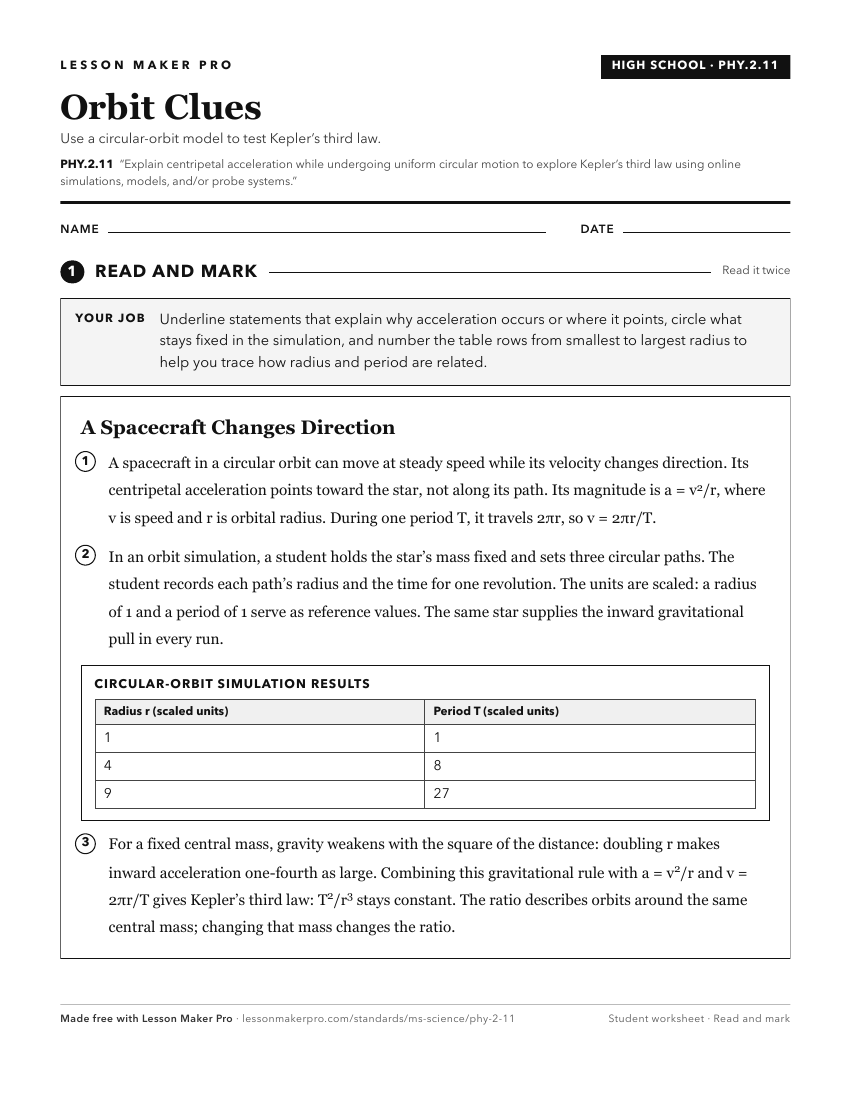
A ready-to-print activity worksheet aligned to PHY.2.11, with an answer key for the teacher on its own page. No account needed.
PDF, US Letter, prints cleanly in black and white.
Download the worksheetKeep exploring
Related Standards
- PHY.4.6
Explore and explain the Doppler effect as it relates to a moving source and to a moving observer using online simulations, probe systems, and/or real-world expe...
- ESS.1B.3
Design a model (e.g., a gravity simulation using PVC and a neoprene screen) to demonstrate Kepler’s laws and the relationships of the orbits of objects in our s...
- PHY.2.7
Analyze real-world applications to draw conclusions about Newton’s three laws of motion using online simulations, probe systems, and/or laboratory experiences.
- PHY.2.2
Use models such as free-body diagrams to explain and predict the motion of an object according to Newton's law of motion, including circular motion.
Turn this exact standard into a lesson
Grade, subject, topic, and the complete standard are prefilled. Create one free, no account needed.
Also for this standard:Make a WorksheetMake a QuizMake a Sub Lesson