Mississippi Science PHY.4.6
The Standard
- PHY.4
- Students will investigate and explore wave properties.
Explore and explain the Doppler effect as it relates to a moving source and to a moving observer using online simulations, probe systems, and/or real-world experiences.
2026 Mississippi College- and Career-Readiness Standards for Science · Waves
Teacher's field guide
What This Standard Means
What Students Need to Do
- Students predict how motion changes the pitch a listener hears. They compare a moving sound source with a moving listener and explain what happens to the wavefronts in each case.
What Mastery Looks Like
- A student can predict a higher pitch when a source and listener move toward each other, and a lower pitch when they move apart. They can explain that a moving source changes wavefront spacing in the air, while a moving listener encounters the same wavefronts at a different rate.
Common Misconceptions
- Students may say a passing siren sounds lower only because it gets quieter. They may also think a moving listener changes the spacing between waves in the air.
How to Assess It
- On an exit ticket, show a siren moving toward a stationary listener and a listener moving away from a stationary siren. Ask students to mark the heard pitch as higher or lower and circle the case where wavefront spacing changes.
Lesson moves
Ways to Teach It
In an online Doppler simulator, move the source while the listener stays still, then swap roles and record the heard frequency.
Ask students to sketch wavefronts around a moving siren and explain why a listener walking toward a stationary siren hears a higher pitch.
Give pairs direction cards for a source and listener, then have them sort each pair into higher, lower, or unchanged heard pitch.
Play a recording of an ambulance passing and have students mark where the pitch drops and explain what changed.
Free download
Printable PHY.4.6 Worksheet
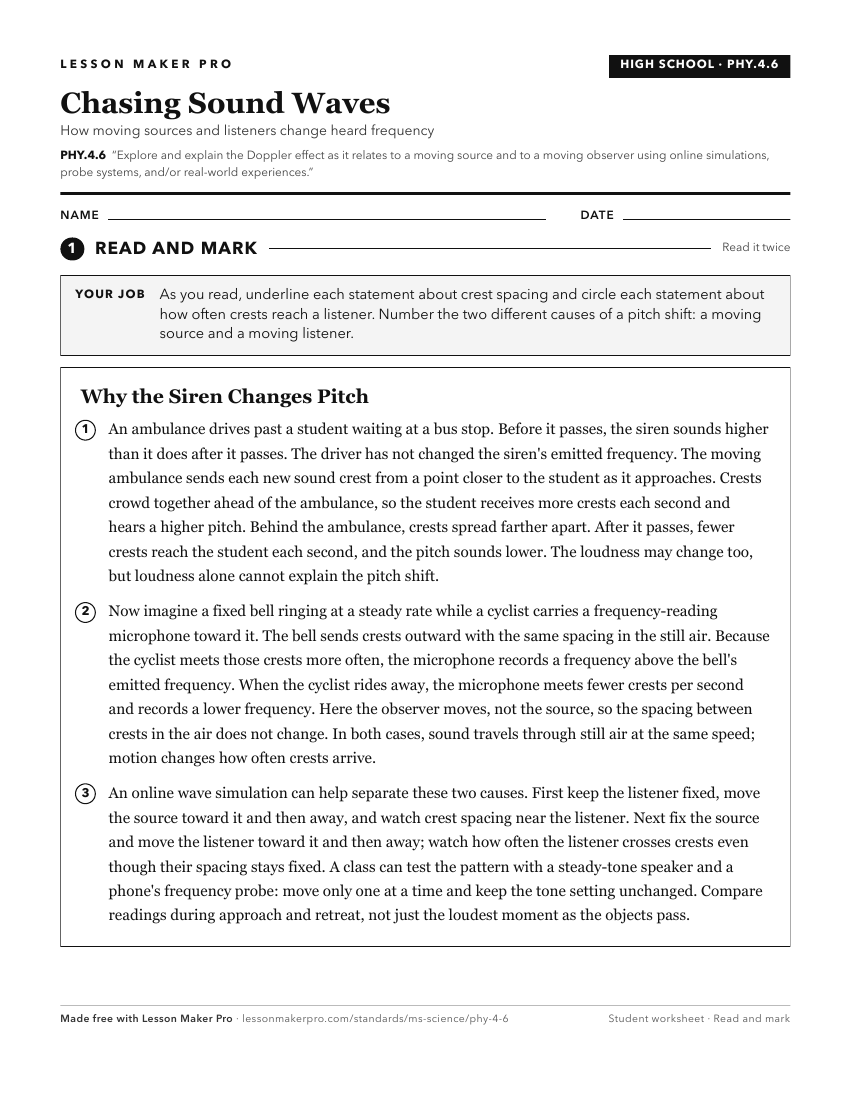
A ready-to-print activity worksheet aligned to PHY.4.6, with an answer key for the teacher on its own page. No account needed.
PDF, US Letter, prints cleanly in black and white.
Download the worksheetKeep exploring
Related Standards
- PHY.2.11
Explain centripetal acceleration while undergoing uniform circular motion to explore Kepler’s third law using online simulations, models, and/or probe systems.
- PHY.2.7
Analyze real-world applications to draw conclusions about Newton’s three laws of motion using online simulations, probe systems, and/or laboratory experiences.
- PHY.4.5
Design, investigate, and collect data on standing waves and waves in specific media (e.g., stretched string, water surface, and air) using online simulations, p...
- PHY.4.4
Investigate and communicate the relationship between the energy of a wave in terms of amplitude and frequency using probe systems, online simulations, and/or la...
Turn this exact standard into a lesson
Grade, subject, topic, and the complete standard are prefilled. Create one free, no account needed.
Also for this standard:Make a WorksheetMake a QuizMake a Sub Lesson