Mississippi Science E.5.8A.1
The Standard
- E.5.8A
- Students will demonstrate an understanding of the locations of objects in the universe.
Develop and use scaled models of Earth’s solar system to demonstrate the size, composition (i.e., rock or gas), location, and order of the planets as they orbit the Sun.
2026 Mississippi College- and Career-Readiness Standards for Science · Earth and the Universe
Teacher's field guide
What This Standard Means
What Students Need to Do
- Students build and read models that use scales to compare planet sizes and distances from the Sun. They put the eight planets in order, identify rocky and gas-rich planets, and show their orbits.
What Mastery Looks Like
- Students place planets at distances that match a given scale and make size circles using a separate scale. They can name the rocky inner planets, identify Jupiter as the largest, and explain why a straight line of cards does not show orbital paths.
Common Misconceptions
- Students may space the planets evenly or draw them all about the same size. Some put the Moon among the planets or think planets travel in straight lines because a model shows them lined up.
How to Assess It
- Give students a 30 cm strip with the Sun marked at one end and a scale of 1 cm per Earth-Sun distance. Ask them to mark Earth at 1 cm, Jupiter at 5 cm, and Neptune at 30 cm, then name the largest and explain what the strip cannot show about orbits.
Lesson moves
Ways to Teach It
In the yard, students measure from a Sun sign and place planet cards at 0.4, 0.7, 1, 1.5, 5, 9.5, 19, and 30 meters.
Show a drawing with equally spaced planets and ask, “Which gaps mislead you, and what would a scaled model change?”
Give pairs planet diameter cards; have them race to arrange eight paper circles by size, then check their choices against the cards.
Show a Mars rover photo; students find Earth and Mars on their model and compare their rocky makeup and Sun distances.
Free download
Printable E.5.8A.1 Worksheet
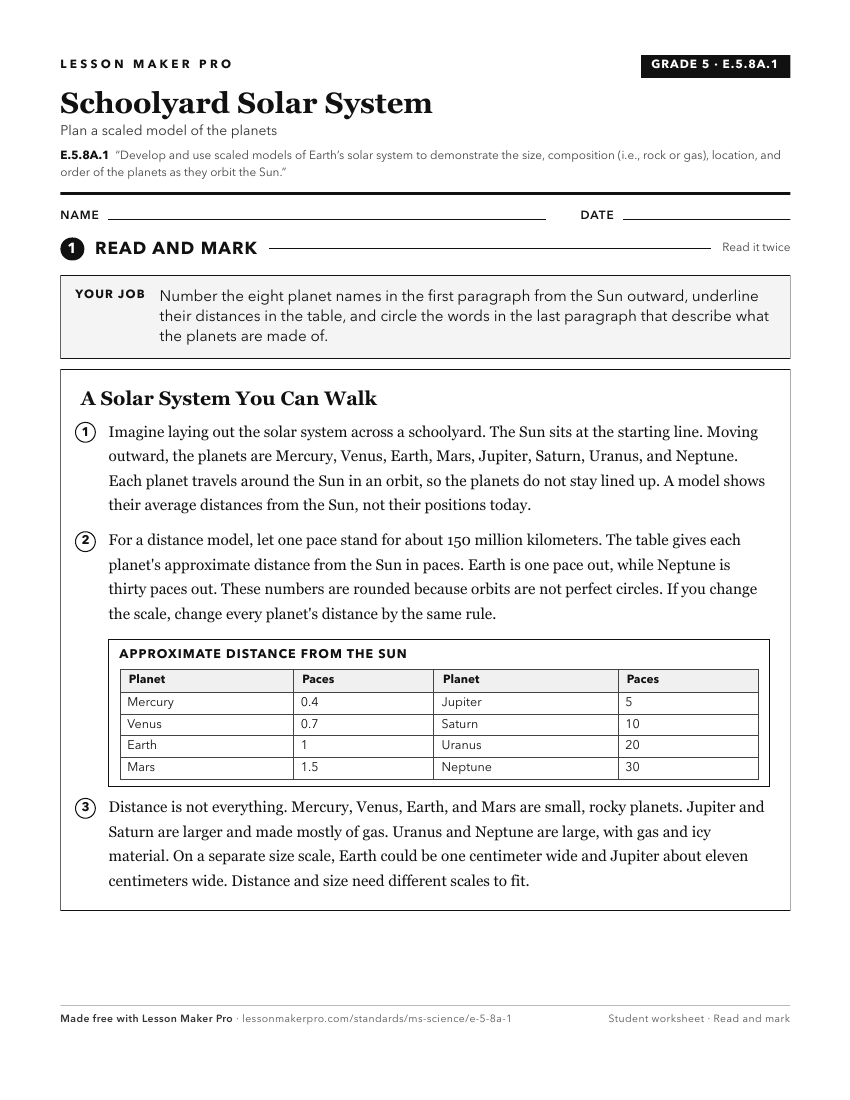
A ready-to-print activity worksheet aligned to E.5.8A.1, with an answer key for the teacher on its own page. No account needed.
PDF, US Letter, prints cleanly in black and white.
Download the worksheetKeep exploring
Related Standards
- E.5.8B.3
Develop and use models to explain the factors (e.g., tilt, revolution, and angle of sunlight) that result in Earth's seasonal changes.
- E.3.9.1
Develop models to communicate the characteristics of the Earth's major systems, including the geosphere, hydrosphere, atmosphere, and biosphere (e.g., digital m...
- E.5.8B.2
Develop and use a model of the Earth-Sun-Moon system to analyze the cyclic patterns of lunar phases, solar and lunar eclipses, and seasons.
- E.6.8
Students will demonstrate an understanding of Earth’s place in the universe and the interactions of the solar system (sun, planets, their moons, comets, and ast...
Turn this exact standard into a lesson
Grade, subject, topic, and the complete standard are prefilled. Create one free, no account needed.
Also for this standard:Make a WorksheetMake a QuizMake a Sub Lesson