Mississippi Science E.5.8B.3
The Standard
- E.5.8B
- Students will demonstrate an understanding of the principles that govern moon phases, day and night, appearance of objects in the sky, and seasonal changes.
Develop and use models to explain the factors (e.g., tilt, revolution, and angle of sunlight) that result in Earth’s seasonal changes.
2026 Mississippi College- and Career-Readiness Standards for Science · Earth and the Universe
Teacher's field guide
What This Standard Means
What Students Need to Do
- Students show how Earth moves around the Sun while its tilted axis keeps pointing in the same direction. They use the model to explain why each hemisphere gets different amounts of daylight and more or less direct sunlight during the year.
What Mastery Looks Like
- A student can move a tilted globe around a lamp without changing the direction its axis points. They can identify which hemisphere has summer at two opposite positions and explain why using daylight hours and sunlight angle.
Common Misconceptions
- Students often say summer happens because Earth is closer to the Sun. Some turn Earth's axis toward the lamp at every position, which hides the reason seasons change.
How to Assess It
- On an exit ticket, draw a lamp and two globes on opposite sides of it. Ask students to add the tilted axes, label Northern Hemisphere summer and winter, and explain one label using sunlight angle.
Lesson moves
Ways to Teach It
Place a sticker on the Northern Hemisphere of a tilted globe; move it around a lamp without changing the direction its axis points.
Ask students to write: 'Earth is closest to the Sun in January, so why is it winter north of the equator?'
Give pairs four orbit diagrams; they race to circle models with a consistently tilted axis and label which hemisphere gets more direct light.
Look up local sunrise and sunset times for June 21 and December 21; calculate daylight hours and connect the difference to Earth's tilt.
Free download
Printable E.5.8B.3 Worksheet
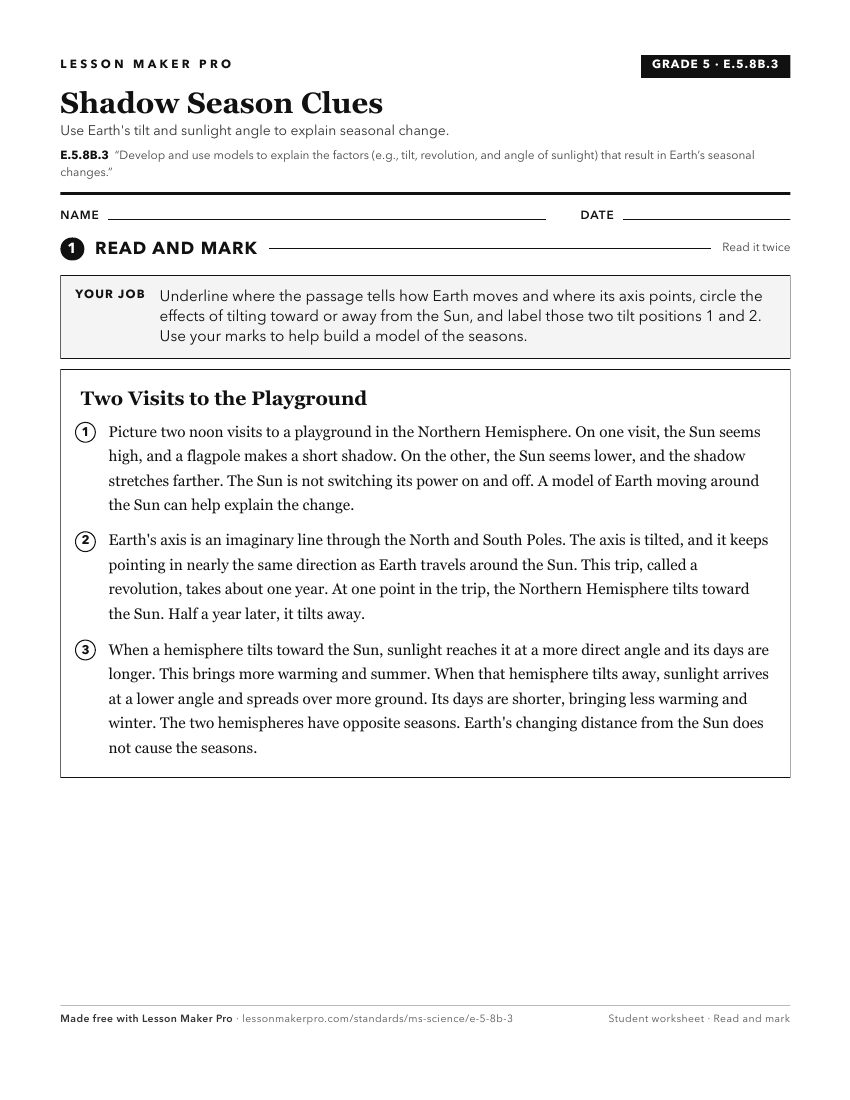
A ready-to-print activity worksheet aligned to E.5.8B.3, with an answer key for the teacher on its own page. No account needed.
PDF, US Letter, prints cleanly in black and white.
Download the worksheetKeep exploring
Related Standards
- E.K.8B.1
With teacher guidance, generate and answer questions to develop a simple model, which describes observable patterns of sunlight on the Earth's surface (day and ...
- E.K.8A.1
Construct an explanation of the pattern of the Earth's seasonal changes in the environment using evidence from observations.
- E.5.8B.2
Develop and use a model of the Earth-Sun-Moon system to analyze the cyclic patterns of lunar phases, solar and lunar eclipses, and seasons.
- E.1.9A.2
Develop and use models to predict weather conditions associated with seasonal patterns and changes.
Turn this exact standard into a lesson
Grade, subject, topic, and the complete standard are prefilled. Create one free, no account needed.
Also for this standard:Make a WorksheetMake a QuizMake a Sub Lesson