Mississippi Science E.K.8B.1
The Standard
- E.K.8B
- Students will demonstrate an understanding that the Sun provides the Earth with heat and light.
With teacher guidance, generate and answer questions to develop a simple model, which describes observable patterns of sunlight on the Earth’s surface (day and night).
2026 Mississippi College- and Career-Readiness Standards for Science · Earth and the Universe
Teacher's field guide
What This Standard Means
What Students Need to Do
- Students notice that their surroundings are light during the day and dark at night. With help, they ask questions and use a flashlight and globe to show where sunlight falls.
What Mastery Looks Like
- A student points to the lit side of the globe for day and the dark side for night. They turn the globe to show how one place moves from day to night and back again.
Common Misconceptions
- Some children think the sun turns off at night or that clouds make nighttime. Others think the moon only appears at night.
How to Assess It
- Shine a flashlight on a globe and point to one spot. Ask, "Is it day or night there? Show me how that spot gets to nighttime."
Lesson moves
Ways to Teach It
Darken the room, shine a flashlight on a globe, and let pairs turn it to find lit and dark places.
Ask, "Does the sun turn off at night?" Have children use the flashlight and globe to explain their answer.
Give pairs day and night picture cards to sort, then have them point to matching places on the lit globe.
Compare photos of the schoolyard taken at noon and after sunset, and ask children what changed.
Free download
Printable E.K.8B.1 Worksheet
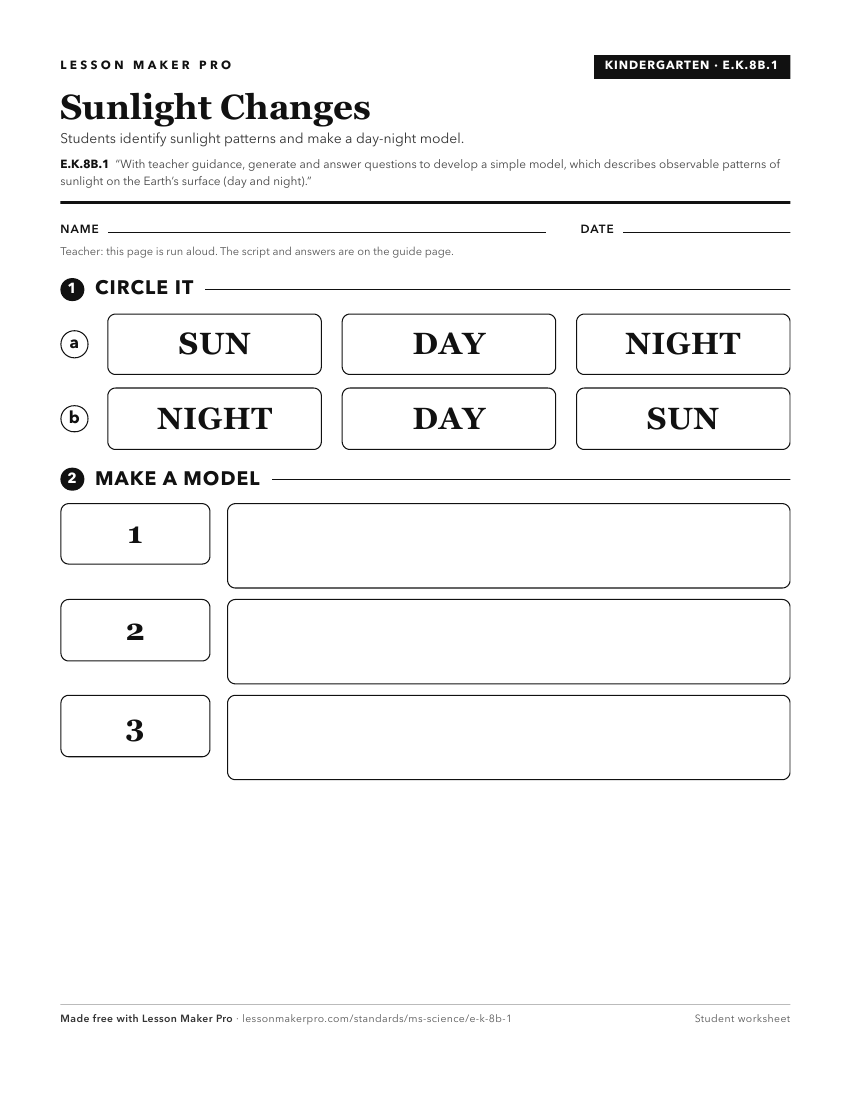
A ready-to-print activity worksheet aligned to E.K.8B.1, with an answer key for the teacher on its own page. No account needed.
PDF, US Letter, prints cleanly in black and white.
Download the worksheetKeep exploring
Related Standards
- E.5.8B.3
Develop and use models to explain the factors (e.g., tilt, revolution, and angle of sunlight) that result in Earth's seasonal changes.
- E.5.8B.2
Develop and use a model of the Earth-Sun-Moon system to analyze the cyclic patterns of lunar phases, solar and lunar eclipses, and seasons.
- E.K.8B.2
With teacher guidance, develop questions to conduct a structured investigation to determine how sunlight affects the temperature of the Earth's natural resource...
- E.2.8.2
With teacher guidance, observe, describe, and predict the seasonal patterns of sunrise and sunset. Collect, represent, and interpret data from internet sources ...
Turn this exact standard into a lesson
Grade, subject, topic, and the complete standard are prefilled. Create one free, no account needed.
Also for this standard:Make a WorksheetMake a QuizMake a Sub Lesson