Mississippi Science E.2.8.2
The Standard
- E.2.8
- Students will demonstrate an understanding of the appearance, movements, and patterns of the sun, moon, and stars.
With teacher guidance, observe, describe, and predict the seasonal patterns of sunrise and sunset. Collect, represent, and interpret data from internet sources to communicate findings.
2026 Mississippi College- and Career-Readiness Standards for Science · Earth and the Universe
Teacher's field guide
What This Standard Means
What Students Need to Do
- With help, students find sunrise and sunset times online for the same town on dates in different seasons. They put the times in a table and use them to describe and predict when days have more daylight.
What Mastery Looks Like
- A student can show that summer sunrise is earlier and sunset is later than in winter. They use times from their table to explain a prediction about another date.
Common Misconceptions
- Students may think the Sun rises and sets at the same time every day. They may also think an earlier sunset means the clock day is shorter, rather than the hours of daylight.
How to Assess It
- Give students these times: December sunrise 7 a.m., sunset 5 p.m.; June sunrise 6 a.m., sunset 8 p.m. Ask which date has more daylight and whether a July sunrise is likely closer to 6 a.m. or 7 a.m. Have them explain with the given times.
Lesson moves
Ways to Teach It
Open a teacher-selected online sunrise calendar for your town; pairs copy times for four seasonal dates and set paper clocks to match.
Ask, “Which season has the longest time between sunrise and sunset?” Have students cite two times from their table in a written answer.
Give teams four date cards and sunrise and sunset times; have them match the cards, then graph the daylight hours.
Compare the school’s recess time with online sunset times for December and June, then ask when recess is closer to sunset.
Free download
Printable E.2.8.2 Worksheet
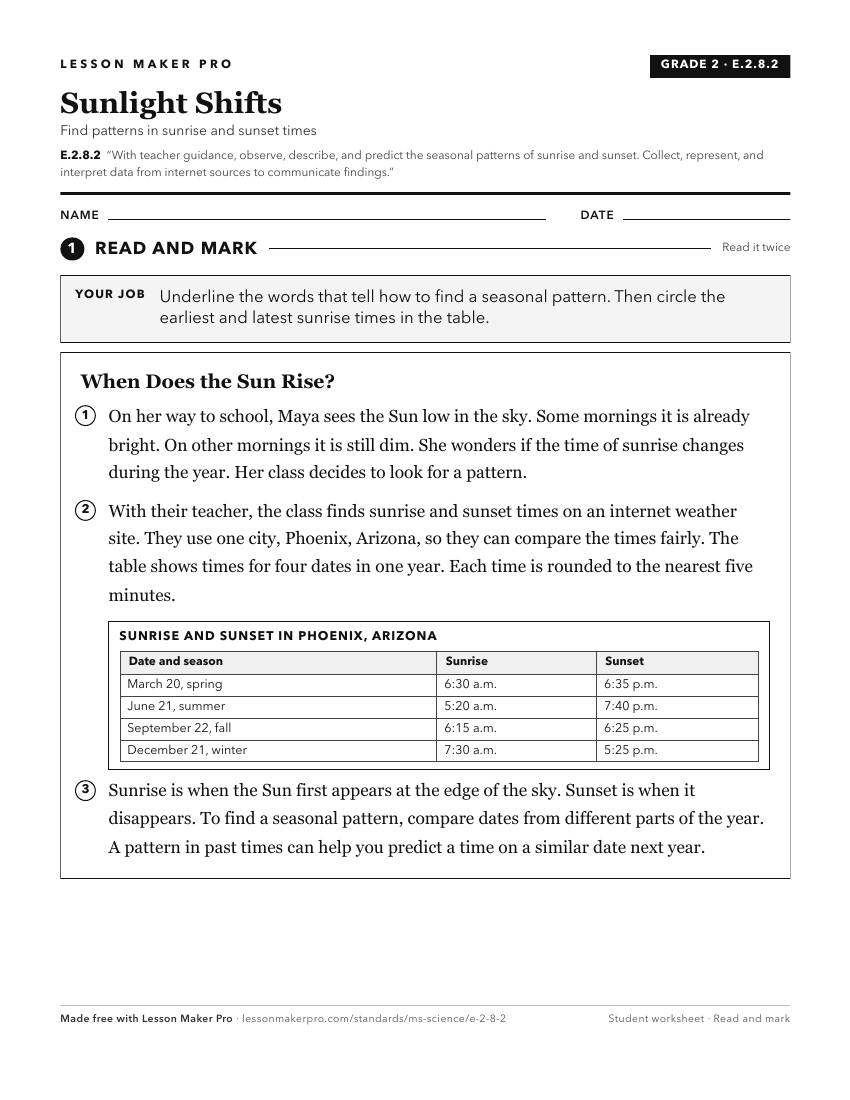
A ready-to-print activity worksheet aligned to E.2.8.2, with an answer key for the teacher on its own page. No account needed.
PDF, US Letter, prints cleanly in black and white.
Download the worksheetKeep exploring
Related Standards
- E.K.8B.1
With teacher guidance, generate and answer questions to develop a simple model, which describes observable patterns of sunlight on the Earth's surface (day and ...
- E.5.8B.3
Develop and use models to explain the factors (e.g., tilt, revolution, and angle of sunlight) that result in Earth's seasonal changes.
- E.1.9A
Students will demonstrate an understanding of the patterns of weather by describing, recording, and analyzing weather data to answer questions about daily and s...
- E.K.8A
Students will demonstrate an understanding of the pattern of seasonal changes on the Earth.
Turn this exact standard into a lesson
Grade, subject, topic, and the complete standard are prefilled. Create one free, no account needed.
Also for this standard:Make a WorksheetMake a QuizMake a Sub Lesson