Mississippi Science E.1.9A
Standard Cluster
Students will demonstrate an understanding of the patterns of weather by describing, recording, and analyzing weather data to answer questions about daily and seasonal weather patterns. Analyze and interpret data from observations and measurements to describe local weather conditions (including temperature, wind, and forms of precipitation). Develop and use models to predict weather conditions associated with seasonal patterns and changes. Construct an explanation for the general pattern of change in daily temperatures by measuring and calculating the difference between morning and afternoon temperatures. Obtain and communicate information about severe weather conditions to explain why certain safety precautions are necessary.
2026 Mississippi College- and Career-Readiness Standards for Science · Earth’s Systems and Cycles
Cluster contents
Standards in This Cluster
E.1.9A is a cluster heading. These are the individual standards under it.
- E.1.9A.1
Analyze and interpret data from observations and measurements to describe local weather conditions (including temperature, wind, and forms of precipitation).
- E.1.9A.2
Develop and use models to predict weather conditions associated with seasonal patterns and changes.
- E.1.9A.3
Construct an explanation for the general pattern of change in daily temperatures by measuring and calculating the difference between morning and afternoon tempe...
- E.1.9A.4
Obtain and communicate information about severe weather conditions to explain why certain safety precautions are necessary.
Teacher's field guide
What This Cluster Means
What Students Need to Do
- Students record local temperature, wind, and rain or snow. They use a weather chart to spot seasonal patterns and predict likely weather. They compare morning and afternoon temperatures and explain how to stay safe during severe storms.
What Mastery Looks Like
- A student describes the day's weather from a chart and uses past records to make a likely seasonal prediction. They count the degrees between morning and afternoon readings, even when the afternoon is cooler. They explain why an inside room away from windows is safer during a tornado warning.
Common Misconceptions
- Students may treat one cold day as proof that winter has begun. They may say afternoons are always warmer without checking both readings. Some think a window is a safe place to watch a tornado.
How to Assess It
- Give students a log showing 60°F in the morning, 65°F in the afternoon, wind, and rain. Ask, 'How much warmer did it get, and what was the weather like?'
Lesson moves
Ways to Teach It
Check a thermometer, windsock, and rain gauge in the morning and afternoon; chart readings and count the temperature difference.
Show a local monthly weather chart and ask, 'Which season had more rain? What on the chart tells you?'
Give pairs printed local monthly weather cards; have them sort by season and use the cards to predict a likely weather pattern.
Read a local storm safety flyer; have students point to where they would shelter during a tornado warning and explain why.
Free download
Printable E.1.9A Worksheet
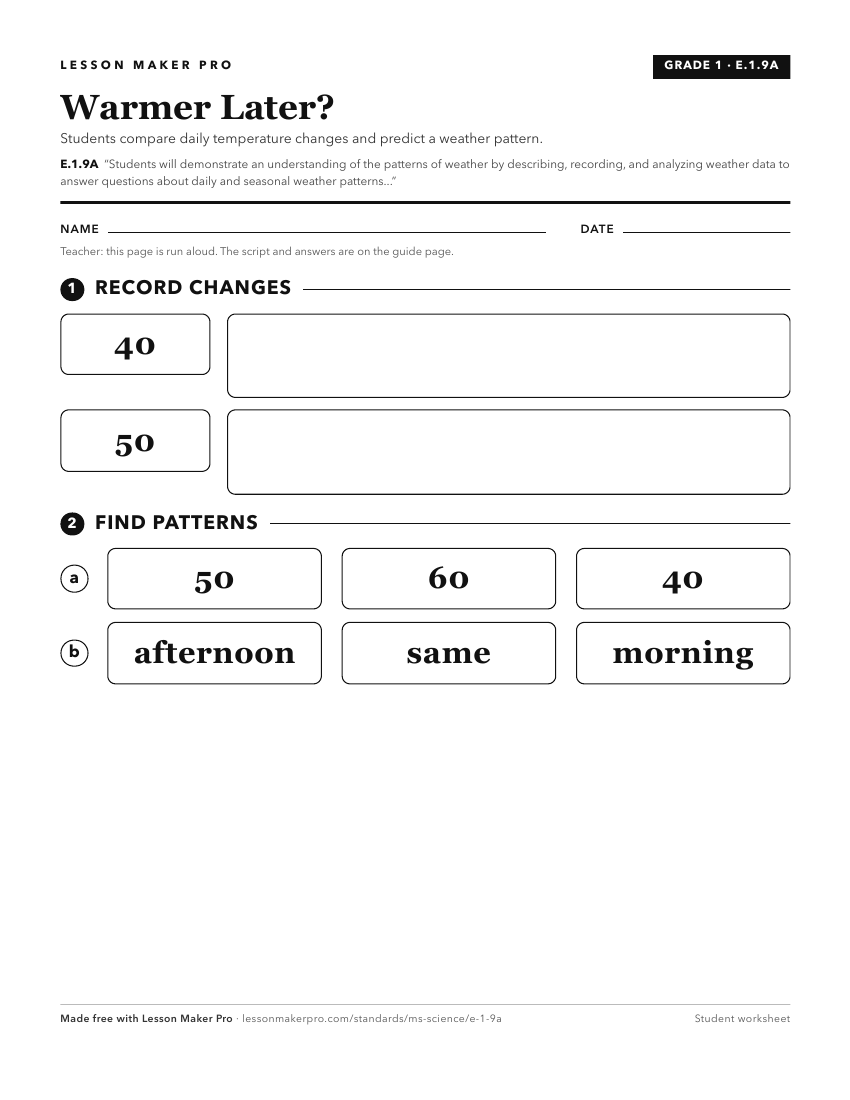
A ready-to-print activity worksheet aligned to E.1.9A, with an answer key for the teacher on its own page. No account needed.
PDF, US Letter, prints cleanly in black and white.
Download the worksheetKeep exploring
Related Standards
- E.7.9A
Students will demonstrate an understanding of how complex changes in the movement and patterns of air and water molecules caused by the sun, winds, landforms, o...
- E.4.9B
Students will demonstrate an understanding of weather and climate patterns.
- E.K.8A
Students will demonstrate an understanding of the pattern of seasonal changes on the Earth.
- E.7.9B
Students will demonstrate an understanding of the relationship between natural phenomena, human activity, and global climate change.
Turn this cluster into a lesson
Grade, subject, topic, and the complete cluster are prefilled. Create one free, no account needed.
Also for this cluster:Make a WorksheetMake a QuizMake a Sub Lesson