Mississippi Science E.1.9A.2
The Standard
- E.1.9A
- Students will demonstrate an understanding of the patterns of weather by describing, recording, and analyzing weather data to answer questions about daily and seasonal weather patterns.
Develop and use models to predict weather conditions associated with seasonal patterns and changes.
2026 Mississippi College- and Career-Readiness Standards for Science · Earth’s Systems and Cycles
Teacher's field guide
What This Standard Means
What Students Need to Do
- Students make a picture model of weather across the seasons using local weather records. They use patterns in the model to predict likely weather and explain their choice.
What Mastery Looks Like
- A student can use a season wheel to predict a likely rainy, sunny, hot, or cold day. They can point to the weather symbols that support the prediction and say that a different kind of day is still possible.
Common Misconceptions
- Some students think winter always means snow, even where they live without snow. Others think one warm day means the season has changed.
How to Assess It
- Show a picture chart with four rainy days in spring and four sunny days in summer. Ask students to draw a likely spring day and point to the chart clue they used.
Lesson moves
Ways to Teach It
Give pairs a four-season wheel and last year's monthly weather icons; have them place the icons and predict next month's likely weather.
Show rainy and sunny photos from the same spring; ask, "Can both happen in spring? Why?"
Play forecast match: students draw a season card, choose a likely weather icon, and point to evidence on their wheel.
Read the local seven-day forecast together; mark its symbols on the season wheel and circle one weather surprise.
Free download
Printable E.1.9A.2 Worksheet
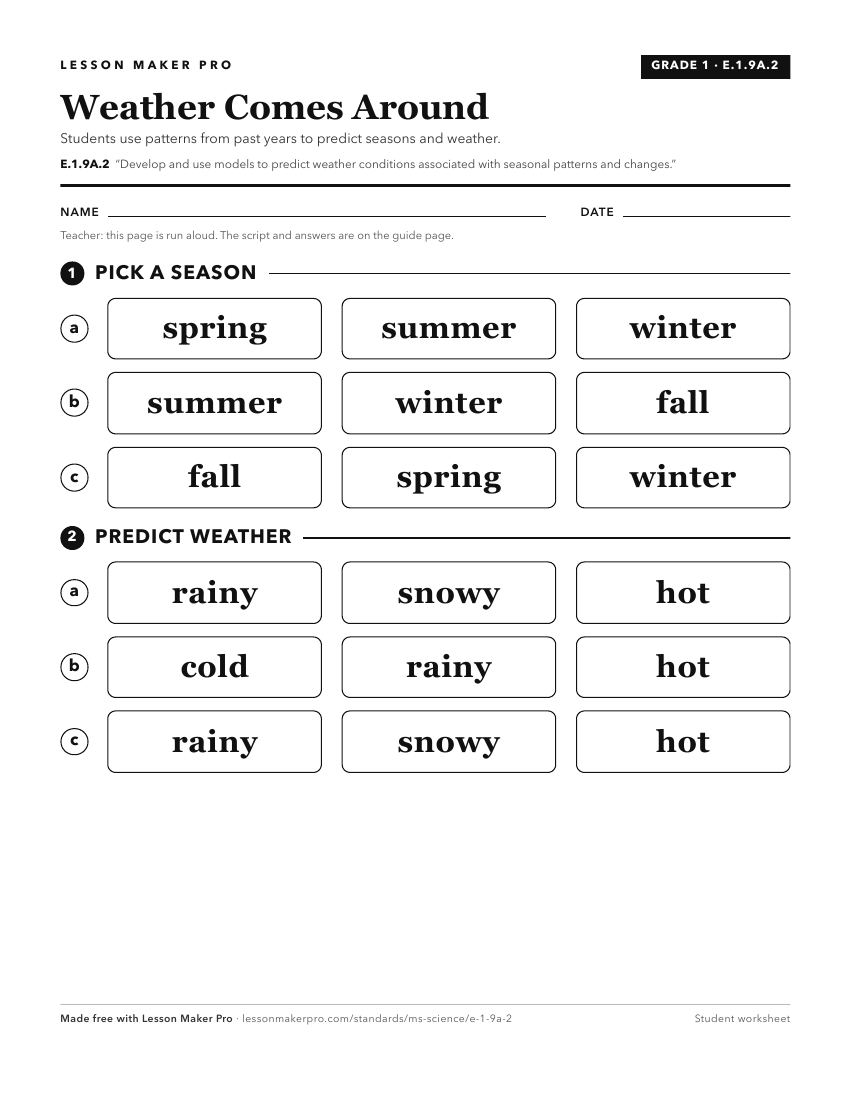
A ready-to-print activity worksheet aligned to E.1.9A.2, with an answer key for the teacher on its own page. No account needed.
PDF, US Letter, prints cleanly in black and white.
Download the worksheetKeep exploring
Related Standards
- E.5.8B.3
Develop and use models to explain the factors (e.g., tilt, revolution, and angle of sunlight) that result in Earth's seasonal changes.
- E.4.9B.1
Analyze and interpret data (e.g., temperature, precipitation, wind speed/direction, relative humidity, or cloud types) to predict changes in weather over time.
- E.7.9A.5
Analyze models to explain the cause and effect relationship between solar energy and convection and the resulting weather patterns and climate conditions.
- E.7.9A.3
Interpret atmospheric data from satellites, radar, and weather maps to predict weather patterns and conditions.
Turn this exact standard into a lesson
Grade, subject, topic, and the complete standard are prefilled. Create one free, no account needed.
Also for this standard:Make a WorksheetMake a QuizMake a Sub Lesson