Mississippi Science E.7.9A.5
The Standard
- E.7.9A
- Students will demonstrate an understanding of how complex changes in the movement and patterns of air and water molecules caused by the sun, winds, landforms, ocean temperatures, and currents in the atmosphere are major determinants of local and global weather patterns.
Analyze models to explain the cause-and-effect relationship between solar energy and convection and the resulting weather patterns and climate conditions.
2026 Mississippi College- and Career-Readiness Standards for Science · Earth’s Systems and Cycles
Teacher's field guide
What This Standard Means
What Students Need to Do
- Students use models to show how sunlight heats land and water at different rates. They trace rising warm air and sinking cool air, then connect that movement to weather and climate.
What Mastery Looks Like
- On a daytime coast diagram, students mark warm air rising over land and cooler air moving inland. They explain how repeated onshore winds can keep coastal summers cooler than inland summers.
Common Misconceptions
- Students may draw warm air sinking or say sunlight pushes air sideways. They may think one windy day describes a region’s climate, or that land and water warm at the same rate.
How to Assess It
- Give students a blank daytime coast diagram labeled warm land and cool water. Ask them to draw air-motion arrows, predict the wind direction, and explain one effect of repeated winds.
Lesson moves
Ways to Teach It
Place cups of sand and water under a lamp, record temperatures every two minutes, and draw arrows showing where warm air would rise.
Show a sea-breeze diagram and ask: Why does wind blow toward land in the afternoon, and what reverses after sunset?
Give pairs cards labeled sunlight, uneven heating, rising air, cool air, daily winds, and long-term climate; have them order and explain the links.
Post average July temperatures for San Francisco and Sacramento, then ask how cooler ocean water and onshore winds affect each city.
Free download
Printable E.7.9A.5 Worksheet
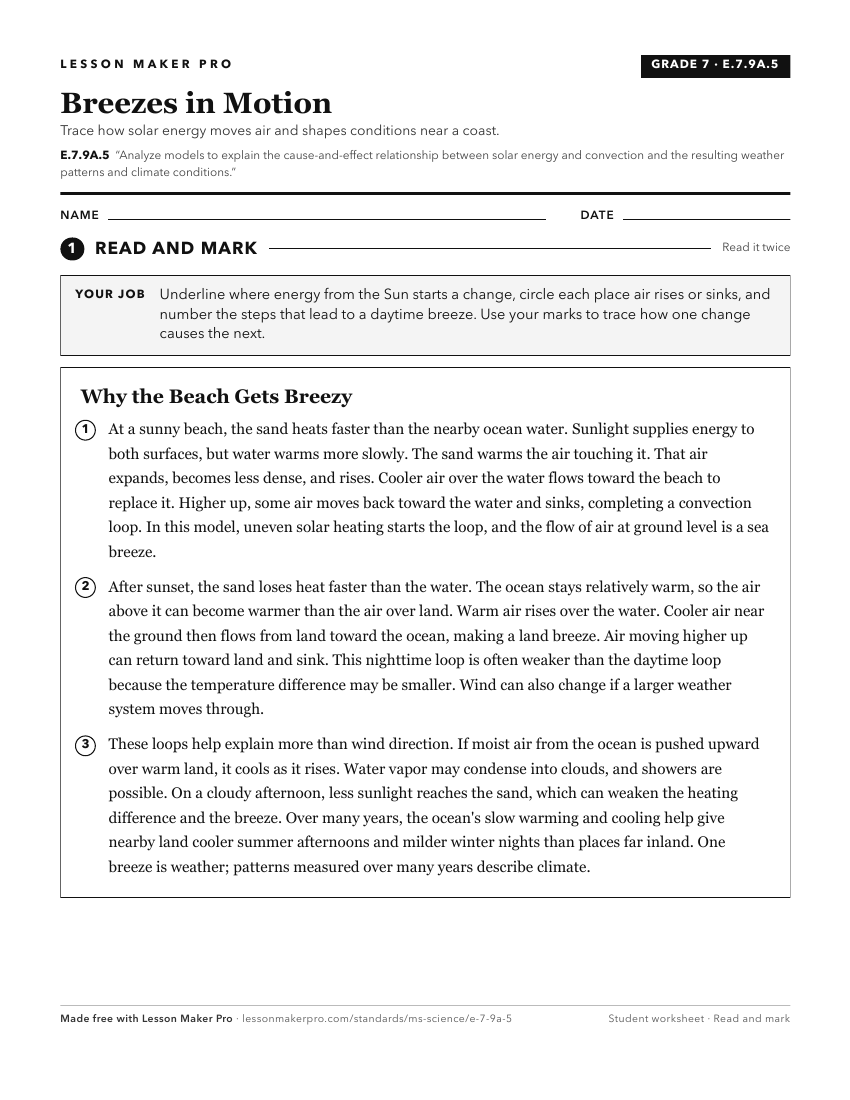
A ready-to-print activity worksheet aligned to E.7.9A.5, with an answer key for the teacher on its own page. No account needed.
PDF, US Letter, prints cleanly in black and white.
Download the worksheetKeep exploring
Related Standards
- E.7.9A.6
Research and use models to explain what type of weather (thunderstorms, hurricanes, and tornadoes) results from the movement and interactions of air masses, hig...
- E.1.9A.2
Develop and use models to predict weather conditions associated with seasonal patterns and changes.
- E.7.9A.2
Analyze evidence to explain the weather conditions that result from the relationship between the movement of water and air masses.
- E.4.9A.1
Develop and use models to explain how the sun's energy drives the water cycle. (e.g., evaporation, condensation, precipitation, transpiration, runoff, and groun...
Turn this exact standard into a lesson
Grade, subject, topic, and the complete standard are prefilled. Create one free, no account needed.
Also for this standard:Make a WorksheetMake a QuizMake a Sub Lesson