Mississippi Science E.7.9A.2
The Standard
- E.7.9A
- Students will demonstrate an understanding of how complex changes in the movement and patterns of air and water molecules caused by the sun, winds, landforms, ocean temperatures, and currents in the atmosphere are major determinants of local and global weather patterns.
Analyze evidence to explain the weather conditions that result from the relationship between the movement of water and air masses.
2026 Mississippi College- and Career-Readiness Standards for Science · Earth’s Systems and Cycles
Teacher's field guide
What This Standard Means
What Students Need to Do
- Students use temperature, humidity, and wind direction to track moving air masses. They explain how water evaporates into air, then may condense into clouds or rain when moist air cools.
What Mastery Looks Like
- A student can read a simple weather map and identify where warm, moist air meets colder air. They can explain why clouds are likely there and why rain depends on how much moisture is present.
Common Misconceptions
- Students may think rain comes straight from a lake or ocean without first evaporating. They may predict a storm whenever two air masses meet, even if the air is dry.
How to Assess It
- Exit ticket: Warm, moist air from the ocean moves toward cold, dry air over land. Predict the weather where they meet, and explain what happens to the water in the air.
Lesson moves
Ways to Teach It
Put warm water in a clear cup, cover it with a chilled plate, and observe droplets forming as water vapor cools.
Show a map with warm, moist air moving toward cold air, and ask students to explain where clouds may form.
Give pairs weather cards showing temperature, humidity, and wind direction, then have them match each card to a cloud or rain prediction.
Compare tomorrow’s local forecast with a weather-front map, and identify which incoming air mass could change the weather.
Free download
Printable E.7.9A.2 Worksheet
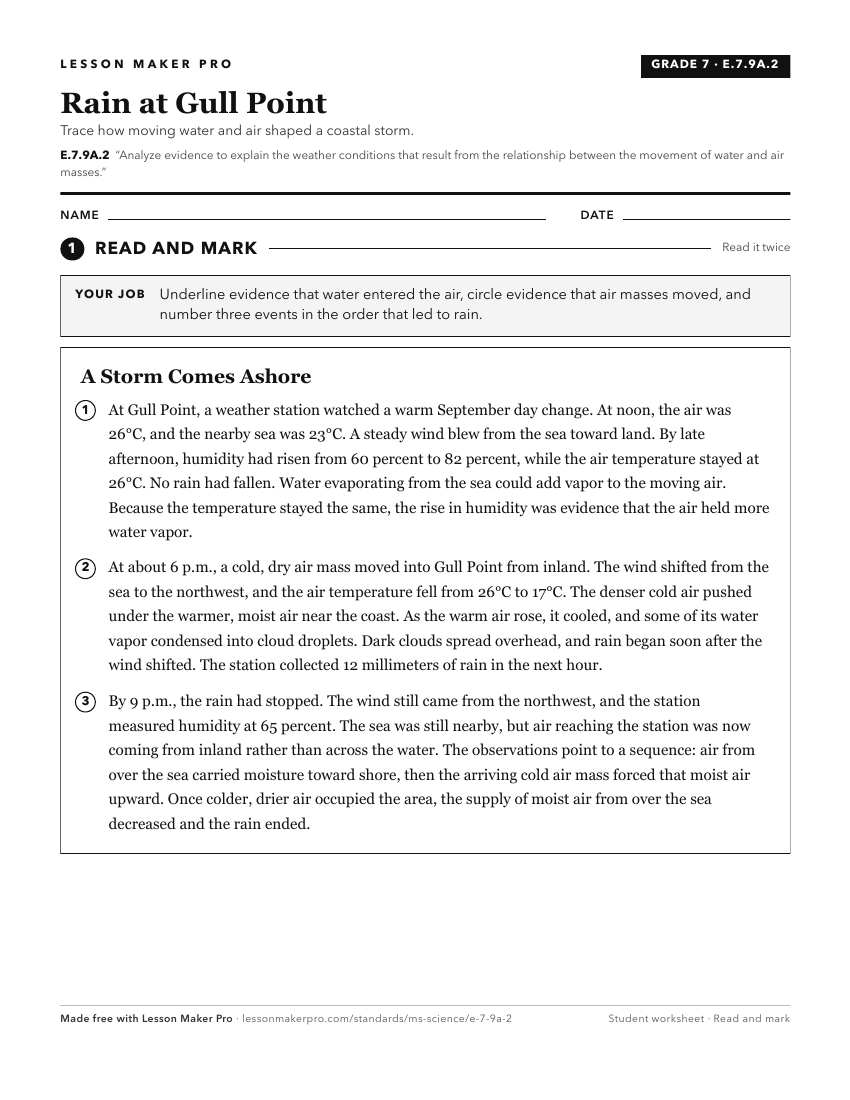
A ready-to-print activity worksheet aligned to E.7.9A.2, with an answer key for the teacher on its own page. No account needed.
PDF, US Letter, prints cleanly in black and white.
Download the worksheetKeep exploring
Related Standards
- E.7.9A.6
Research and use models to explain what type of weather (thunderstorms, hurricanes, and tornadoes) results from the movement and interactions of air masses, hig...
- ESS.3.5
Analyze and interpret weather data using maps and global weather systems to explain and communicate the relationships among air masses, pressure systems, and fr...
- E.4.9B.1
Analyze and interpret data (e.g., temperature, precipitation, wind speed/direction, relative humidity, or cloud types) to predict changes in weather over time.
- E.7.9A.5
Analyze models to explain the cause and effect relationship between solar energy and convection and the resulting weather patterns and climate conditions.
Turn this exact standard into a lesson
Grade, subject, topic, and the complete standard are prefilled. Create one free, no account needed.
Also for this standard:Make a WorksheetMake a QuizMake a Sub Lesson