Mississippi Science E.6.8
Standard Cluster
Students will demonstrate an understanding of Earth’s place in the universe and the interactions of the solar system (sun, planets, their moons, comets, and asteroids) using evidence from multiple scientific resources to explain how these objects are held in orbit around the Sun because of its gravitational pull. Obtain, evaluate, and summarize past and present theories and evidence to explain the formation and composition of the universe. Use graphical displays or models to explain the hierarchical structure (stars, galaxies, galactic clusters) of the universe. Evaluate modern techniques used to explore our solar system’s position in the universe. Obtain and evaluate information to model and compare the characteristics and movements of objects in the solar system (including planets, moons, asteroids, comets, and meteors). Construct explanations for how gravity affects the motion of objects in the solar system and tides on Earth. Design models representing motions within the Sun-Earth-Moon system to explain phenomena observed from the Earth’s surface (positions of celestial bodies, day and year, moon phases, solar and lunar eclipses, and tides). Analyze and interpret data from the surface features of the Sun (e.g., photosphere, corona, sunspots, prominences, and solar flares) to predict how these features may affect Earth.
2026 Mississippi College- and Career-Readiness Standards for Science · Earth and the Universe
Cluster contents
Standards in This Cluster
E.6.8 is a cluster heading. These are the individual standards under it.
- E.6.8.1
Obtain, evaluate, and summarize past and present theories and evidence to explain the formation and composition of the universe.
- E.6.8.2
Use graphical displays or models to explain the hierarchical structure (stars, galaxies, galactic clusters) of the universe.
- E.6.8.3
Evaluate modern techniques used to explore our solar system’s position in the universe.
- E.6.8.4
Obtain and evaluate information to model and compare the characteristics and movements of objects in the solar system (including planets, moons, asteroids, come...
- E.6.8.5
Construct explanations for how gravity affects the motion of objects in the solar system and tides on Earth.
- E.6.8.6
Design models representing motions within the Sun-Earth-Moon system to explain phenomena observed from the Earth’s surface (positions of celestial bodies, day a...
- E.6.8.7
Analyze and interpret data from the surface features of the Sun (e.g., photosphere, corona, sunspots, prominences, and solar flares) to predict how these featur...
Teacher's field guide
What This Cluster Means
What Students Need to Do
- Students model Earth's motions and gravity to explain orbits, day, year, moon phases, eclipses, and tides. They compare solar system objects and changes on the Sun using telescope and spacecraft data. They compare older ideas about the universe with evidence for its expansion and makeup, then place stars in galaxies and galaxies in clusters.
What Mastery Looks Like
- With a lamp and balls, a student can model a day, a year, moon phases, and eclipses. They can explain why gravity keeps planets and moons in orbit and helps cause tides. They can use a redshift graph, a galaxy diagram, and solar data to support claims about the universe and effects on Earth.
Common Misconceptions
- Students often mistake moon phases for Earth's shadow and expect an eclipse at every full moon. They may say space has no gravity or that wind causes tides. Some think a galaxy is one star or that the universe expanded into empty space.
How to Assess It
- On an exit ticket, draw the Sun, Earth, and Moon at full moon. Label the Moon's lit half and explain why a full moon does not always cause an eclipse.
Lesson moves
Ways to Teach It
Use a lamp, globe, and foam Moon to model Earth's spin, Earth's orbit, moon phases, and eclipse alignment.
Give pairs a redshift graph and a hydrogen-helium chart; ask what each suggests about the universe's history and makeup.
Deal picture cards of planets, moons, comets, asteroids, meteors, stars, galaxies, and clusters; have teams sort them and draw containment arrows.
Show a NOAA solar flare alert; ask students to explain how a flare could affect satellite signals on Earth.
Free download
Printable E.6.8 Worksheet
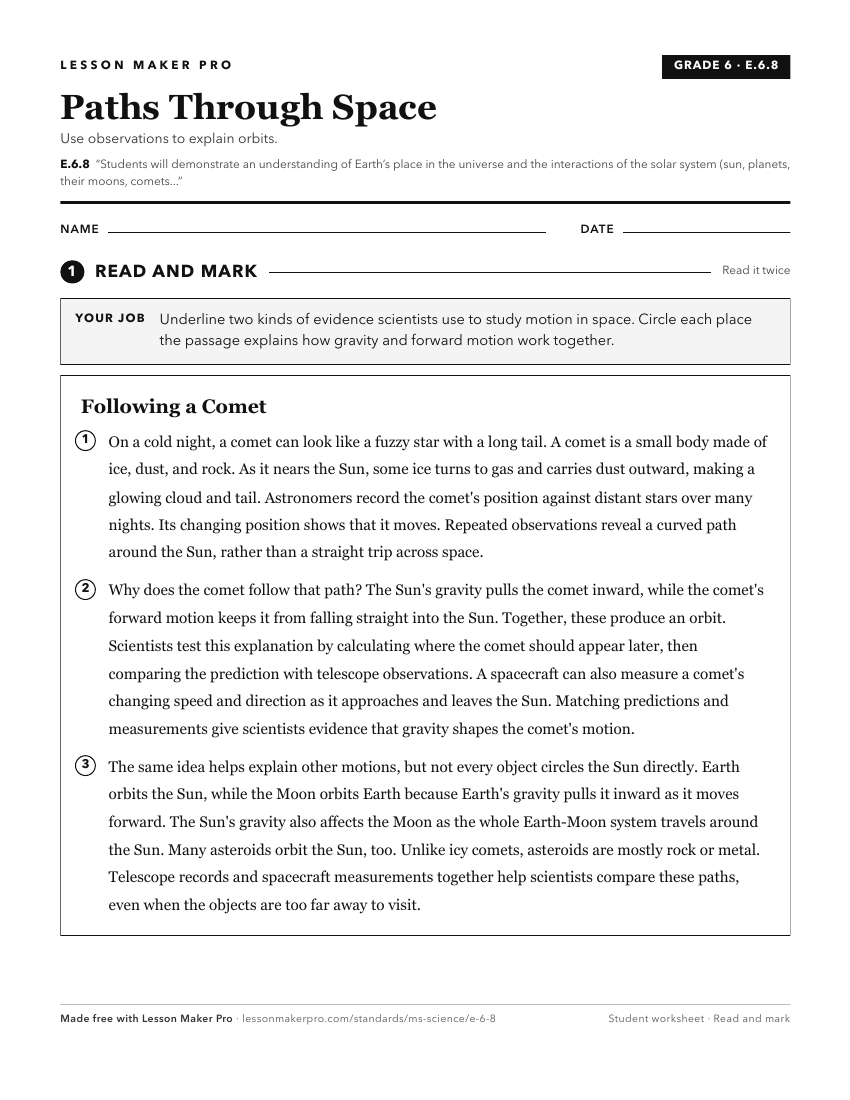
A ready-to-print activity worksheet aligned to E.6.8, with an answer key for the teacher on its own page. No account needed.
PDF, US Letter, prints cleanly in black and white.
Download the worksheetKeep exploring
Related Standards
- ESS.1B
Students will develop an understanding of Earth, the solar system, and the laws that predict the motion of celestial bodies.
- E.5.8A
Students will demonstrate an understanding of the locations of objects in the universe.
- E.K.8B
Students will demonstrate an understanding that the Sun provides the Earth with heat and light.
- E.2.8
Students will demonstrate an understanding of the appearance, movements, and patterns of the sun, moon, and stars.
Turn this cluster into a lesson
Grade, subject, topic, and the complete cluster are prefilled. Create one free, no account needed.
Also for this cluster:Make a WorksheetMake a QuizMake a Sub Lesson