Mississippi Science E.6.8.4
The Standard
- E.6.8
- Students will demonstrate an understanding of Earth’s place in the universe and the interactions of the solar system (sun, planets, their moons, comets, and asteroids) using evidence from multiple scientific resources to explain how these objects are held in orbit around the Sun because of its gravitational pull.
Obtain and evaluate information to model and compare the characteristics and movements of objects in the solar system (including planets, moons, asteroids, comets, and meteors).
2026 Mississippi College- and Career-Readiness Standards for Science · Earth and the Universe
Teacher's field guide
What This Standard Means
What Students Need to Do
- Students gather facts about planets, moons, asteroids, comets, and meteors from sources they can check. They use those facts to model what the objects are like and how they move. They compare what orbits the Sun, what orbits planets, and what appears in Earth's atmosphere.
What Mastery Looks Like
- A student shows planets, asteroids, and comets orbiting the Sun, and moons orbiting planets. They show a meteor as a streak of light caused by debris entering Earth's atmosphere. They use a named source to explain two differences between the objects.
Common Misconceptions
- Students may call a rock in space a meteor, though the meteor is the streak seen in the atmosphere. They may leave out the Moon's orbit around Earth or draw a comet's tail always trailing behind it, rather than pointing away from the Sun.
How to Assess It
- Hand out a Sun-Earth sketch and a short excerpt from a NASA solar system page. Ask students to add a moon, asteroid, comet, and meteor, draw motion arrows, and cite one fact from the excerpt.
Lesson moves
Ways to Teach It
Use a lamp, foam balls, and beads to model Earth's orbit, the Moon's orbit, an asteroid's path, and debris entering Earth's atmosphere.
Compare a NASA solar system page with an unsigned poster; write which better supports your model and name one claim you would check.
Give pairs object cards and motion cards to match, then have them defend their matches for comets and meteors.
Use a Perseid meteor shower calendar to trace comet debris entering Earth's atmosphere on a diagram, then explain why a streak appears.
Free download
Printable E.6.8.4 Worksheet
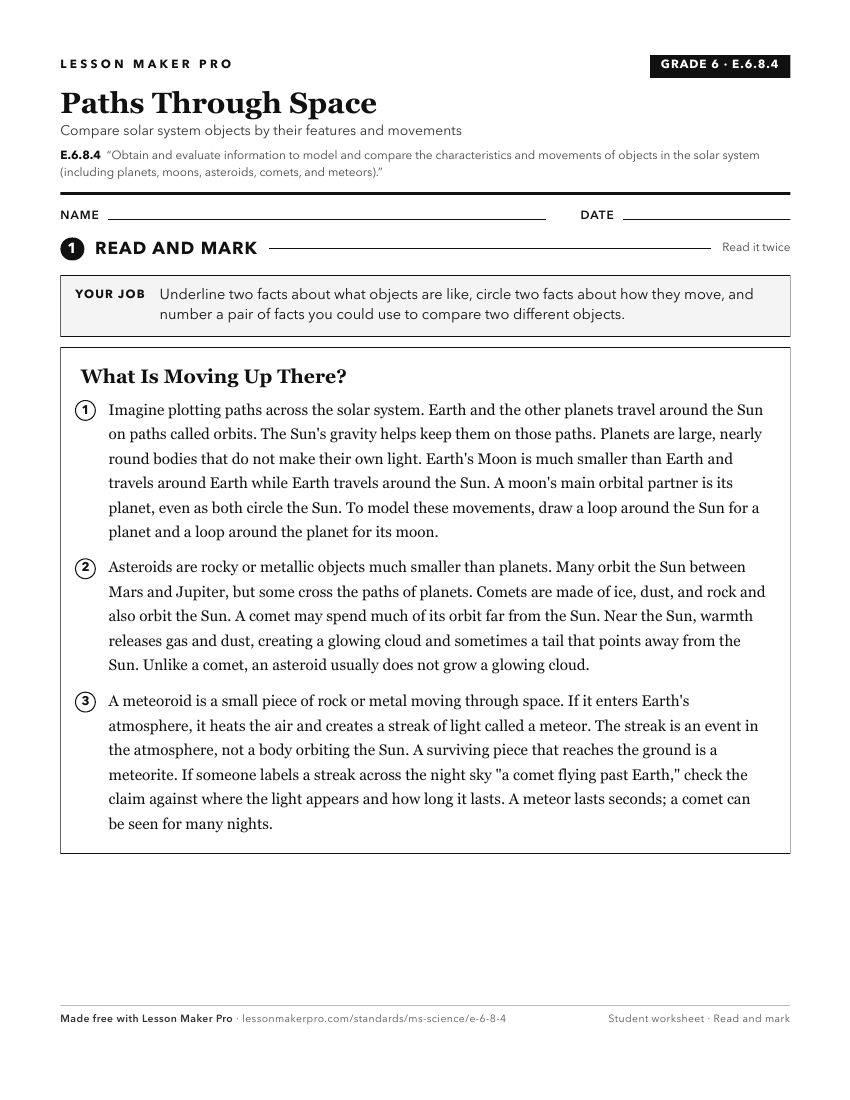
A ready-to-print activity worksheet aligned to E.6.8.4, with an answer key for the teacher on its own page. No account needed.
PDF, US Letter, prints cleanly in black and white.
Download the worksheetKeep exploring
Related Standards
- ESS.1B.2
Compare and contrast celestial bodies (e.g., planets, natural satellites, comets, asteroids, and the Oort cloud) and their motion in our solar system (e.g., rev...
- E.5.8B.4
Obtain information and analyze how our understanding of the solar system has evolved over time (e.g., Earth-centered model of Aristotle and Ptolemy compared to ...
- E.6.8
Students will demonstrate an understanding of Earth’s place in the universe and the interactions of the solar system (sun, planets, their moons, comets, and ast...
- E.2.8.3
Observe and compare the details in images of the moon and planets using the perspective of the naked eye, telescopes, and data from space exploration.
Turn this exact standard into a lesson
Grade, subject, topic, and the complete standard are prefilled. Create one free, no account needed.
Also for this standard:Make a WorksheetMake a QuizMake a Sub Lesson