Mississippi Science E.2.8.3
The Standard
- E.2.8
- Students will demonstrate an understanding of the appearance, movements, and patterns of the sun, moon, and stars.
Observe and compare the details in images of the moon and planets using the perspective of the naked eye, telescopes, and data from space exploration.
2026 Mississippi College- and Career-Readiness Standards for Science · Earth and the Universe
Teacher's field guide
What This Standard Means
What Students Need to Do
- Students compare pictures of the Moon and a planet seen with the naked eye, through a telescope, and by spacecraft. They name details they can see in each view.
What Mastery Looks Like
- A student can point to craters in a Moon photo and cloud bands in a Jupiter photo. They can tell which views show those details and which do not.
Common Misconceptions
- Students may think craters or cloud bands formed between photos, rather than becoming easier to see. They may mistake a bright planet in a sky photo for a star.
How to Assess It
- Show three labeled views each of the Moon and Jupiter. Ask students to circle one detail visible in a telescope or spacecraft view but not in the naked-eye view.
Lesson moves
Ways to Teach It
Give pairs six labeled Moon and Jupiter photo cards, three views of each; have them line up the cards and circle visible details.
Ask, 'Why can you see Jupiter's cloud bands in this photo but not that one?' Have partners point to evidence.
Play a photo match game: students pair close spacecraft views with wider views of the same object and name a detail they can now see.
Show a backyard sky photo and a spacecraft photo of Jupiter; ask which would help an astronomer study its clouds and why.
Free download
Printable E.2.8.3 Worksheet
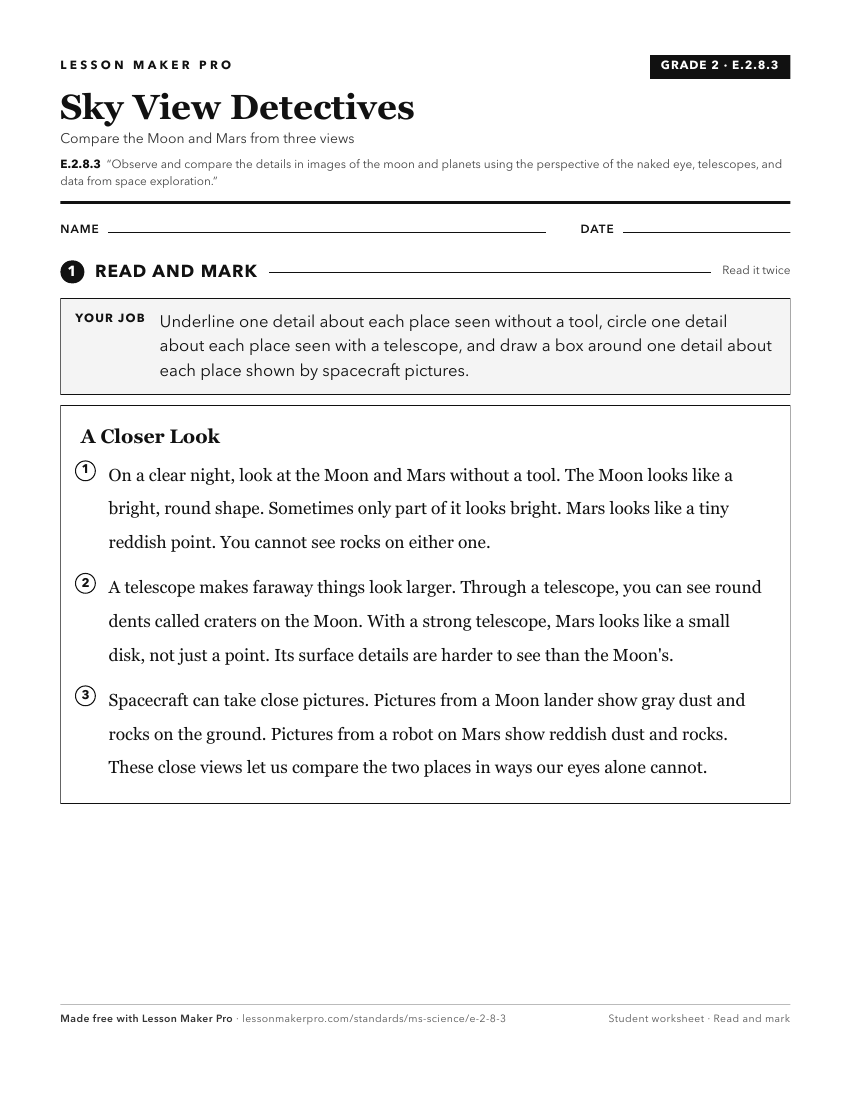
A ready-to-print activity worksheet aligned to E.2.8.3, with an answer key for the teacher on its own page. No account needed.
PDF, US Letter, prints cleanly in black and white.
Download the worksheetKeep exploring
Related Standards
- ESS.1B.2
Compare and contrast celestial bodies (e.g., planets, natural satellites, comets, asteroids, and the Oort cloud) and their motion in our solar system (e.g., rev...
- E.6.8.4
Obtain and evaluate information to model and compare the characteristics and movements of objects in the solar system (including planets, moons, asteroids, come...
- E.5.8B.2
Develop and use a model of the Earth-Sun-Moon system to analyze the cyclic patterns of lunar phases, solar and lunar eclipses, and seasons.
- E.5.8B.1
Analyze and interpret data from observations and research (e.g., from NASA, NOAA, or the USGS) to explain patterns in the location, movement, and appearance of ...
Turn this exact standard into a lesson
Grade, subject, topic, and the complete standard are prefilled. Create one free, no account needed.
Also for this standard:Make a WorksheetMake a QuizMake a Sub Lesson