Mississippi Science E.5.8B.1
The Standard
- E.5.8B
- Students will demonstrate an understanding of the principles that govern moon phases, day and night, appearance of objects in the sky, and seasonal changes.
Analyze and interpret data from observations and research (e.g., from NASA, NOAA, or the USGS) to explain patterns in the location, movement, and appearance of the moon throughout a month and over the course of a year.
2026 Mississippi College- and Career-Readiness Standards for Science · Earth and the Universe
Teacher's field guide
What This Standard Means
What Students Need to Do
- Students use dated Moon observations and NASA or NOAA records to track its shape, sky position, and rise time. They find patterns over a month and compare records from different times of year. They use the data to explain what changes as the Moon orbits Earth.
What Mastery Looks Like
- Given dated Moon pictures and rise times, students predict the next shape and approximate rise time. They use records from different seasons to describe changes in when and where the Moon appears. They explain that phases come from seeing different parts of the Moon's sunlit half.
Common Misconceptions
- Students may think Earth's shadow causes the Moon's phases. They may expect it to rise at sunset every day or show the same phase on the same date each month. Some think the Moon is never visible during the day.
How to Assess It
- Give students this chart: Day 1, thin crescent, 9 a.m.; Day 2, wider crescent, 10 a.m.; Day 3, half lit, noon. Ask them to sketch Day 4's Moon, estimate its rise time, and cite two clues from the chart.
Lesson moves
Ways to Teach It
Move a foam ball around your head beside a lamp, and sketch its lit shape at four positions.
Show two weeks of dated Moon photos and moonrise times; ask, "Why does its shape change, and why does it rise later?"
Give pairs undated Moon photo cards to order, then have them check the sequence against a dated NASA Moon calendar.
Compare April and October NASA phase calendars and NOAA moonrise tables; choose a 7 p.m. Moon-viewing night in each month and explain why.
Free download
Printable E.5.8B.1 Worksheet
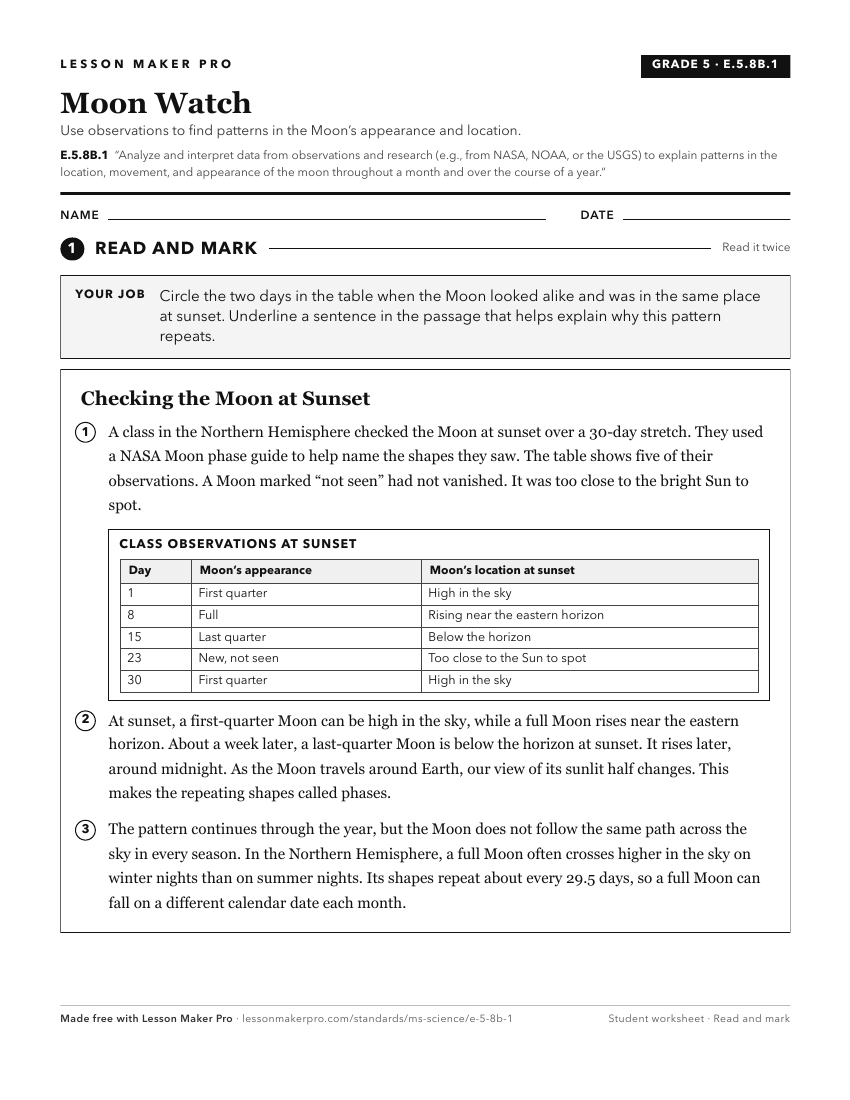
A ready-to-print activity worksheet aligned to E.5.8B.1, with an answer key for the teacher on its own page. No account needed.
PDF, US Letter, prints cleanly in black and white.
Download the worksheetKeep exploring
Related Standards
- E.5.8B.2
Develop and use a model of the Earth-Sun-Moon system to analyze the cyclic patterns of lunar phases, solar and lunar eclipses, and seasons.
- MAQ.2.2
Survey predictable patterns of tides (i.e., tidal period and range, diurnal, semidiurnal, mixed, spring, and neap tides) to correlate with moon phases in graphi...
- E.2.8.3
Observe and compare the details in images of the moon and planets using the perspective of the naked eye, telescopes, and data from space exploration.
- E.4.9C.1
Analyze and interpret data to describe (i.e., NASA, NOAA, USGS) and predict how natural processes (e.g., weathering, erosion, deposition, earthquakes, tsunamis,...
Turn this exact standard into a lesson
Grade, subject, topic, and the complete standard are prefilled. Create one free, no account needed.
Also for this standard:Make a WorksheetMake a QuizMake a Sub Lesson