Mississippi Science MAQ.2.2
The Standard
- MAQ.2
- Students will develop an understanding of the principles of fluid dynamics as it relates to both salt and freshwater systems.
Survey predictable patterns of tides (i.e., tidal period and range, diurnal, semidiurnal, mixed, spring, and neap tides) to correlate with moon phases in graphical form.
2026 Mississippi College- and Career-Readiness Standards for Science · Fluid Dynamics
Teacher's field guide
What This Standard Means
What Students Need to Do
- Students graph tide heights over time and mark the moon phases. They measure the time between high tides and the difference between high and low water. They use the graphs to spot daily tide patterns and changes in range.
What Mastery Looks Like
- A student can identify a graph with one high tide per day, two similar highs, or two unequal highs. They calculate period and range, then connect larger ranges with new and full moons and smaller ranges with quarter moons.
Common Misconceptions
- Some students think spring tides happen only in spring. Others assume every coast has two equal high tides each day. They may subtract two high-tide heights instead of a high and a low to find the range.
How to Assess It
- Exit ticket: Plot these full-moon tide heights at 0, 6, 12, and 18 hours: 2.4, 0.2, 2.3, and 0.1 meters. Find the range, name the daily pattern, and explain what the full moon suggests about the range.
Lesson moves
Ways to Teach It
Give pairs tide-height cards for 24 hours; have them sort the cards by time, plot the values, and measure the range.
Show graphs from one harbor at full moon and first quarter; ask students which has the larger range and how they know.
Hand out diurnal, semidiurnal, and mixed tide graphs; teams label each and circle the highs and lows that support their choice.
Use a harbor tide table and moon calendar to plan a low-tide beach walk; mark the range and moon phase.
Free download
Printable MAQ.2.2 Worksheet
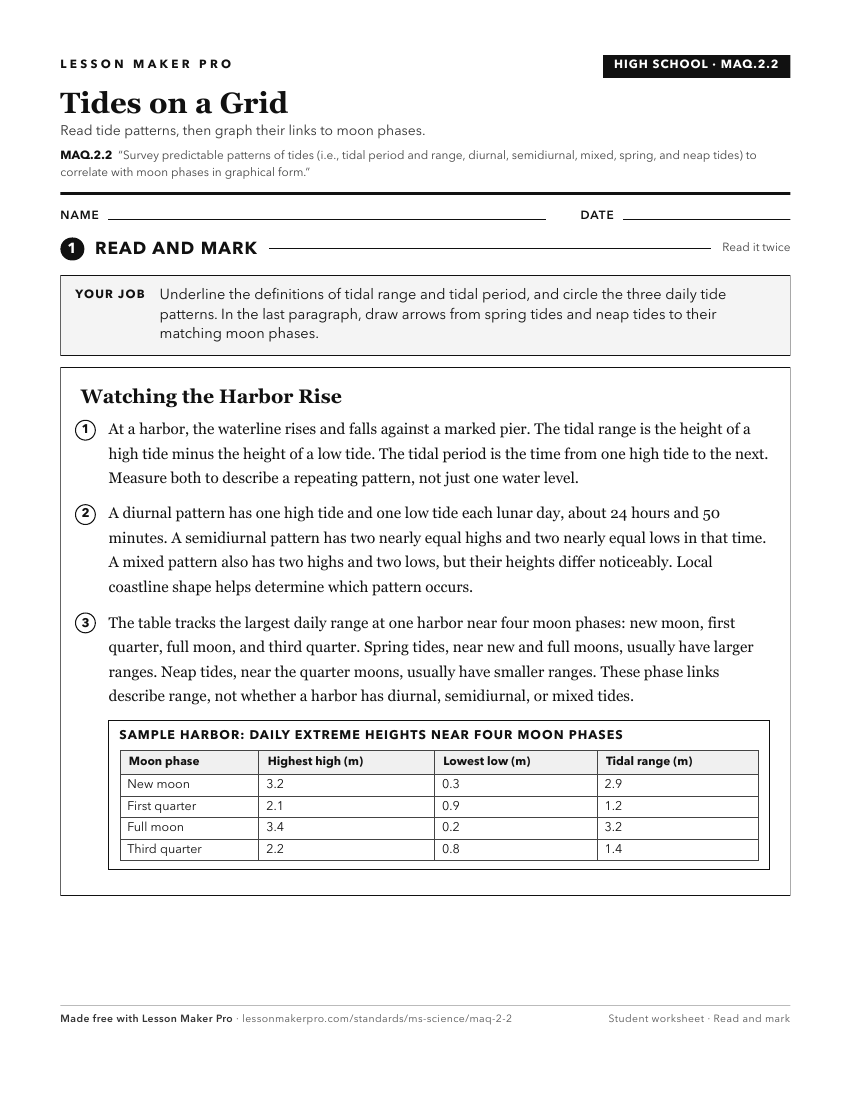
A ready-to-print activity worksheet aligned to MAQ.2.2, with an answer key for the teacher on its own page. No account needed.
PDF, US Letter, prints cleanly in black and white.
Download the worksheetKeep exploring
Related Standards
- E.2.8.5
Use informational text and other media to observe, describe, and predict the visual patterns of motion of the Sun (sunrise, sunset) and Moon (phases).
- E.5.8B.2
Develop and use a model of the Earth-Sun-Moon system to analyze the cyclic patterns of lunar phases, solar and lunar eclipses, and seasons.
- E.5.8B.1
Analyze and interpret data from observations and research (e.g., from NASA, NOAA, or the USGS) to explain patterns in the location, movement, and appearance of ...
- E.6.8.6
Design models representing motions within the Sun-Earth-Moon system to explain phenomena observed from the Earth’s surface (positions of celestial bodies, day a...
Turn this exact standard into a lesson
Grade, subject, topic, and the complete standard are prefilled. Create one free, no account needed.
Also for this standard:Make a WorksheetMake a QuizMake a Sub Lesson