Mississippi Science E.6.8.6
The Standard
- E.6.8
- Students will demonstrate an understanding of Earth’s place in the universe and the interactions of the solar system (sun, planets, their moons, comets, and asteroids) using evidence from multiple scientific resources to explain how these objects are held in orbit around the Sun because of its gravitational pull.
Design models representing motions within the Sun-Earth-Moon system to explain phenomena observed from the Earth’s surface (positions of celestial bodies, day and year, moon phases, solar and lunar eclipses, and tides).
2026 Mississippi College- and Career-Readiness Standards for Science · Earth and the Universe
Teacher's field guide
What This Standard Means
What Students Need to Do
- Students build and label a model they can move, then check whether it matches what people see from Earth. They use it to explain daily sky changes, a year, moon phases, eclipses, and tides.
What Mastery Looks Like
- A student shows how Earth's spin changes what we see each day and how its orbit marks a year. They position the Moon to explain phases and rare eclipses, then use the Moon's and Sun's gravity to explain tides.
Common Misconceptions
- Some students think the Sun circles Earth each day. Others think Earth's shadow causes moon phases, eclipses happen every month, or wind alone causes tides.
How to Assess It
- On an exit slip, sketch two full moons, one with a lunar eclipse and one without. Label sunlight and the Moon's tilted path, then explain the difference.
Lesson moves
Ways to Teach It
Set out a lamp, globe, and foam Moon on a tilted wire; have groups move them to test phases and eclipses.
Ask, "If Earth's shadow makes moon phases, why can we see a half Moon while the Sun is up?" Have students draw an answer.
Give pairs phase and eclipse cards; have them place three labeled tokens on a desk and explain each arrangement.
Use a harbor tide chart and moon calendar to mark larger tidal ranges near new and full moons.
Free download
Printable E.6.8.6 Worksheet
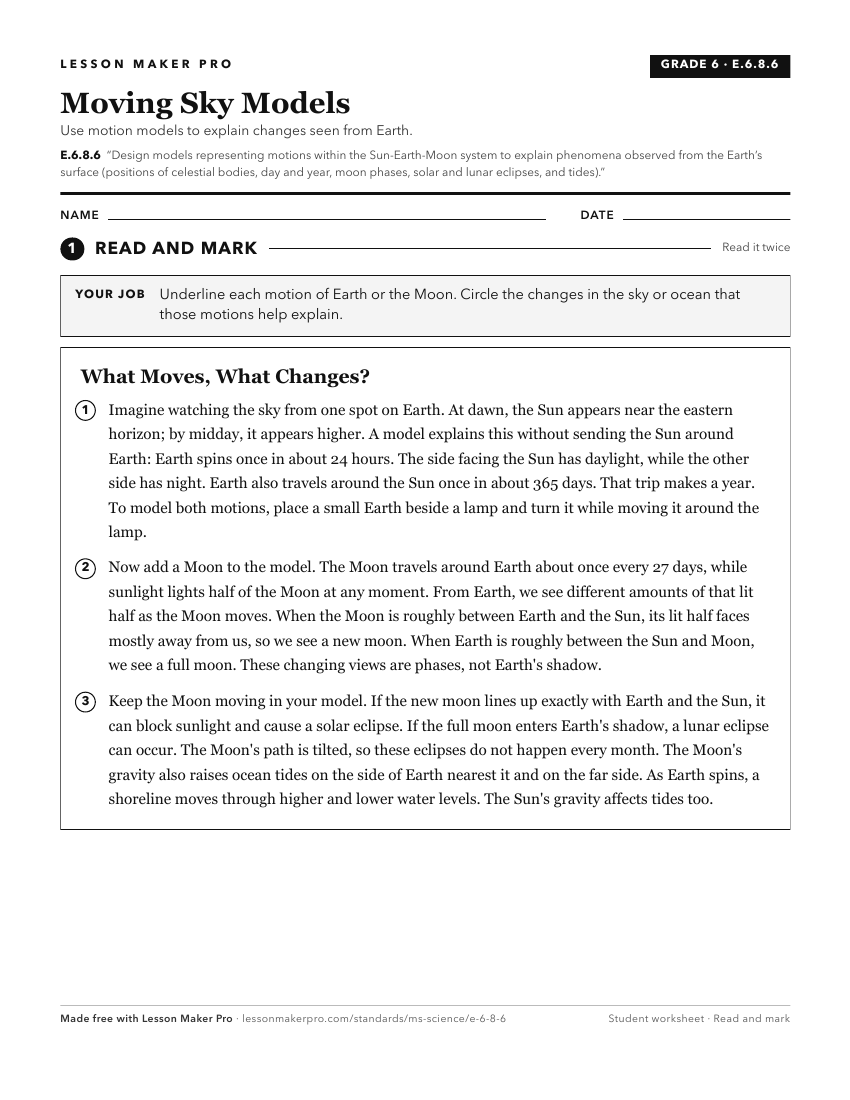
A ready-to-print activity worksheet aligned to E.6.8.6, with an answer key for the teacher on its own page. No account needed.
PDF, US Letter, prints cleanly in black and white.
Download the worksheetKeep exploring
Related Standards
- E.2.8.6
Create a model that will demonstrate the observable pattern of motion of the Sun or Moon. Use an engineering design process to define the problem, design, const...
- E.2.8.5
Use informational text and other media to observe, describe, and predict the visual patterns of motion of the Sun (sunrise, sunset) and Moon (phases).
- E.5.8B.2
Develop and use a model of the Earth-Sun-Moon system to analyze the cyclic patterns of lunar phases, solar and lunar eclipses, and seasons.
- E.6.8.5
Construct explanations for how gravity affects the motion of objects in the solar system and tides on Earth.
Turn this exact standard into a lesson
Grade, subject, topic, and the complete standard are prefilled. Create one free, no account needed.
Also for this standard:Make a WorksheetMake a QuizMake a Sub Lesson