Mississippi Science E.6.8.5
The Standard
- E.6.8
- Students will demonstrate an understanding of Earth’s place in the universe and the interactions of the solar system (sun, planets, their moons, comets, and asteroids) using evidence from multiple scientific resources to explain how these objects are held in orbit around the Sun because of its gravitational pull.
Construct explanations for how gravity affects the motion of objects in the solar system and tides on Earth.
2026 Mississippi College- and Career-Readiness Standards for Science · Earth and the Universe
Teacher's field guide
What This Standard Means
What Students Need to Do
- Students explain why planets and moons orbit instead of moving in straight lines. They explain how the Moon's and Sun's gravity affect ocean tides.
What Mastery Looks Like
- A student can draw a planet's forward motion and an arrow showing gravity pulling it toward the Sun. On an Earth-Moon sketch, they can mark high tides on the near and far sides of Earth and explain that the Moon pulls on those sides by different amounts.
Common Misconceptions
- Students may think gravity pushes planets along their orbits, or that there is no gravity in space. They may think high tide happens only on the side of Earth facing the Moon.
How to Assess It
- Ask students to draw a planet orbiting the Sun and Earth beside the Moon. Have them add a gravity arrow for the planet, mark two high-tide areas on Earth, and write one sentence explaining each drawing.
Lesson moves
Ways to Teach It
Tie a foam ball to a string and swing it slowly, then sketch what the string represents and which way the ball would move if released.
Ask, 'Why does a planet circle the Sun instead of flying straight away?' Have students answer with a drawing and two sentences.
Give pairs an Earth-Moon diagram and four tide markers; have them place two high tides and two low tides, then check their choices.
Show a beach tide chart; students choose a low-tide time for tide pools and explain how the Moon's gravity affects the chart.
Free download
Printable E.6.8.5 Worksheet
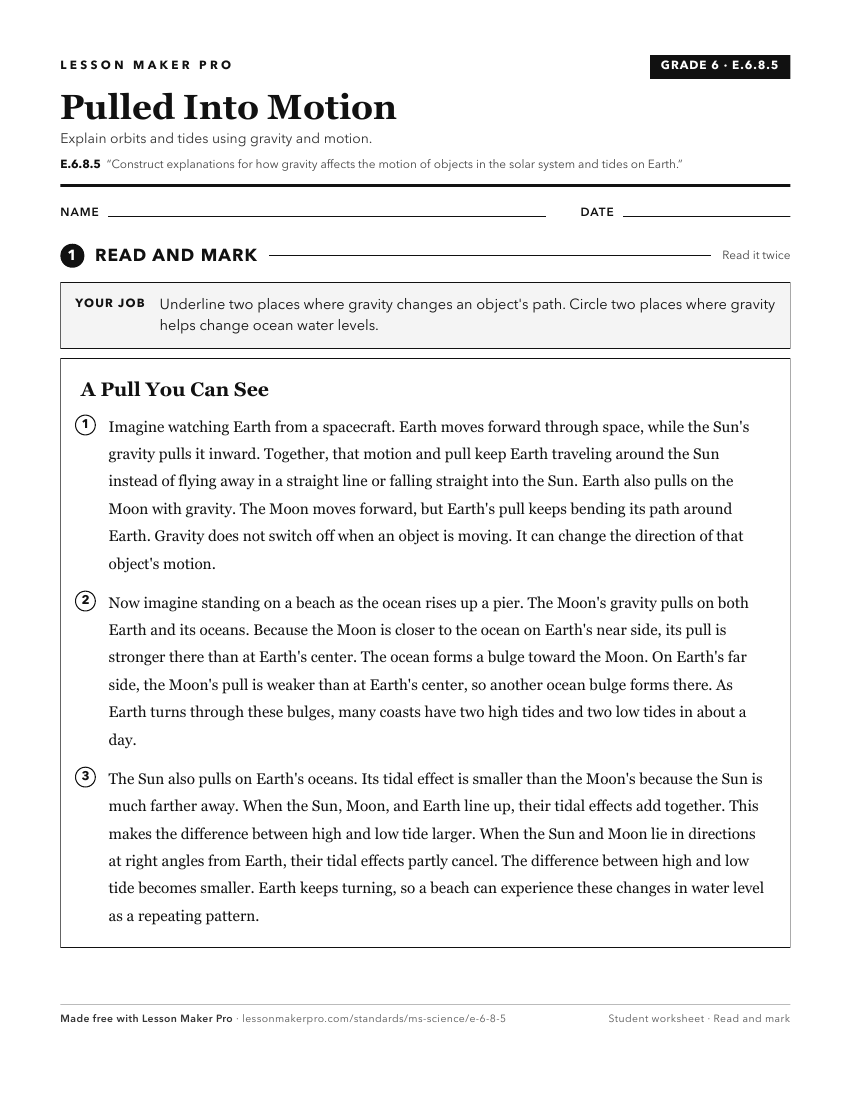
A ready-to-print activity worksheet aligned to E.6.8.5, with an answer key for the teacher on its own page. No account needed.
PDF, US Letter, prints cleanly in black and white.
Download the worksheetKeep exploring
Related Standards
- P.5.6.1
Obtain and communicate information describing gravity's effect on an object.
- ESS.1B.3
Design a model (e.g., a gravity simulation using PVC and a neoprene screen) to demonstrate Kepler’s laws and the relationships of the orbits of objects in our s...
- E.6.8.6
Design models representing motions within the Sun-Earth-Moon system to explain phenomena observed from the Earth’s surface (positions of celestial bodies, day a...
- PHY.2.10
Apply the effects of the universal gravitation law to generate a digital/physical graph, and interpret the forces between two masses, acceleration due to gravit...
Turn this exact standard into a lesson
Grade, subject, topic, and the complete standard are prefilled. Create one free, no account needed.
Also for this standard:Make a WorksheetMake a QuizMake a Sub Lesson