Mississippi Science ESS.1B.2
The Standard
- ESS.1B
- Students will develop an understanding of Earth, the solar system, and the laws that predict the motion of celestial bodies.
Compare and contrast celestial bodies (e.g., planets, natural satellites, comets, asteroids, and the Oort cloud) and their motion in our solar system (e.g., revolution and rotation). Build an Analemma calendar.
2026 Mississippi College- and Career-Readiness Standards for Science · Earth in the Universe
Teacher's field guide
What This Standard Means
What Students Need to Do
- Students compare planets, moons, comets, asteroids, and the Oort cloud by what they are, where they are, and how they move. They tell rotation from revolution and use dated Sun positions to make an analemma calendar.
What Mastery Looks Like
- Students can explain that moons orbit planets, while planets, asteroids, and comets orbit the Sun. They distinguish icy comets from mostly rocky asteroids and describe the Oort cloud as a distant region of icy bodies. Their calendar shows the Sun’s changing position at the same clock time through the year.
Common Misconceptions
- Students may call orbiting the Sun rotation instead of revolution. They may picture the Oort cloud as one solid object or think the Sun traces an analemma in a single day.
How to Assess It
- Give students a blank sky grid and 12 dated Sun positions recorded at the same clock time. Ask them to plot an analemma calendar and write how Earth’s rotation differs from its revolution.
Lesson moves
Ways to Teach It
Use a lamp and tilted globe; have pairs spin Earth, move it around the lamp, and sketch arrows for each motion.
Show comet, asteroid, and moon images; ask, “Which orbits a planet, and which might come from the Oort cloud?”
Hand out planet, moon, comet, asteroid, and Oort cloud cards; students match each to a description and orbit sketch.
Provide dated noon Sun positions for your town; students plot an analemma calendar and compare winter and summer playground shadows.
Free download
Printable ESS.1B.2 Worksheet
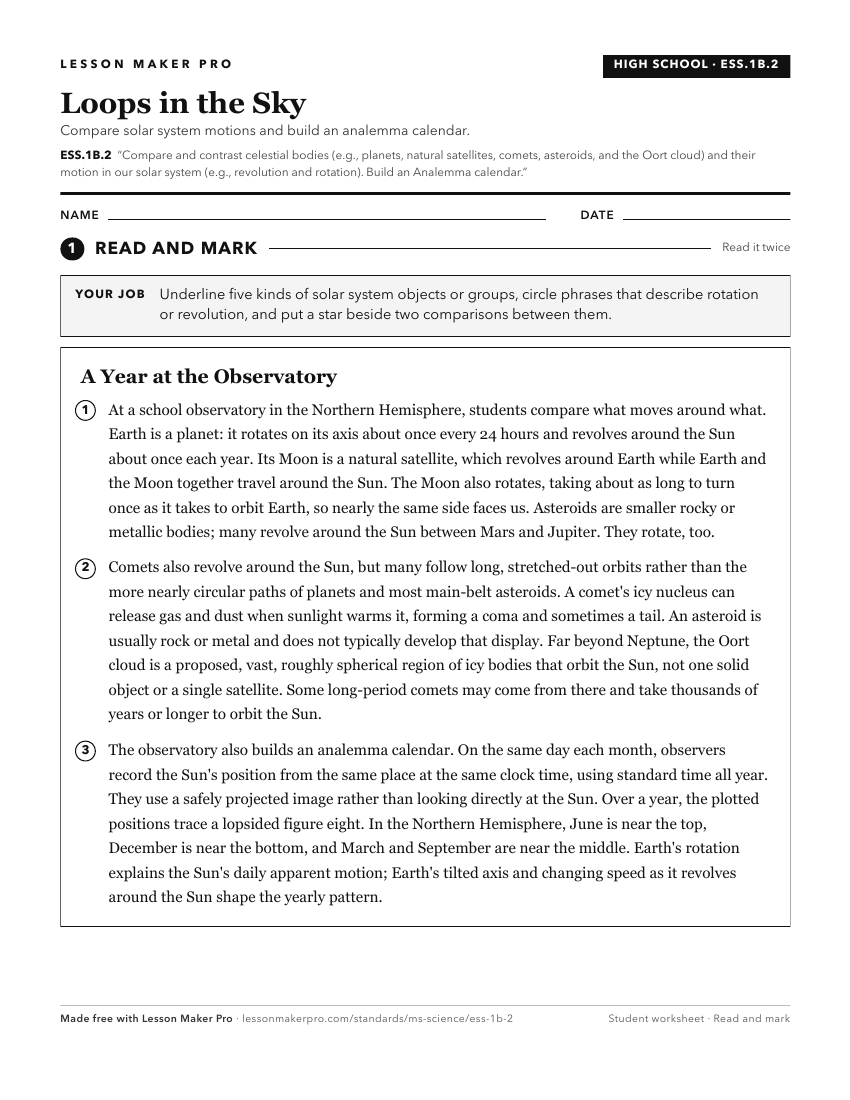
A ready-to-print activity worksheet aligned to ESS.1B.2, with an answer key for the teacher on its own page. No account needed.
PDF, US Letter, prints cleanly in black and white.
Download the worksheetKeep exploring
Related Standards
- E.6.8.4
Obtain and evaluate information to model and compare the characteristics and movements of objects in the solar system (including planets, moons, asteroids, come...
- ESS.1B
Students will develop an understanding of Earth, the solar system, and the laws that predict the motion of celestial bodies.
- E.5.8B.2
Develop and use a model of the Earth-Sun-Moon system to analyze the cyclic patterns of lunar phases, solar and lunar eclipses, and seasons.
- E.5.8A.1
Develop and use scaled models of Earth's solar system to demonstrate the size, composition (i.e., rock or gas), location, and order of the planets as they orbit...
Turn this exact standard into a lesson
Grade, subject, topic, and the complete standard are prefilled. Create one free, no account needed.
Also for this standard:Make a WorksheetMake a QuizMake a Sub Lesson