Mississippi Science ESS.1B
Standard Cluster
Students will develop an understanding of Earth, the solar system, and the laws that predict the motion of celestial bodies. Read and evaluate scientific information for mechanisms/results (e.g., the solar nebular theory) to explain how the solar system was formed. Cite evidence and develop a logical argument. Compare and contrast celestial bodies (e.g., planets, natural satellites, comets, asteroids, and the Oort cloud) and their motion in our solar system (e.g., revolution and rotation). Build an Analemma calendar. Design a model (e.g., a gravity simulation using PVC and a neoprene screen) to demonstrate Kepler’s laws and the relationships of the orbits of objects in our solar system. Relate them to Newton’s law of universal gravitation and laws of motion.
2026 Mississippi College- and Career-Readiness Standards for Science · Earth in the Universe
Cluster contents
Standards in This Cluster
ESS.1B is a cluster heading. These are the individual standards under it.
- ESS.1B.1
Read and evaluate scientific information for mechanisms/results (e.g., the solar nebular theory) to explain how the solar system was formed. Cite evidence and d...
- ESS.1B.2
Compare and contrast celestial bodies (e.g., planets, natural satellites, comets, asteroids, and the Oort cloud) and their motion in our solar system (e.g., rev...
- ESS.1B.3
Design a model (e.g., a gravity simulation using PVC and a neoprene screen) to demonstrate Kepler’s laws and the relationships of the orbits of objects in our s...
Teacher's field guide
What This Cluster Means
What Students Need to Do
- Students use evidence to explain how the solar system formed from a disk of gas and dust. They compare planets, moons, comets, asteroids, and the Oort cloud, including how objects rotate and orbit. They plot an analemma and use Kepler’s laws and Newton’s gravity to explain orbital motion.
What Mastery Looks Like
- A student can use an orbit diagram to show where a planet moves fastest and explain how gravity and inertia affect its path. They can cite an observation of a disk around a young star as evidence for solar system formation. Their analemma plots the Sun’s position at the same clock time across the year.
Common Misconceptions
- Students may think planets formed from pieces of the Sun rather than from a shared disk of gas and dust. They confuse rotation with revolution or assume planets move at constant speed in perfect circles. They may call the Oort cloud one object rather than a distant region of icy bodies.
How to Assess It
- Give students an elliptical orbit diagram with the Sun at one focus. Ask them to mark where a planet moves fastest and explain why using gravity and inertia.
Lesson moves
Ways to Teach It
Stretch a neoprene sheet over a PVC hoop, place a heavy ball at its center, and roll marbles to test how their paths change.
Read a NASA image caption of a protoplanetary disk, then write a formation claim and cite one detail from the caption.
Sort Earth, Moon, Halley’s Comet, Vesta, and Oort cloud cards, then label each orbit or, for the cloud, its location.
Print weekly Sun azimuth and altitude data for your town at 12:00 standard time, then plot a dated analemma to explain shifting sundial noon.
Free download
Printable ESS.1B Worksheet
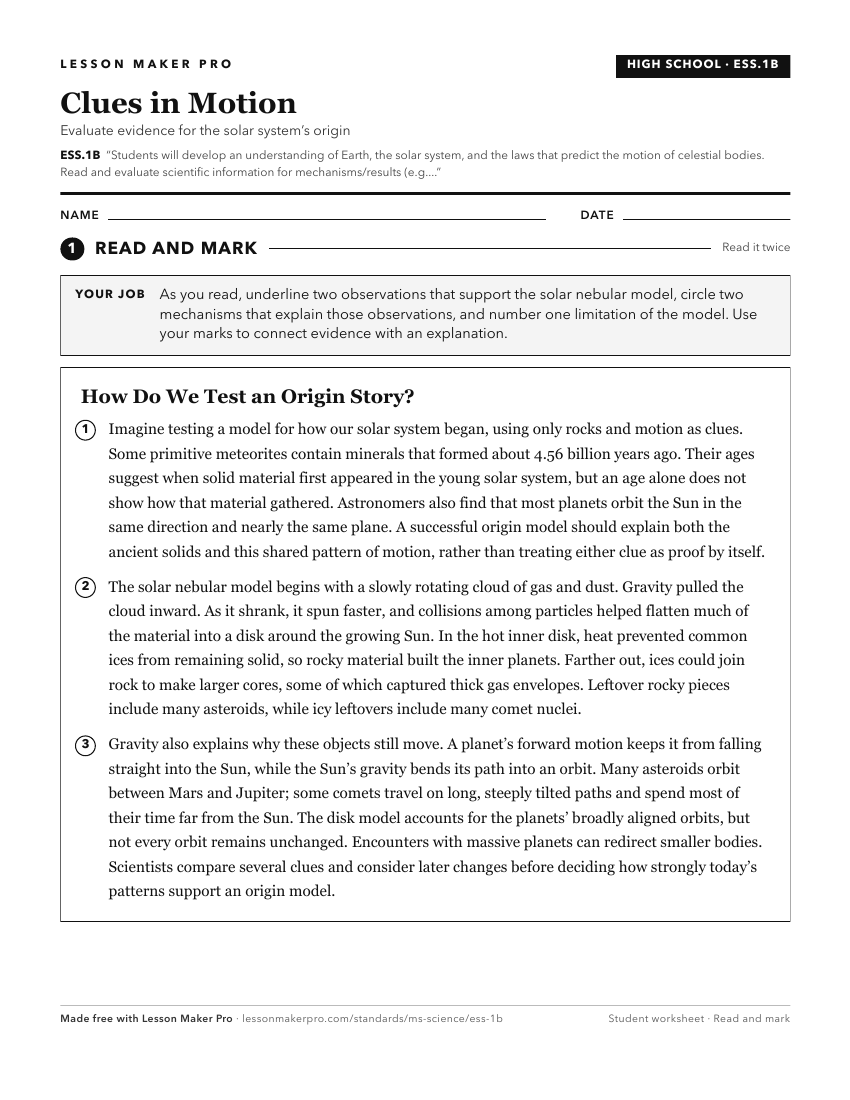
A ready-to-print activity worksheet aligned to ESS.1B, with an answer key for the teacher on its own page. No account needed.
PDF, US Letter, prints cleanly in black and white.
Download the worksheetKeep exploring
Related Standards
- ESS.1A
Students will develop an understanding of the universe, its development, immense size, and composition.
- ESS.3
Students will develop an understanding of Earth’s systems and cycles.
- E.6.8
Students will demonstrate an understanding of Earth’s place in the universe and the interactions of the solar system (sun, planets, their moons, comets, and ast...
- E.2.8
Students will demonstrate an understanding of the appearance, movements, and patterns of the sun, moon, and stars.
Turn this cluster into a lesson
Grade, subject, topic, and the complete cluster are prefilled. Create one free, no account needed.
Also for this cluster:Make a WorksheetMake a QuizMake a Sub Lesson