Mississippi Science E.2.8
Standard Cluster
Students will demonstrate an understanding of the appearance, movements, and patterns of the sun, moon, and stars. Recognize that there are many stars that can be observed in the night sky and the Sun is the Earth’s closest star. With teacher guidance, observe, describe, and predict the seasonal patterns of sunrise and sunset. Collect, represent, and interpret data from internet sources to communicate findings. Observe and compare the details in images of the moon and planets using the perspective of the naked eye, telescopes, and data from space exploration. With teacher support, gain an understanding that scientists are humans who use observations and experiments to learn about space. Obtain information from informational text or other media about scientists who have made important discoveries about objects in space (e.g., Galileo Galilei, Johannes Kepler, George Ellery Hale, Jill Tarter) or the development of technologies (e.g., various telescopes and detection devices, computer modeling, and space exploration). Use informational text and other media to observe, describe, and predict the visual patterns of motion of the Sun (sunrise, sunset) and Moon (phases). Create a model that will demonstrate the observable pattern of motion of the Sun or Moon. Use an engineering design process to define the problem, design, construct, evaluate, and improve the model. *
2026 Mississippi College- and Career-Readiness Standards for Science · Earth and the Universe
Cluster contents
Standards in This Cluster
E.2.8 is a cluster heading. These are the individual standards under it.
- E.2.8.1
Recognize that there are many stars that can be observed in the night sky and the Sun is the Earth’s closest star.
- E.2.8.2
With teacher guidance, observe, describe, and predict the seasonal patterns of sunrise and sunset. Collect, represent, and interpret data from internet sources ...
- E.2.8.3
Observe and compare the details in images of the moon and planets using the perspective of the naked eye, telescopes, and data from space exploration.
- E.2.8.4
With teacher support, gain an understanding that scientists are humans who use observations and experiments to learn about space. Obtain information from inform...
- E.2.8.5
Use informational text and other media to observe, describe, and predict the visual patterns of motion of the Sun (sunrise, sunset) and Moon (phases).
- E.2.8.6
Create a model that will demonstrate the observable pattern of motion of the Sun or Moon. Use an engineering design process to define the problem, design, const...
Teacher's field guide
What This Cluster Means
What Students Need to Do
- Students use sunrise and sunset times to find patterns and make predictions. They compare images of the Moon and planets and read about scientists who study space. They build and improve a model of the Sun’s path or the Moon’s phases.
What Mastery Looks Like
- A student uses a chart to predict whether sunrise will be earlier or later. Their revised model shows a repeating pattern. They can say that the Sun is Earth’s closest star and point out details a spacecraft image reveals.
Common Misconceptions
- Some students think the Sun is different from other stars or that sunrise happens at the same time all year. Others think the Moon changes shape or that Earth’s shadow causes its regular phases.
How to Assess It
- Show sunrise times of 7:00 on October 1, 7:05 on October 8, and 7:10 on October 15. Ask students to predict the October 22 time and explain their choice.
Lesson moves
Ways to Teach It
Have pairs slide a paper Sun across a cardboard horizon, then adjust its path to match sunrise and sunset.
Compare printed Moon photos from a phone, telescope, and spacecraft; ask which shows craters most clearly and why.
Give pairs four labeled Moon phase cards to put in order, then ask which phase comes next.
Look up local sunrise times for November and January, then decide when a 7 a.m. walk would need a flashlight.
Free download
Printable E.2.8 Worksheet
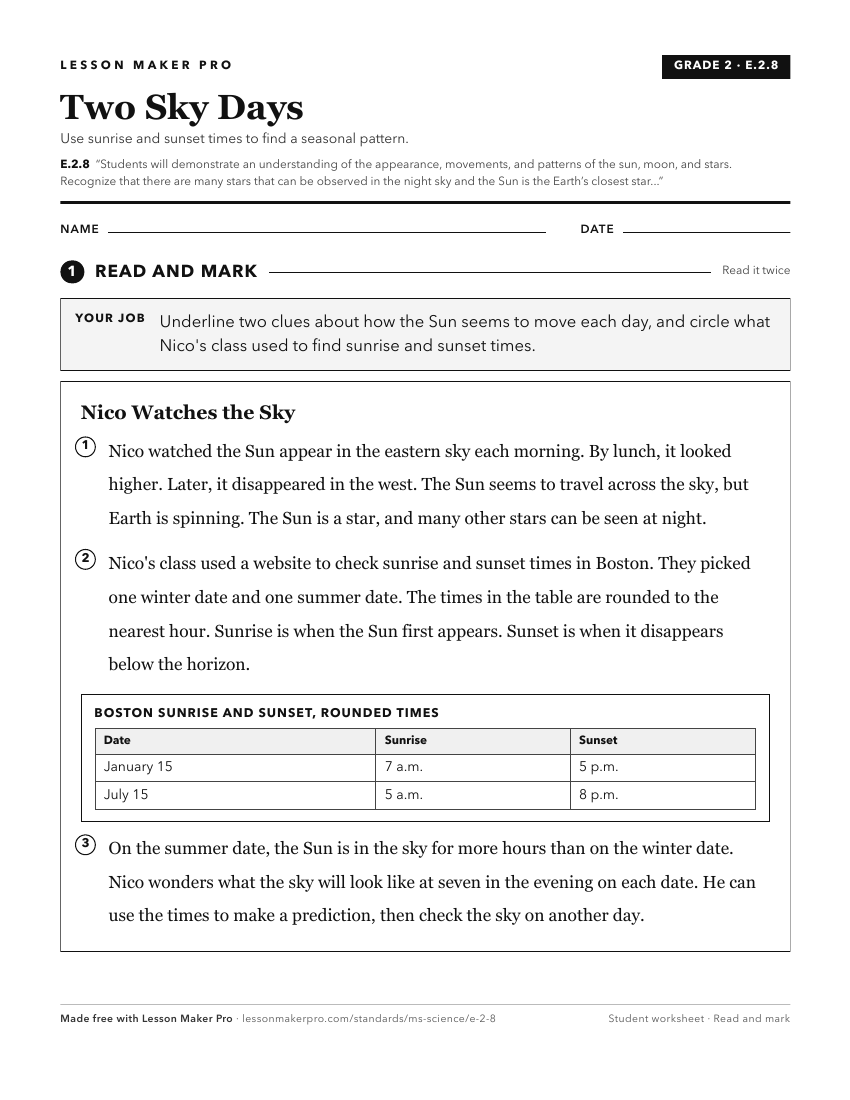
A ready-to-print activity worksheet aligned to E.2.8, with an answer key for the teacher on its own page. No account needed.
PDF, US Letter, prints cleanly in black and white.
Download the worksheetKeep exploring
Related Standards
- ESS.1B
Students will develop an understanding of Earth, the solar system, and the laws that predict the motion of celestial bodies.
- E.5.8B
Students will demonstrate an understanding of the principles that govern moon phases, day and night, appearance of objects in the sky, and seasonal changes.
- E.K.8B
Students will demonstrate an understanding that the Sun provides the Earth with heat and light.
- E.6.8
Students will demonstrate an understanding of Earth’s place in the universe and the interactions of the solar system (sun, planets, their moons, comets, and ast...
Turn this cluster into a lesson
Grade, subject, topic, and the complete cluster are prefilled. Create one free, no account needed.
Also for this cluster:Make a WorksheetMake a QuizMake a Sub Lesson