Mississippi Science E.2.8.4
The Standard
- E.2.8
- Students will demonstrate an understanding of the appearance, movements, and patterns of the sun, moon, and stars.
With teacher support, gain an understanding that scientists are humans who use observations and experiments to learn about space. Obtain information from informational text or other media about scientists who have made important discoveries about objects in space (e.g., Galileo Galilei, Johannes Kepler, George Ellery Hale, Jill Tarter) or the development of technologies (e.g., various telescopes and detection devices, computer modeling, and space exploration).
2026 Mississippi College- and Career-Readiness Standards for Science · Earth and the Universe
Teacher's field guide
What This Standard Means
What Students Need to Do
- Students read or watch a short account of a space scientist, with teacher help. They tell what the scientist observed or tested, what tool helped, and what they learned about space.
What Mastery Looks Like
- A student can explain that Galileo used a telescope to see moons near Jupiter. They can use a detail from the reading to explain how his observations helped him learn.
Common Misconceptions
- Some students think scientists must fly into space to study it. Others think a guess counts as a discovery without observations or a test.
How to Assess It
- Read aloud: "Galileo used a telescope to see dots near Jupiter. On later nights, he saw the dots move around Jupiter and learned they were moons." Ask students to write what he observed and how the telescope helped.
Lesson moves
Ways to Teach It
Use a flashlight and foam ball to model sunlight on a planet; turn the ball and sketch which side is lit.
Read a short Galileo passage aloud, then ask, "What did he see near Jupiter, and what tool helped him?"
Match cards showing Galileo, a telescope, and Jupiter's moons; then match Jill Tarter, radio telescopes, and her search for signals.
Show a Mars rover photo and ask students to record one detail the rover camera lets scientists observe.
Free download
Printable E.2.8.4 Worksheet
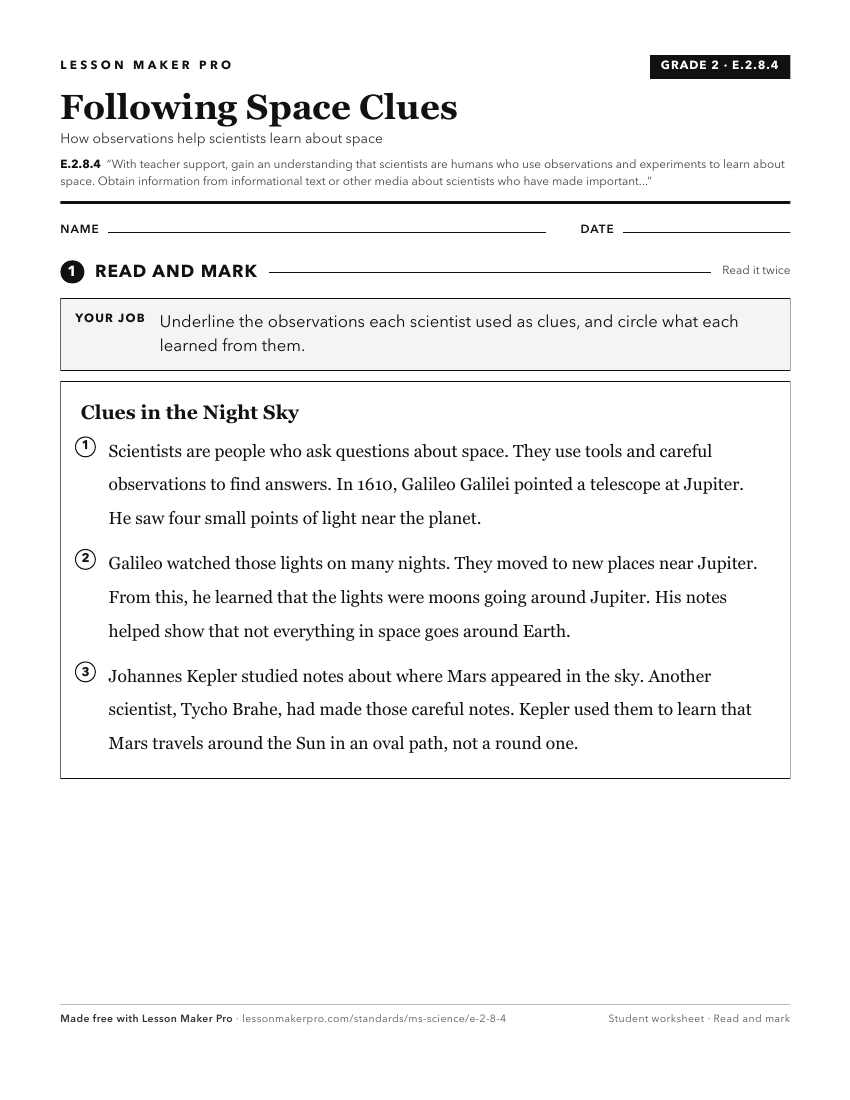
A ready-to-print activity worksheet aligned to E.2.8.4, with an answer key for the teacher on its own page. No account needed.
PDF, US Letter, prints cleanly in black and white.
Download the worksheetKeep exploring
Related Standards
- E.5.8B.4
Obtain information and analyze how our understanding of the solar system has evolved over time (e.g., Earth-centered model of Aristotle and Ptolemy compared to ...
- L.1.1.5
With teacher support, gain an understanding that scientists are humans who use observations and experiments to learn about the natural world. Obtain information...
- E.5.8A.4
Construct scientific arguments to support claims about the importance of astronomy in navigation and exploration, including the use of telescopes, compasses, an...
- L.K.1A.2
With teacher support, gain an understanding that scientists are humans who use observations to learn about the natural world. Obtain information from informatio...
Turn this exact standard into a lesson
Grade, subject, topic, and the complete standard are prefilled. Create one free, no account needed.
Also for this standard:Make a WorksheetMake a QuizMake a Sub Lesson