Mississippi Science E.5.8B.4
The Standard
- E.5.8B
- Students will demonstrate an understanding of the principles that govern moon phases, day and night, appearance of objects in the sky, and seasonal changes.
Obtain information and analyze how our understanding of the solar system has evolved over time (e.g., Earth-centered model of Aristotle and Ptolemy compared to the Sun-centered model of Copernicus and Galileo).
2026 Mississippi College- and Career-Readiness Standards for Science · Earth and the Universe
Teacher's field guide
What This Standard Means
What Students Need to Do
- Students use diagrams and short readings to compare Earth-centered and Sun-centered models. They explain how new observations led scientists to question older ideas about the solar system.
What Mastery Looks Like
- A student can identify Aristotle and Ptolemy with the Earth-centered model and Copernicus with the Sun-centered model. They can explain that Galileo saw moons circling Jupiter, which challenged the idea that everything circles Earth.
Common Misconceptions
- Some students think Copernicus used a telescope, but Galileo's telescope work came later. Others think the Sun's daily movement across the sky proves it circles Earth, or that Jupiter's moons alone proved the Sun-centered model.
How to Assess It
- On an exit ticket, give students an Earth-centered diagram, a Sun-centered diagram, and Galileo's dated sketches of Jupiter's moons. Ask which model came later and what the sketches showed about objects orbiting Earth.
Lesson moves
Ways to Teach It
Use yellow and blue foam balls to act out a fixed Earth with a moving Sun, then a fixed Sun with a moving Earth.
Show Galileo's dated sketches of Jupiter's moons and ask, 'What idea about Earth would these observations make you question?'
Have pairs match cards for Aristotle, Ptolemy, Copernicus, and Galileo to two model diagrams and a telescope observation card.
Compare Galileo's sketches with a NASA image of Jupiter and its moons, then ask what newer tools let scientists check.
Free download
Printable E.5.8B.4 Worksheet
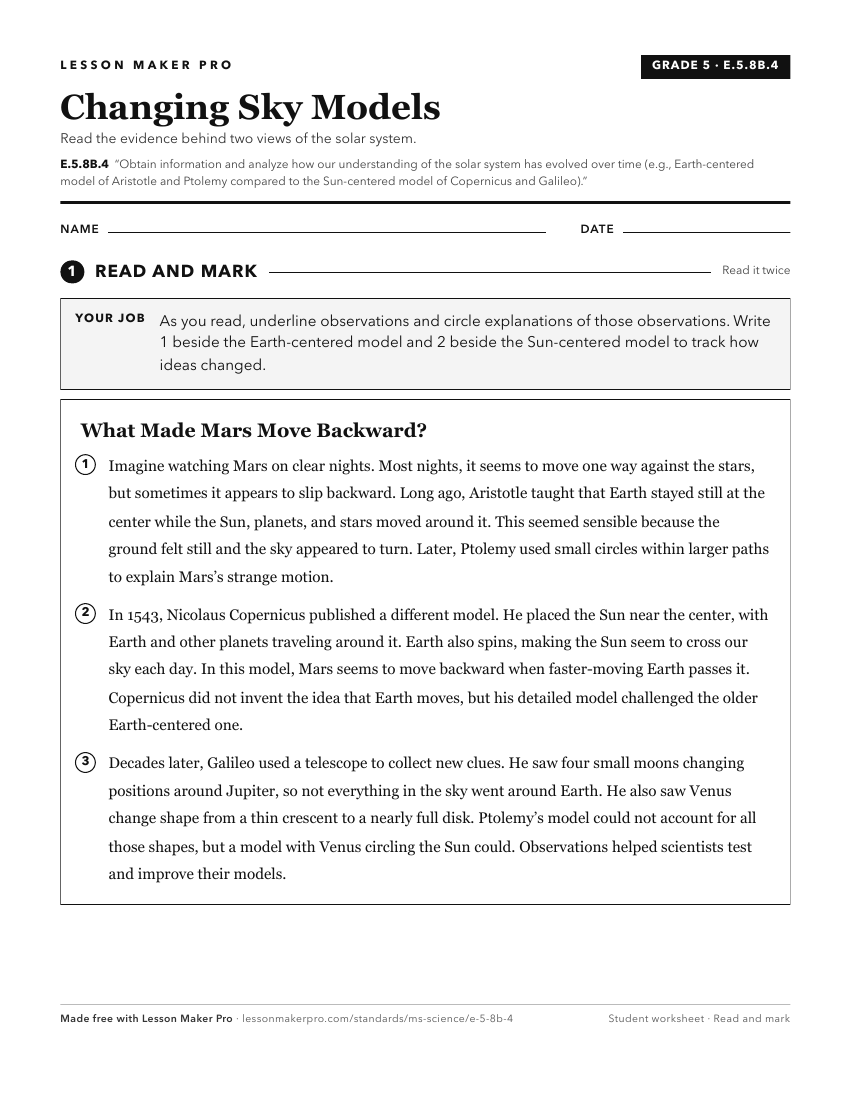
A ready-to-print activity worksheet aligned to E.5.8B.4, with an answer key for the teacher on its own page. No account needed.
PDF, US Letter, prints cleanly in black and white.
Download the worksheetKeep exploring
Related Standards
- E.6.8.4
Obtain and evaluate information to model and compare the characteristics and movements of objects in the solar system (including planets, moons, asteroids, come...
- ESS.1B.1
Read and evaluate scientific information for mechanisms/results (e.g., the solar nebular theory) to explain how the solar system was formed. Cite evidence and d...
- E.5.8B.2
Develop and use a model of the Earth-Sun-Moon system to analyze the cyclic patterns of lunar phases, solar and lunar eclipses, and seasons.
- E.5.8A.1
Develop and use scaled models of Earth's solar system to demonstrate the size, composition (i.e., rock or gas), location, and order of the planets as they orbit...
Turn this exact standard into a lesson
Grade, subject, topic, and the complete standard are prefilled. Create one free, no account needed.
Also for this standard:Make a WorksheetMake a QuizMake a Sub Lesson