Mississippi Science ESS.1B.1
The Standard
- ESS.1B
- Students will develop an understanding of Earth, the solar system, and the laws that predict the motion of celestial bodies.
Read and evaluate scientific information for mechanisms/results (e.g., the solar nebular theory) to explain how the solar system was formed. Cite evidence and develop a logical argument.
2026 Mississippi College- and Career-Readiness Standards for Science · Earth in the Universe
Teacher's field guide
What This Standard Means
What Students Need to Do
- Students read accounts of how a cloud of gas and dust formed the Sun and planets. They compare each account with observations and cite evidence in their own explanation.
What Mastery Looks Like
- A student can explain how gravity formed a spinning disk and how material in that disk built planets. They use young-star disk images, planetary orbits, and meteorite ages as evidence, while saying what each observation supports.
Common Misconceptions
- Some students think the Big Bang made the planets directly, or that the Sun threw off pieces that became planets. Others treat an image of a disk around another star as a picture of our solar system forming.
How to Assess It
- Give students a young-star disk image and a paragraph stating that the planets orbit in nearly the same plane. Ask: 'How did the solar system form? Cite one detail from each source and name one thing the image cannot show.'
Lesson moves
Ways to Teach It
Have groups arrange cards labeled cloud, gravity, rotation, disk, and planetesimals on a desk, then add arrows to explain the sequence.
Give pairs two short source excerpts, one with disk observations and one with an unsupported claim; ask which account has stronger evidence and why.
Play evidence match: teams pair disk images, meteorite ages, and orbital patterns with formation claims, then explain which match is weakest.
Show an ALMA telescope image of a disk around a young star; students label what is observed and what remains inferred.
Free download
Printable ESS.1B.1 Worksheet
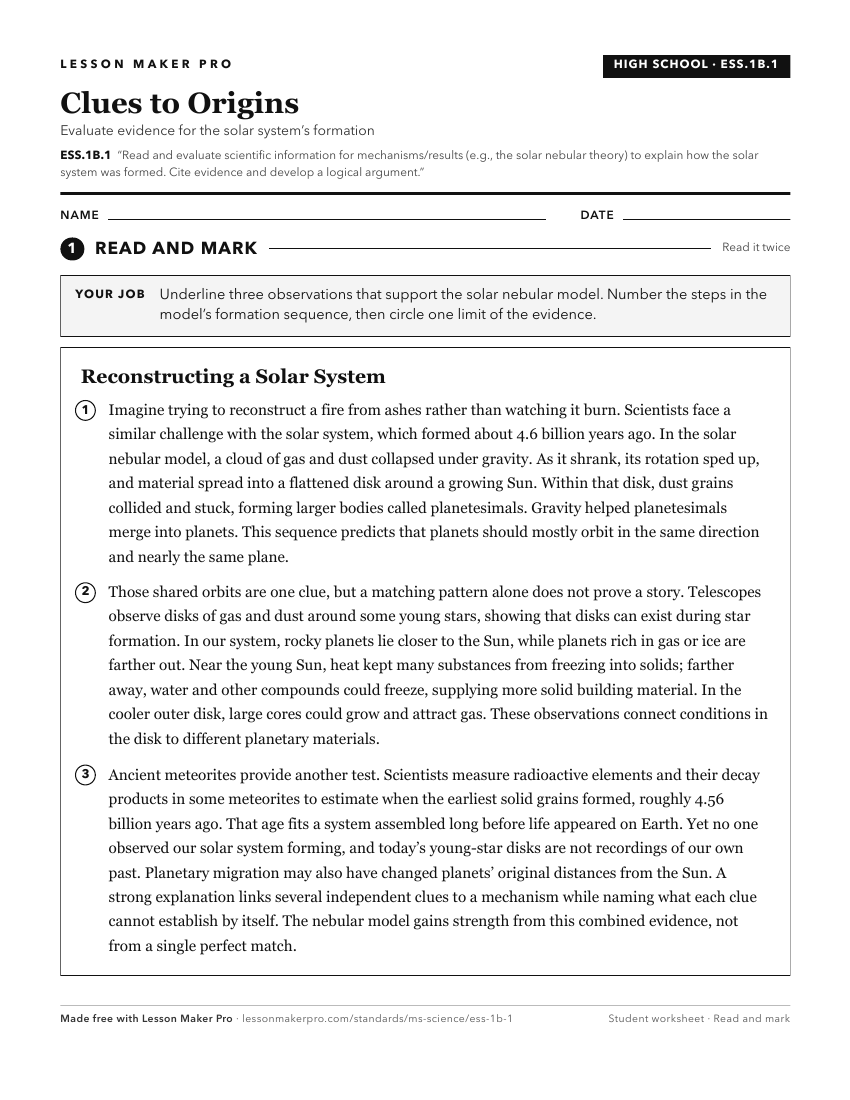
A ready-to-print activity worksheet aligned to ESS.1B.1, with an answer key for the teacher on its own page. No account needed.
PDF, US Letter, prints cleanly in black and white.
Download the worksheetKeep exploring
Related Standards
- E.6.8.4
Obtain and evaluate information to model and compare the characteristics and movements of objects in the solar system (including planets, moons, asteroids, come...
- E.5.8B.4
Obtain information and analyze how our understanding of the solar system has evolved over time (e.g., Earth-centered model of Aristotle and Ptolemy compared to ...
- E.6.8
Students will demonstrate an understanding of Earth’s place in the universe and the interactions of the solar system (sun, planets, their moons, comets, and ast...
- ESS.3.7
Cite evidence and develop logical arguments to identify the cause-and-effect relationships of the evolutionary milestones (e.g., photosynthesis and the atmosphe...
Turn this exact standard into a lesson
Grade, subject, topic, and the complete standard are prefilled. Create one free, no account needed.
Also for this standard:Make a WorksheetMake a QuizMake a Sub Lesson