Mississippi Science ESS.3.7
The Standard
- ESS.3
- Students will develop an understanding of Earth’s systems and cycles.
Cite evidence and develop logical arguments to identify the cause-and-effect relationships of the evolutionary milestones (e.g., photosynthesis and the atmosphere, the evolution of multicellular animals, the development of shells, and the colonization of terrestrial environments by plants and animals) that most profoundly shaped Earth’s systems.
2026 Mississippi College- and Career-Readiness Standards for Science · Earth’s Systems and Cycles
Teacher's field guide
What This Standard Means
What Students Need to Do
- Students use dated fossils and rock layers to put major changes in life in order. They explain how those changes affected air, oceans, or land, and support each link with evidence.
What Mastery Looks Like
- A student uses banded iron layers as evidence that oxygen changed ancient oceans. They use fossils to order the appearance of multicellular animals, shells, and life on land. They explain effects on food webs or soils without treating a proposed cause as a proven fact.
Common Misconceptions
- Students may think oxygen rose as soon as photosynthesis began. They may treat the oldest fossil found as the exact date a trait evolved, or claim that shells alone prove predators caused them.
How to Assess It
- Exit ticket: “Banded iron layers formed after oxygen reacted with iron in ancient oceans. How does this evidence support a link between photosynthesis and a change in Earth’s oceans?”
Lesson moves
Ways to Teach It
Build a paper timeline with dated cards for banded iron layers, animal fossils, shells, and land-plant spores, then add cause-and-effect arrows.
Ask, “Does a shell fossil prove predators caused shells to evolve?” Have students write a claim and name evidence they would need.
Race to match banded iron layers, shell fossils, and plant spores to claims about ocean chemistry, hard body parts, and land vegetation.
Compare photos of bare and planted roadside slopes after rain, then predict how early land plants changed erosion.
Free download
Printable ESS.3.7 Worksheet
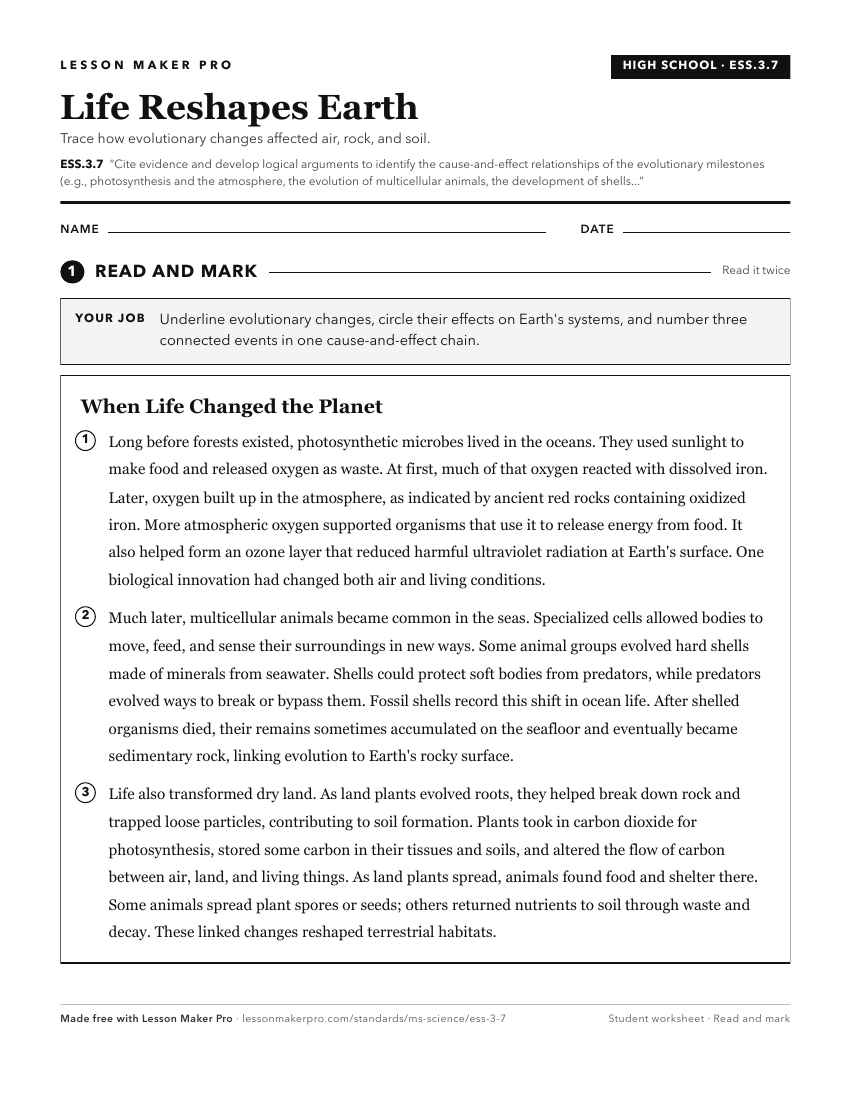
A ready-to-print activity worksheet aligned to ESS.3.7, with an answer key for the teacher on its own page. No account needed.
PDF, US Letter, prints cleanly in black and white.
Download the worksheetKeep exploring
Related Standards
- L.3.4.5
Construct scientific arguments using evidence from fossils of plants and animals that lived long ago to infer the characteristics of early environments (e.g., m...
- E.8.7.3
Construct and analyze scientific arguments to support claims that most fossil evidence is an indication of the diversity of life that was present on Earth and t...
- E.8.7.1
Use scientific evidence to create a timeline of Earth’s history that depicts relative dates from index fossil records and layers of rock (strata).
- E.8.7.4
Use research and evidence to document how evolution has been shaped both gradually and through mass extinction by Earth’s varying geological conditions (e.g., c...
Turn this exact standard into a lesson
Grade, subject, topic, and the complete standard are prefilled. Create one free, no account needed.
Also for this standard:Make a WorksheetMake a QuizMake a Sub Lesson