Mississippi Science E.2.8.1
The Standard
- E.2.8
- Students will demonstrate an understanding of the appearance, movements, and patterns of the sun, moon, and stars.
Recognize that there are many stars that can be observed in the night sky and the Sun is the Earth’s closest star.
2026 Mississippi College- and Career-Readiness Standards for Science · Earth and the Universe
Teacher's field guide
What This Standard Means
What Students Need to Do
- Students identify the Sun as a star. They recognize that many other stars can be seen at night and that the Sun is the closest star to Earth.
What Mastery Looks Like
- Given pictures of the daytime and night sky, a student points out the Sun and the other stars. They explain that the Sun is closer to Earth than the stars seen at night.
Common Misconceptions
- Students may think the Sun is not a star because it looks bigger and appears during the day. They may call the Moon a star or think other stars disappear at sunrise.
How to Assess It
- Show a daytime sky picture and a star-filled night sky picture. Ask, "Which star is closest to Earth, and are the stars in the night sky closer or farther away?"
Lesson moves
Ways to Teach It
Set a paper Earth on a desk, place a paper Sun nearby, and tape other paper stars across the room.
Show daytime and night sky photos; ask, "Why does the Sun look bigger than the stars we see at night?"
Have students sort Sun, Moon, and night-sky picture cards into stars and not stars, then name the closest star.
Ask students to count stars from a window with an adult and note whether clouds or streetlights block their view.
Free download
Printable E.2.8.1 Worksheet
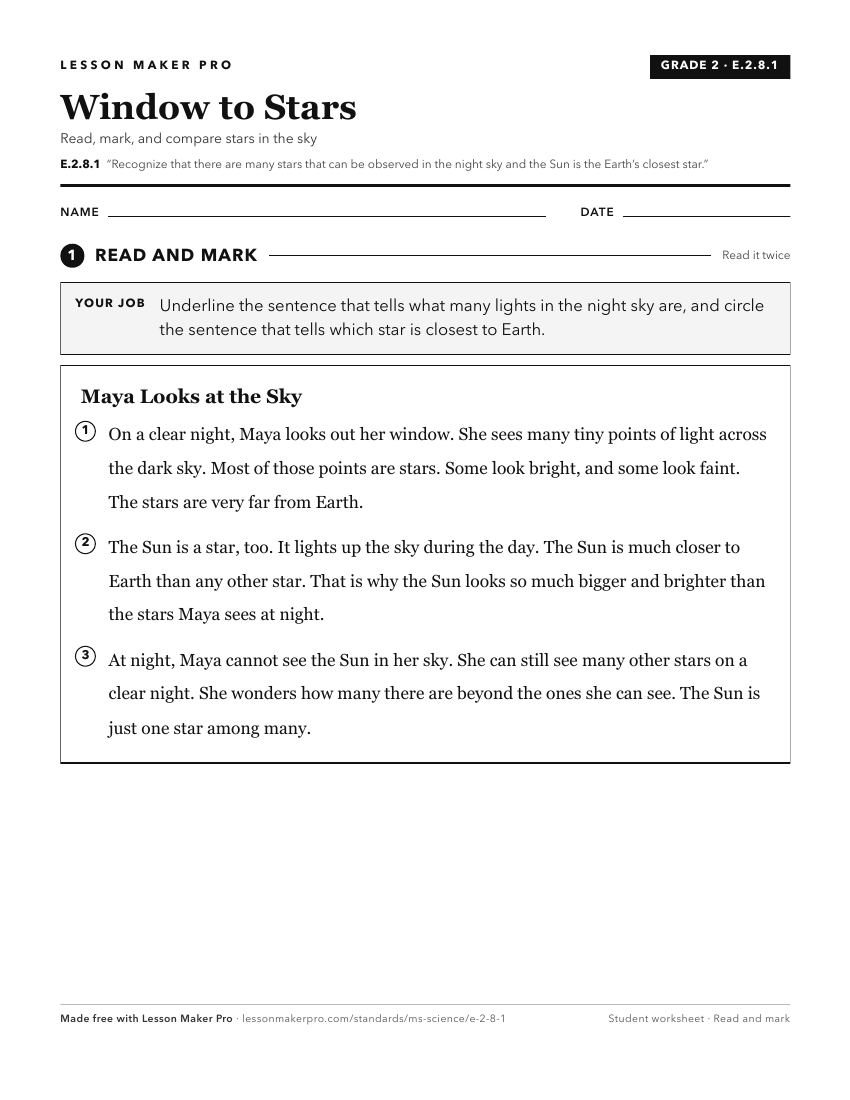
A ready-to-print activity worksheet aligned to E.2.8.1, with an answer key for the teacher on its own page. No account needed.
PDF, US Letter, prints cleanly in black and white.
Download the worksheetKeep exploring
Related Standards
- E.K.8B
Students will demonstrate an understanding that the Sun provides the Earth with heat and light.
- E.5.8A.2
Use evidence to argue why the sun appears brighter than other stars.
- E.6.8
Students will demonstrate an understanding of Earth’s place in the universe and the interactions of the solar system (sun, planets, their moons, comets, and ast...
- E.2.8
Students will demonstrate an understanding of the appearance, movements, and patterns of the sun, moon, and stars.
Turn this exact standard into a lesson
Grade, subject, topic, and the complete standard are prefilled. Create one free, no account needed.
Also for this standard:Make a WorksheetMake a QuizMake a Sub Lesson