Mississippi Science E.5.8A.2
The Standard
- E.5.8A
- Students will demonstrate an understanding of the locations of objects in the universe.
Use evidence to argue why the sun appears brighter than other stars.
2026 Mississippi College- and Career-Readiness Standards for Science · Earth and the Universe
Teacher's field guide
What This Standard Means
What Students Need to Do
- Students compare how much light reaches a surface from a nearby light and a distant one. They use that evidence to explain why the Sun looks brighter than other stars from Earth.
What Mastery Looks Like
- A student uses the same light at two distances to show that less light reaches a surface when the light is farther away. They explain that the Sun looks brighter because it is much closer to Earth, not because it must be the biggest star.
Common Misconceptions
- Students may think the Sun is bigger or gives off more light than every other star. Some think the other stars are tiny, or that the Sun is not a star.
How to Assess It
- Exit ticket: The same flashlight lights a sheet of paper brightly from 30 cm away and dimly from 2 m away. Use this evidence to explain why the Sun looks brighter than other stars.
Lesson moves
Ways to Teach It
Shine one flashlight at white paper from 30 cm and 2 m; students record how the paper's brightness changes.
Ask: Could a star bigger than the Sun still look dimmer from Earth? Have students explain using the flashlight results.
Give pairs four cards showing identical stars at different distances; students rank how bright each would look from Earth.
Have students explain why a nearby streetlight looks brighter than an identical streetlight farther down the road, then connect it to stars.
Free download
Printable E.5.8A.2 Worksheet
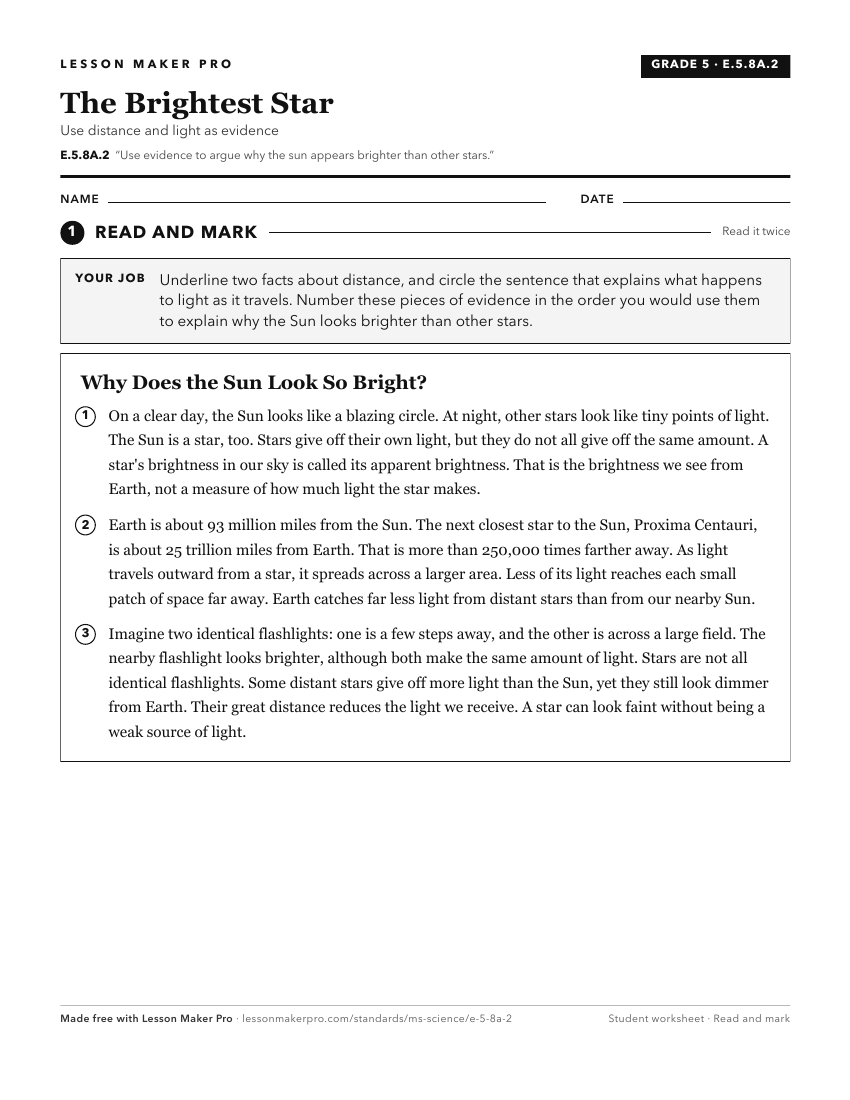
A ready-to-print activity worksheet aligned to E.5.8A.2, with an answer key for the teacher on its own page. No account needed.
PDF, US Letter, prints cleanly in black and white.
Download the worksheetKeep exploring
Related Standards
- P.1.6A.2
Use evidence from observations to explain how shadows form and change with the position of the light source. * (Just for demonstration purpose)
- P.4.6B.1
Construct scientific evidence to support the claim that white light is made up of different colors. Include the work of Sir Isaac Newton to communicate results.
- E.2.8.1
Recognize that there are many stars that can be observed in the night sky and the Sun is the Earth’s closest star.
- E.2.8
Students will demonstrate an understanding of the appearance, movements, and patterns of the sun, moon, and stars.
Turn this exact standard into a lesson
Grade, subject, topic, and the complete standard are prefilled. Create one free, no account needed.
Also for this standard:Make a WorksheetMake a QuizMake a Sub Lesson