Mississippi Science ESS.3
Standard Cluster
Students will develop an understanding of Earth’s systems and cycles. Use mathematical representations (e.g., latitude, longitude, and maps) to calculate the angle of noon solar incidence and relate the value to day length, distribution of sunlight, and seasonal change. Enrichment: Use an engineering design process to explore the concepts of passive solar architecture to design a structure that best utilizes solar incidence. * Explain how temperature and density of ocean water influence circulation. Research and communicate information to explain the importance of the transfer of thermal energy among the hydrosphere, geosphere, and atmosphere. Include the unique physical and chemical properties of water, the water cycle, and energy transfer within the rock cycle. Analyze and interpret weather data using maps and global weather systems to explain and communicate the relationships among air masses, pressure systems, and frontal boundaries. Construct an explanation from data sets to obtain and evaluate scientific information to construct scientific arguments on changes in climate caused by various natural factors (e.g., plate tectonics and continent location and Milankovitch cycles) versus anthropogenic factors (e.g., fossil fuel use and agricultural factors). Cite evidence and develop logical arguments to identify the cause-and-effect relationships of the evolutionary milestones (e.g., photosynthesis and the atmosphere, the evolution of multicellular animals, the development of shells, and the colonization of terrestrial environments by plants and animals) that most profoundly shaped Earth’s systems. Analyze and interpret the record of shared ancestry, evolution, and extinction as related to natural selection using fossils.
2026 Mississippi College- and Career-Readiness Standards for Science · Earth’s Systems and Cycles
Cluster contents
Standards in This Cluster
ESS.3 is a cluster heading. These are the individual standards under it.
- ESS.3.1
Use mathematical representations (e.g., latitude, longitude, and maps) to calculate the angle of noon solar incidence and relate the value to day length, distri...
- ESS.3.2
Enrichment: Use an engineering design process to explore the concepts of passive solar architecture to design a structure that best utilizes solar incidence. *
- ESS.3.3
Explain how temperature and density of ocean water influence circulation.
- ESS.3.4
Research and communicate information to explain the importance of the transfer of thermal energy among the hydrosphere, geosphere, and atmosphere. Include the u...
- ESS.3.5
Analyze and interpret weather data using maps and global weather systems to explain and communicate the relationships among air masses, pressure systems, and fr...
- ESS.3.6
Construct an explanation from data sets to obtain and evaluate scientific information to construct scientific arguments on changes in climate caused by various ...
- ESS.3.7
Cite evidence and develop logical arguments to identify the cause-and-effect relationships of the evolutionary milestones (e.g., photosynthesis and the atmosphe...
- ESS.3.8
Analyze and interpret the record of shared ancestry, evolution, and extinction as related to natural selection using fossils.
Teacher's field guide
What This Cluster Means
What Students Need to Do
- Students calculate noon Sun angles and connect them to daylight and seasons. They use water properties, weather maps, and cycle diagrams to explain how water and heat move through Earth’s systems. They compare climate records and fossils to explain climate change, shared ancestry, extinction, and ways life has changed Earth.
What Mastery Looks Like
- A student calculates the noon Sun angle for a given latitude and date, then explains the daylight pattern. They use temperature and salinity data to predict ocean flow, read a weather map to predict conditions, and trace heat through water and rock cycles. They cite climate data and fossils to distinguish natural from human causes of change and explain how organisms changed Earth’s air and land.
Common Misconceptions
- Students may think seasons happen because Earth moves closer to the Sun, or that warm water always floats regardless of its salt content. They may think fronts stop air from moving or that wind alone drives ocean circulation. They may treat a fossil sequence as a direct family tree or assume that past natural climate changes rule out human causes now.
How to Assess It
- Exit ticket: At 40° N, calculate the noon Sun angle on June 21 using a solar declination of 23.5° N. Explain why June has longer days there, then predict whether cold, salty water or warm, fresh water will sink.
Lesson moves
Ways to Teach It
Slowly inject blue, cold saltwater beneath red, warm freshwater in a clear tray; have students sketch where each moves and explain why.
Compare an orbital cycle graph with recent CO2 and temperature graphs, then write what each can and cannot explain about recent warming.
Give pairs a weather map with two fronts and pressure centers; have them predict tomorrow’s temperature, wind, and rainfall for one marked town.
Measure a noon shadow at a south-facing window, then use solstice Sun angles to sketch a shade that blocks summer light.
Free download
Printable ESS.3 Worksheet
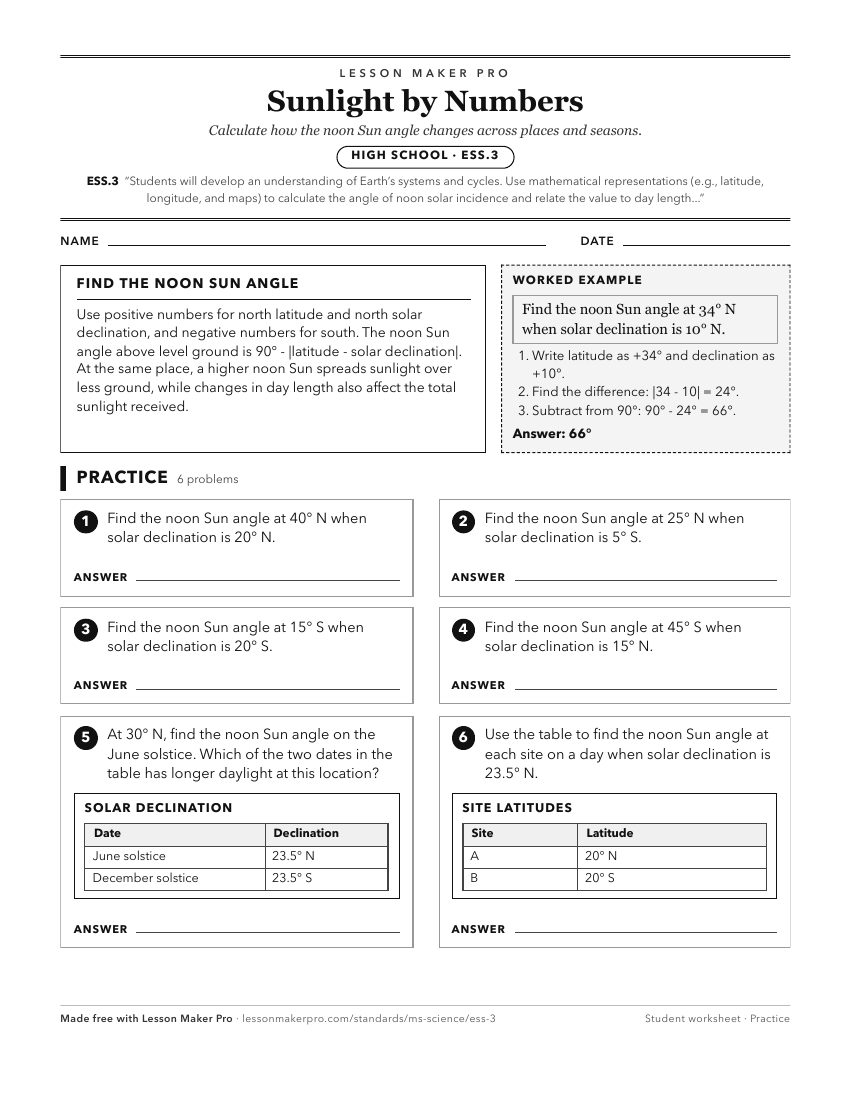
A ready-to-print activity worksheet aligned to ESS.3, with an answer key for the teacher on its own page. No account needed.
PDF, US Letter, prints cleanly in black and white.
Download the worksheetKeep exploring
Related Standards
- E.3.9
Students will demonstrate an understanding of how the Earth’s systems (i.e., geosphere, hydrosphere, atmosphere, and biosphere) interact in multiple ways to aff...
- ESS.2B
Students will develop an understanding of the history and evolution of the earth.
- E.K.8A
Students will demonstrate an understanding of the pattern of seasonal changes on the Earth.
- ESS.4
Students will develop an understanding of Earth’s resources and the impact of human activities.
Turn this cluster into a lesson
Grade, subject, topic, and the complete cluster are prefilled. Create one free, no account needed.
Also for this cluster:Make a WorksheetMake a QuizMake a Sub Lesson