Mississippi Science ESS.3.3
The Standard
- ESS.3
- Students will develop an understanding of Earth’s systems and cycles.
Explain how temperature and density of ocean water influence circulation.
2026 Mississippi College- and Career-Readiness Standards for Science · Earth’s Systems and Cycles
Teacher's field guide
What This Standard Means
What Students Need to Do
- Students compare warm and cold seawater with the same salt content. They explain why colder, denser water tends to sink and how that movement helps circulate ocean water.
What Mastery Looks Like
- Given a drawing of warm and cold seawater, a student marks where water sinks and where surface water moves to replace it. They explain both arrows using temperature and density.
Common Misconceptions
- Some students think cold water floats because ice floats. Others think temperature alone decides where seawater sinks, even though salt content also changes density.
How to Assess It
- Draw an ocean cross-section with equal-salinity surface water labeled 5°C at one end and 25°C at the other. Ask students to draw circulation arrows and explain the sinking arrow.
Lesson moves
Ways to Teach It
Add blue ice at one end of a clear tub of water and red warm water at the other; have students trace the colored paths.
Ask students to write two sentences explaining why cold seawater might sink while ice floats.
Give pairs cards showing equal-salinity water at 2°C, 15°C, and 28°C; have them rank density and place each on an ocean cross-section.
Show a map of Atlantic currents; ask students to trace warm surface water north, then cold, dense water sinking and moving south.
Free download
Printable ESS.3.3 Worksheet
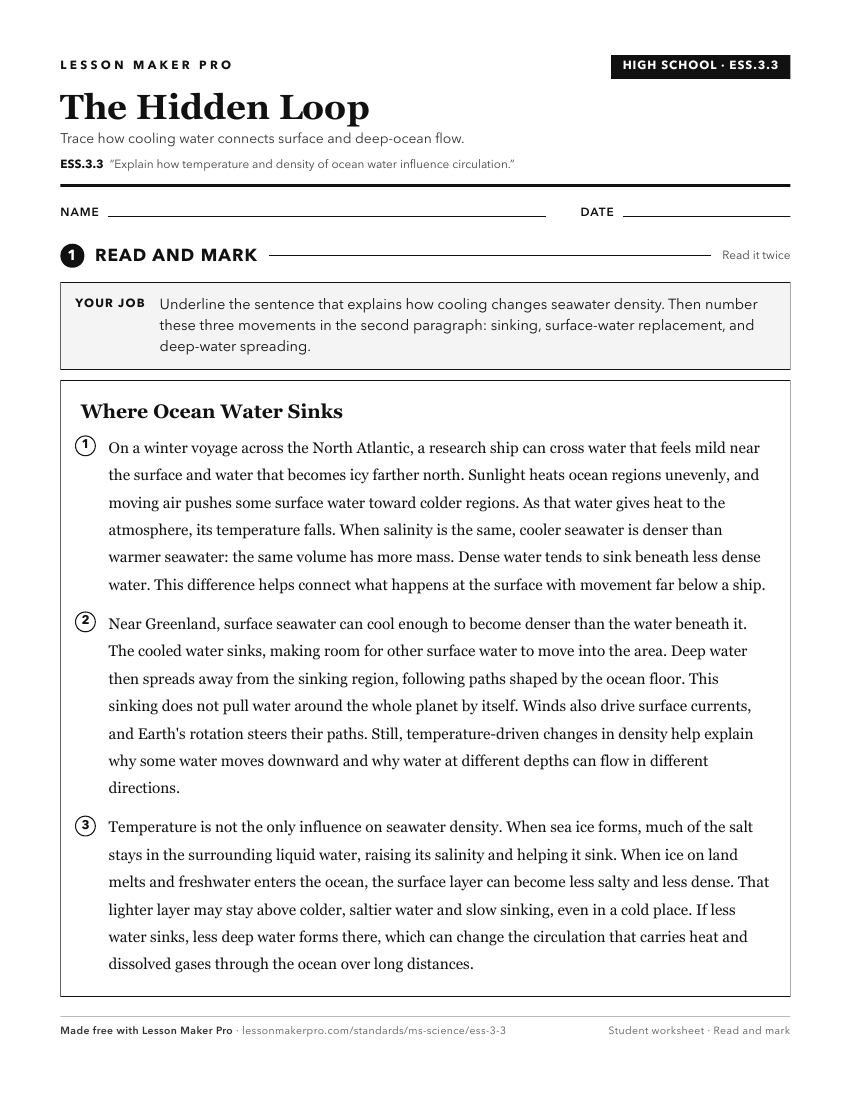
A ready-to-print activity worksheet aligned to ESS.3.3, with an answer key for the teacher on its own page. No account needed.
PDF, US Letter, prints cleanly in black and white.
Download the worksheetKeep exploring
Related Standards
- CHE.8.3
Analyze and interpret data to predict the effect of temperature and pressure on solids and gases dissolved in water.
- MAQ.2.3
Summarize principles related to currents (e.g., global wind patterns, Coriolis effect, Ekman spiral, surface, thermohaline, upwelling, downwelling, El Niño, La ...
- P.7.5B.3
Ask questions to explain how density of matter (observable in various objects) is affected by a change in heat and/or pressure.
- E.8.9A.1
Investigate and explain how the flow of Earth's internal energy drives the cycling of matter through convection currents between Earth's surface and the deep in...
Turn this exact standard into a lesson
Grade, subject, topic, and the complete standard are prefilled. Create one free, no account needed.
Also for this standard:Make a WorksheetMake a QuizMake a Sub Lesson