Mississippi Science CHE.8.3
The Standard
- CHE.8
- Students will demonstrate an understanding of the nature of properties of various types of chemical solutions.
Analyze and interpret data to predict the effect of temperature and pressure on solids and gases dissolved in water.
2026 Mississippi College- and Career-Readiness Standards for Science · Solutions
Teacher's field guide
What This Standard Means
What Students Need to Do
- Students read tables or graphs to predict how much solid or gas can dissolve in water at different temperatures. They also predict how changing pressure affects dissolved gases and explain their answers with data.
What Mastery Looks Like
- A student uses numbers from a table to predict that warmer water will hold more sugar but less oxygen. They predict that higher pressure will keep more gas dissolved, while having little effect on a solid.
Common Misconceptions
- Students may think heating water increases the solubility of every substance, including gases. They may confuse faster dissolving with a greater amount dissolving. Some expect pressure to change a solid’s solubility as much as a gas’s.
How to Assess It
- Exit ticket: At 10°C and 30°C, sugar solubility is 190 and 220 g per 100 g water, while oxygen is 11 and 8 mg/L. At 30°C, oxygen is 8 mg/L at 1 atm and 16 mg/L at 2 atm. Ask students to predict what warming and higher pressure do, using the numbers as evidence.
Lesson moves
Ways to Teach It
Stir sugar into equal cups of warm and cold water, adding measured spoonfuls until some remains; compare the amounts dissolved.
Post oxygen readings of 11 mg/L at 10°C and 8 mg/L at 30°C; ask which water holds more oxygen and how students know.
Give pairs four mini-graphs of solubility versus temperature or pressure; have them match each to sugar, oxygen, or carbon dioxide and explain.
Give students a heat-wave lake report showing oxygen falling from 11 to 8 mg/L; ask why fish may struggle.
Free download
Printable CHE.8.3 Worksheet
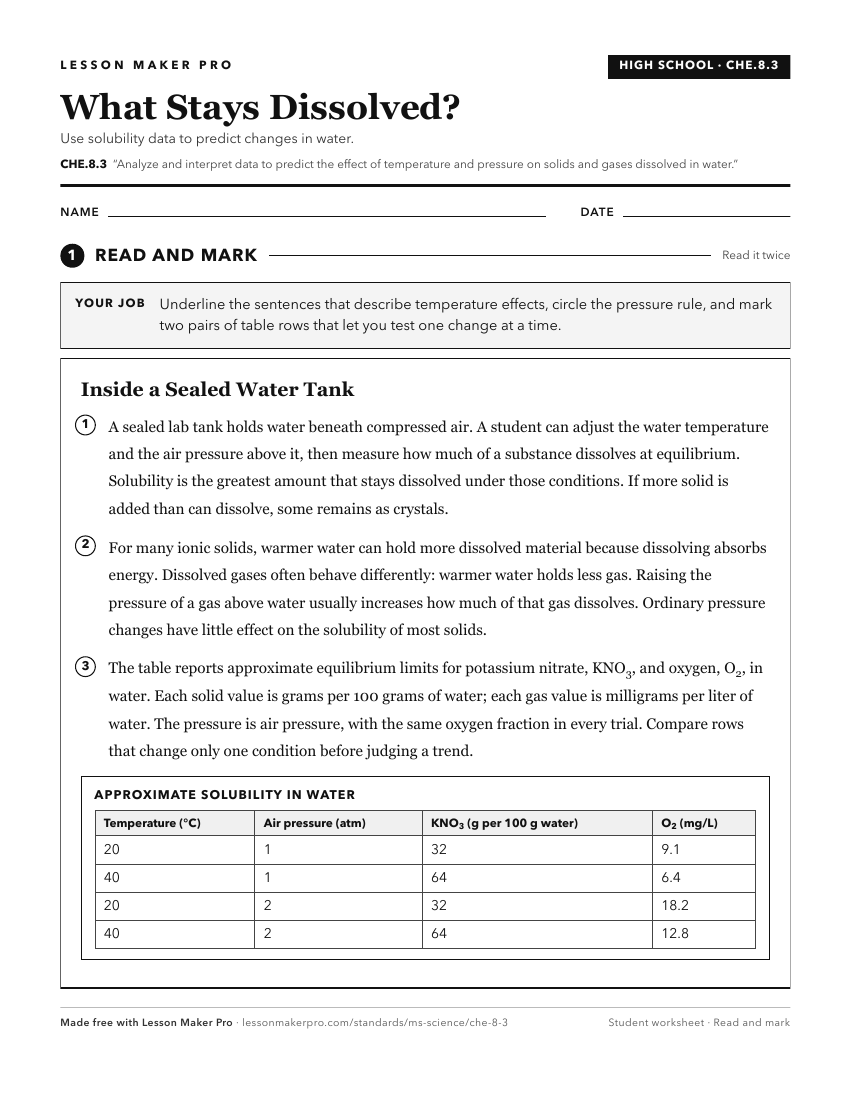
A ready-to-print activity worksheet aligned to CHE.8.3, with an answer key for the teacher on its own page. No account needed.
PDF, US Letter, prints cleanly in black and white.
Download the worksheetKeep exploring
Related Standards
- P.5.5B.2
Analyze and interpret data to communicate that the concentration of a solution is determined by the relative amount of solute versus solvent in various mixtures...
- P.5.5A.2
Collect, analyze, and interpret data from measurements of the physical properties of solids, liquids, and gases (e.g., volume, shape, movement, and spacing of p...
- PHS.1.5
Design and conduct an investigation using graphical analysis (e.g., line graph) to determine the density of liquids and/or solids.
- P.7.5B.1
Make predictions about the effect of temperature and pressure on the relative motion of atoms and molecules (speed, expansion, and condensation) relative to rec...
Turn this exact standard into a lesson
Grade, subject, topic, and the complete standard are prefilled. Create one free, no account needed.
Also for this standard:Make a WorksheetMake a QuizMake a Sub Lesson