Mississippi Science ESS.3.1
The Standard
- ESS.3
- Students will develop an understanding of Earth’s systems and cycles.
Use mathematical representations (e.g., latitude, longitude, and maps) to calculate the angle of noon solar incidence and relate the value to day length, distribution of sunlight, and seasonal change.
2026 Mississippi College- and Career-Readiness Standards for Science · Earth’s Systems and Cycles
Teacher's field guide
What This Standard Means
What Students Need to Do
- Students find a place on a map and use its latitude and the date to calculate the Sun's angle above the horizon at noon. For the same place, they connect higher noon angles with longer days and sunlight spread over less ground.
What Mastery Looks Like
- At 40°N, a student calculates a noon angle of 73.5° in June and 26.5° in December. They explain why June has more daylight and more concentrated sunlight.
Common Misconceptions
- Students may use longitude instead of latitude, or treat a negative solar declination as positive. Some blame seasons on Earth's distance from the Sun or assume every place gets 12 hours of daylight.
How to Assess It
- Exit ticket: At 40°N, calculate noon angles for June (+23.5°) and December (-23.5°) using 90° minus the absolute difference between latitude and solar declination. Circle the date with longer daylight and explain how its sunlight hits the ground.
Lesson moves
Ways to Teach It
Tape a toothpick at 40°N on a tilted globe; set it on opposite sides of a lamp, rotate to noon, and compare shadows.
Ask: Why does 40°N have a higher noon Sun and longer daylight in June than December if Earth is not closer to the Sun?
Make cards labeled 40°N, 20°S, +23.5°, and -23.5°; pairs match one latitude and one declination, then calculate noon angles.
Print local June and December sunrise and sunset times; students calculate daylight hours and compare them with noon angles from a map.
Free download
Printable ESS.3.1 Worksheet
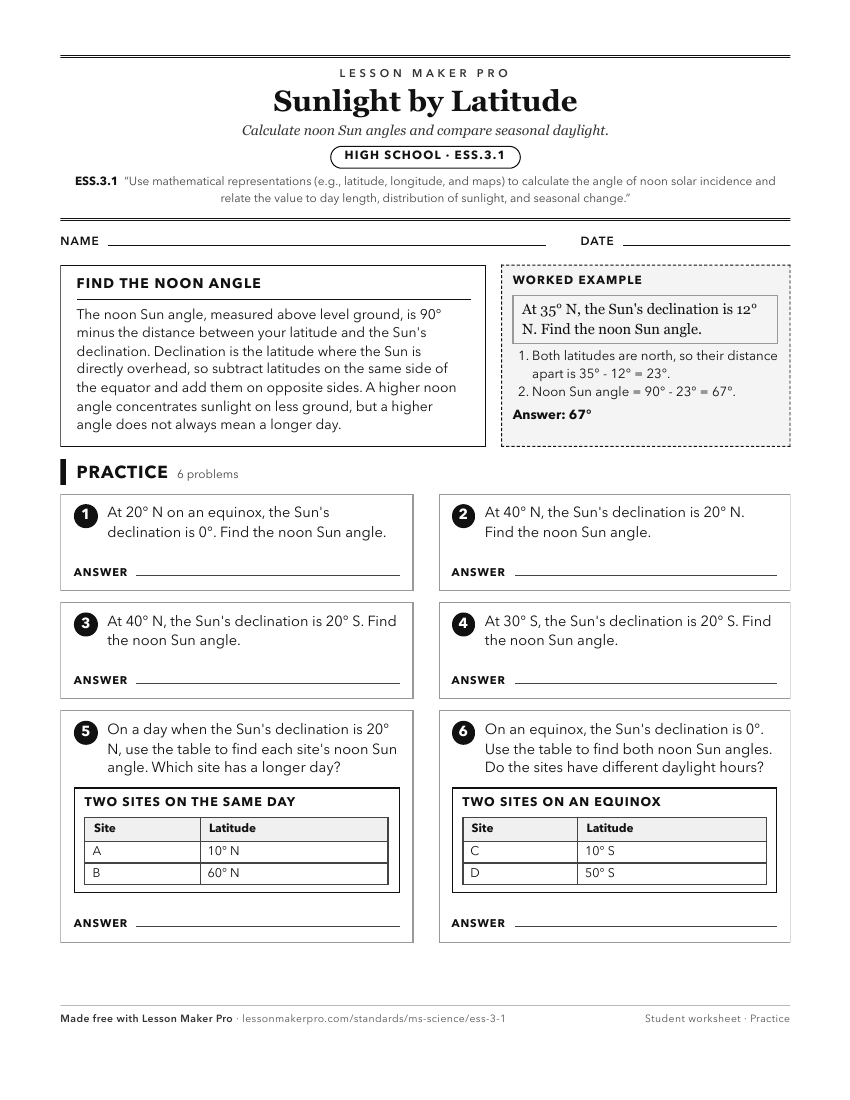
A ready-to-print activity worksheet aligned to ESS.3.1, with an answer key for the teacher on its own page. No account needed.
PDF, US Letter, prints cleanly in black and white.
Download the worksheetKeep exploring
Related Standards
- E.K.8B.1
With teacher guidance, generate and answer questions to develop a simple model, which describes observable patterns of sunlight on the Earth's surface (day and ...
- E.5.8B.3
Develop and use models to explain the factors (e.g., tilt, revolution, and angle of sunlight) that result in Earth's seasonal changes.
- E.5.8B.2
Develop and use a model of the Earth-Sun-Moon system to analyze the cyclic patterns of lunar phases, solar and lunar eclipses, and seasons.
- E.7.9C.1
Construct models and diagrams to illustrate how the tilt of Earth's axis results in differences in intensity of sunlight on the Earth's hemispheres throughout t...
Turn this exact standard into a lesson
Grade, subject, topic, and the complete standard are prefilled. Create one free, no account needed.
Also for this standard:Make a WorksheetMake a QuizMake a Sub Lesson