Mississippi Science E.7.9C.1
The Standard
- E.7.9C
- Students will demonstrate an understanding that the seasons are the direct result of the Earth's tilt and the intensity of sunlight on the Earth's hemispheres.
Construct models and diagrams to illustrate how the tilt of Earth’s axis results in differences in intensity of sunlight on the Earth’s hemispheres throughout the course of one full revolution around the Sun.
2026 Mississippi College- and Career-Readiness Standards for Science · Earth’s Systems and Cycles
Teacher's field guide
What This Standard Means
What Students Need to Do
- Students draw Earth at several points in its orbit, with its axis tilted in the same direction each time. They show which hemisphere gets more direct sunlight and where the light spreads over more ground.
What Mastery Looks Like
- A student's model keeps the axis pointed the same way through a full orbit. It shows when each hemisphere gets more direct sunlight and when both get about the same.
Common Misconceptions
- Students often say summer happens because Earth moves closer to the Sun. They may flip the tilt as Earth orbits, or confuse daily rotation with the yearly change in sunlight angle.
How to Assess It
- On an exit ticket, have students draw a tilted Earth at four marked spots around the Sun, keeping the axis aimed the same way. Ask them to label which hemisphere gets more direct sunlight at each spot, or write “about the same.”
Lesson moves
Ways to Teach It
Move a tilted globe around a lamp at four floor marks, keeping its axis pointed toward one wall; compare light angles in both hemispheres.
Ask, “Why is December summer in the Southern Hemisphere but winter in the Northern Hemisphere?” Have students answer with a tilted-Earth sketch.
Give pairs four orbit cards; have them sort by which hemisphere gets more direct sunlight and defend each choice with a tilted-axis sketch.
Give students June and December noon Sun angles for their town; ask which month brings stronger midday sunlight to a flat rooftop.
Free download
Printable E.7.9C.1 Worksheet
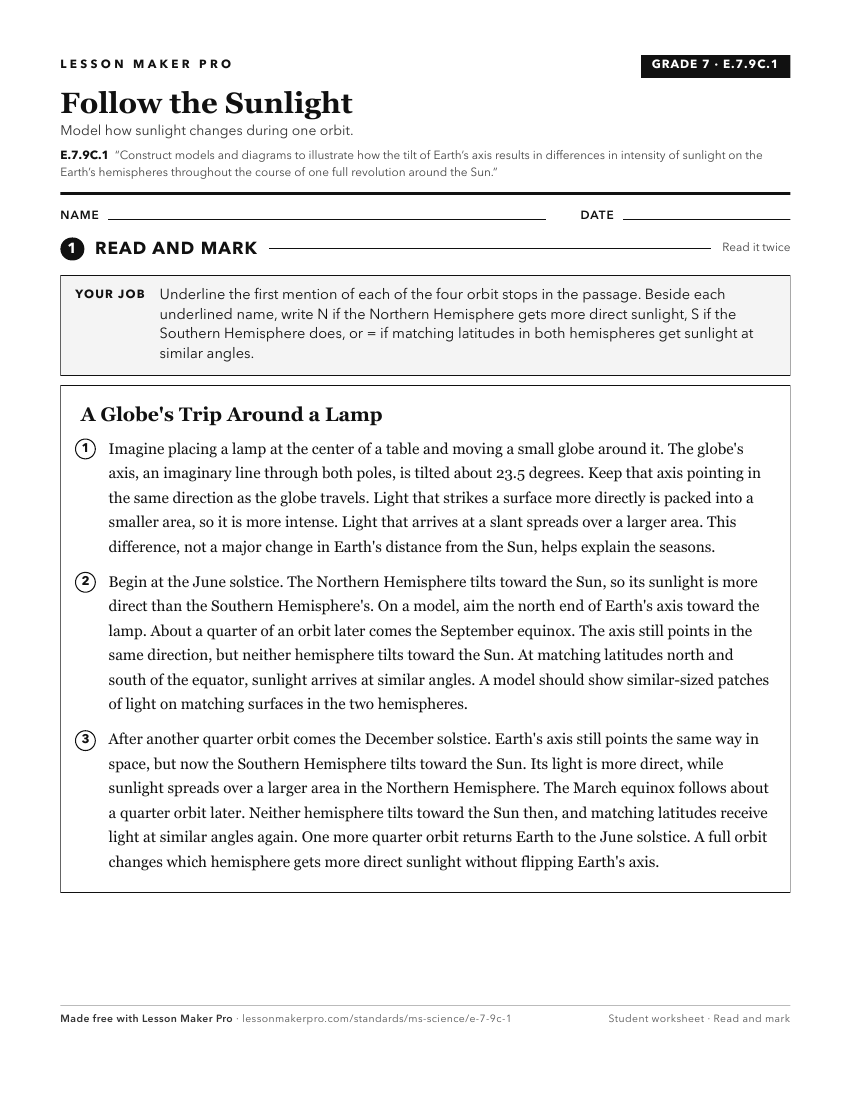
A ready-to-print activity worksheet aligned to E.7.9C.1, with an answer key for the teacher on its own page. No account needed.
PDF, US Letter, prints cleanly in black and white.
Download the worksheetKeep exploring
Related Standards
- E.K.8B.1
With teacher guidance, generate and answer questions to develop a simple model, which describes observable patterns of sunlight on the Earth's surface (day and ...
- E.5.8B.3
Develop and use models to explain the factors (e.g., tilt, revolution, and angle of sunlight) that result in Earth's seasonal changes.
- E.7.9C
Students will demonstrate an understanding that the seasons are the direct result of the Earth's tilt and the intensity of sunlight on the Earth's hemispheres.
- E.7.9C.2
Investigate how variations of sunlight intensity experienced by each hemisphere (to include the equator and poles) create the four seasons.
Turn this exact standard into a lesson
Grade, subject, topic, and the complete standard are prefilled. Create one free, no account needed.
Also for this standard:Make a WorksheetMake a QuizMake a Sub Lesson