Mississippi Science ESS.1A
Standard Cluster
Students will develop an understanding of the universe, its development, immense size, and composition. Describe the Big Bang theory and summarize observations (e.g., cosmic microwave background radiation, Hubble’s law, and redshift caused by the Doppler effect) as evidence to support the formation and expansion of the universe. Interpret information from the Hertzsprung -Russell diagram to differentiate types of stars, including our sun, according to size, magnitude, and classification. Organize and interpret data sets for patterns and trends to compare and contrast stellar evolution in order to explain and communicate how a star changes during its life. Research and explain how nuclear fusion in stars and supernova lead to the formation of all other elements.
2026 Mississippi College- and Career-Readiness Standards for Science · Earth in the Universe
Cluster contents
Standards in This Cluster
ESS.1A is a cluster heading. These are the individual standards under it.
- ESS.1A.1
Describe the Big Bang theory and summarize observations (e.g., cosmic microwave background radiation, Hubble’s law, and redshift caused by the Doppler effect) a...
- ESS.1A.2
Interpret information from the Hertzsprung -Russell diagram to differentiate types of stars, including our sun, according to size, magnitude, and classification...
- ESS.1A.3
Organize and interpret data sets for patterns and trends to compare and contrast stellar evolution in order to explain and communicate how a star changes during...
- ESS.1A.4
Research and explain how nuclear fusion in stars and supernova lead to the formation of all other elements.
Teacher's field guide
What This Cluster Means
What Students Need to Do
- Students use galaxy redshifts and microwave background radiation to explain a hot early universe that has expanded over vast distances. They read a star diagram to compare the Sun with other types of stars. They use life-cycle data to explain how stars change and how fusion and supernovae make and spread elements.
What Mastery Looks Like
- Students use a distance and redshift table to show that farther galaxies have larger redshifts. They place the Sun among main-sequence stars and compare stars by temperature, brightness, and size. They trace a massive star to a supernova and explain how its path differs from the Sun's.
Common Misconceptions
- Some picture the Big Bang as an explosion into empty space or think redshift means galaxies change color. Others think red stars are hotter than blue stars or that a brighter star must be larger. Many expect the Sun to become a supernova or think every element formed in the Big Bang.
How to Assess It
- Give students two galaxies' distances and redshifts, a note on microwave background radiation, and a star diagram with the Sun marked. Ask them to explain what the two observations tell us about the early universe, classify the Sun, and name what a supernova spreads.
Lesson moves
Ways to Teach It
Draw galaxy dots on a balloon, inflate it, and measure how distances between pairs of dots change.
Show a microwave background map and two galaxy spectra; ask, 'What does each observation tell us about the early universe?'
Give pairs star cards and a star diagram; have them place the Sun, a red giant, and a white dwarf.
Compare a pencil's carbon with a paper clip's iron; use a star life-cycle chart to trace how each element formed and reached space.
Free download
Printable ESS.1A Worksheet
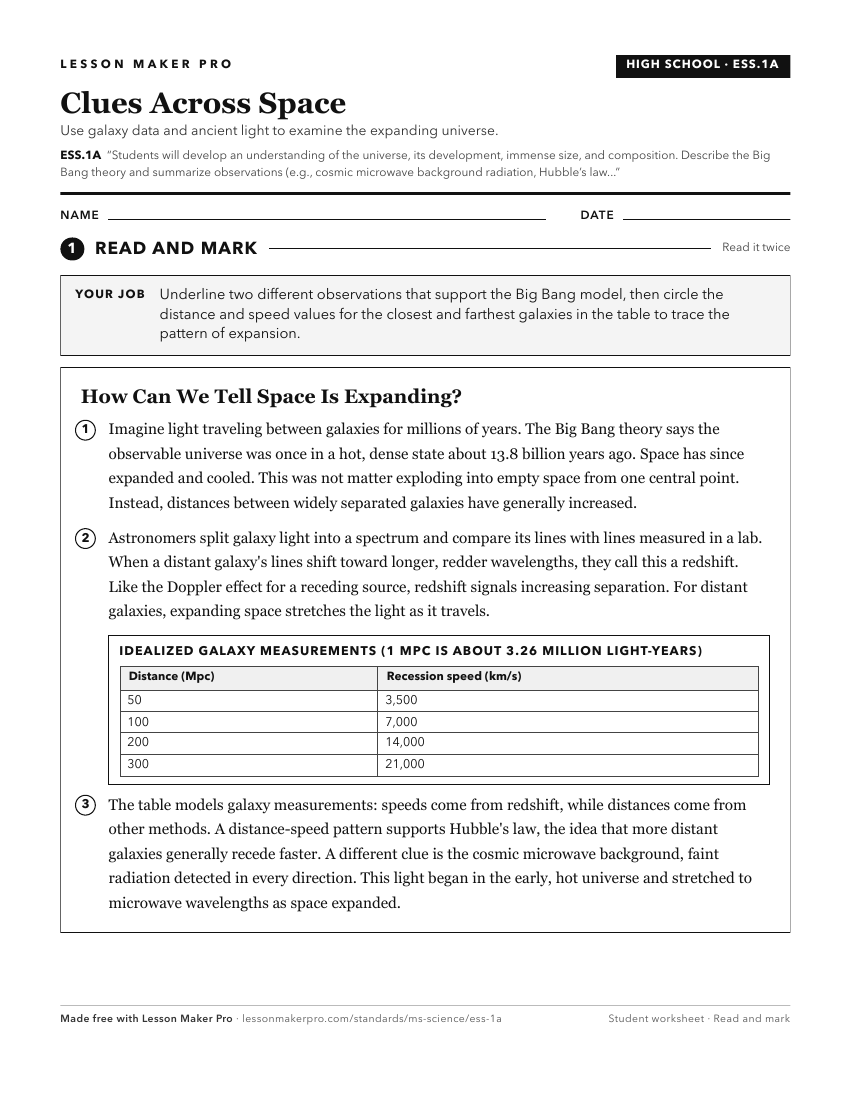
A ready-to-print activity worksheet aligned to ESS.1A, with an answer key for the teacher on its own page. No account needed.
PDF, US Letter, prints cleanly in black and white.
Download the worksheetKeep exploring
Related Standards
- ESS.1B
Students will develop an understanding of Earth, the solar system, and the laws that predict the motion of celestial bodies.
- ESS.2B
Students will develop an understanding of the history and evolution of the earth.
- E.5.8A
Students will demonstrate an understanding of the locations of objects in the universe.
- ESS.2A
Students will develop an understanding of the structure and composition of Earth and its materials.
Turn this cluster into a lesson
Grade, subject, topic, and the complete cluster are prefilled. Create one free, no account needed.
Also for this cluster:Make a WorksheetMake a QuizMake a Sub Lesson