Mississippi Science ESS.1A.4
The Standard
- ESS.1A
- Students will develop an understanding of the universe, its development, immense size, and composition.
Research and explain how nuclear fusion in stars and supernova lead to the formation of all other elements.
2026 Mississippi College- and Career-Readiness Standards for Science · Earth in the Universe
Teacher's field guide
What This Standard Means
What Students Need to Do
- Students use an element-origin chart and a reliable source to find where different elements form. They explain how fusion makes new elements inside stars and how supernovae can make and spread others. They trace that material to later planets.
What Mastery Looks Like
- A student can explain that carbon forms through fusion in stars and that massive stars can fuse elements up to iron. They can explain that supernovae make some heavier elements and scatter material that can become part of planets.
Common Misconceptions
- Some students think every element formed in the Big Bang. Others think supernovae make every heavy element from scratch, rather than also scattering elements made earlier in stars.
How to Assess It
- Give students a printed element-origin chart. Ask: “Where did carbon form, what can a supernova do to elements, and how could those elements reach Earth?” Require one detail from the chart.
Lesson moves
Ways to Teach It
Use beads to combine three helium-4 nuclei into carbon-12, then place a carbon card inside a star diagram.
Show an element-origin chart and ask students to write why a massive star cannot keep gaining energy by fusing elements past iron.
Give pairs Big Bang, star fusion, and supernova cards to match with hydrogen, carbon, and nickel-56 origin clues.
Have students trace the iron in a steel paper clip from a star, through scattered debris, to the material that formed Earth.
Free download
Printable ESS.1A.4 Worksheet
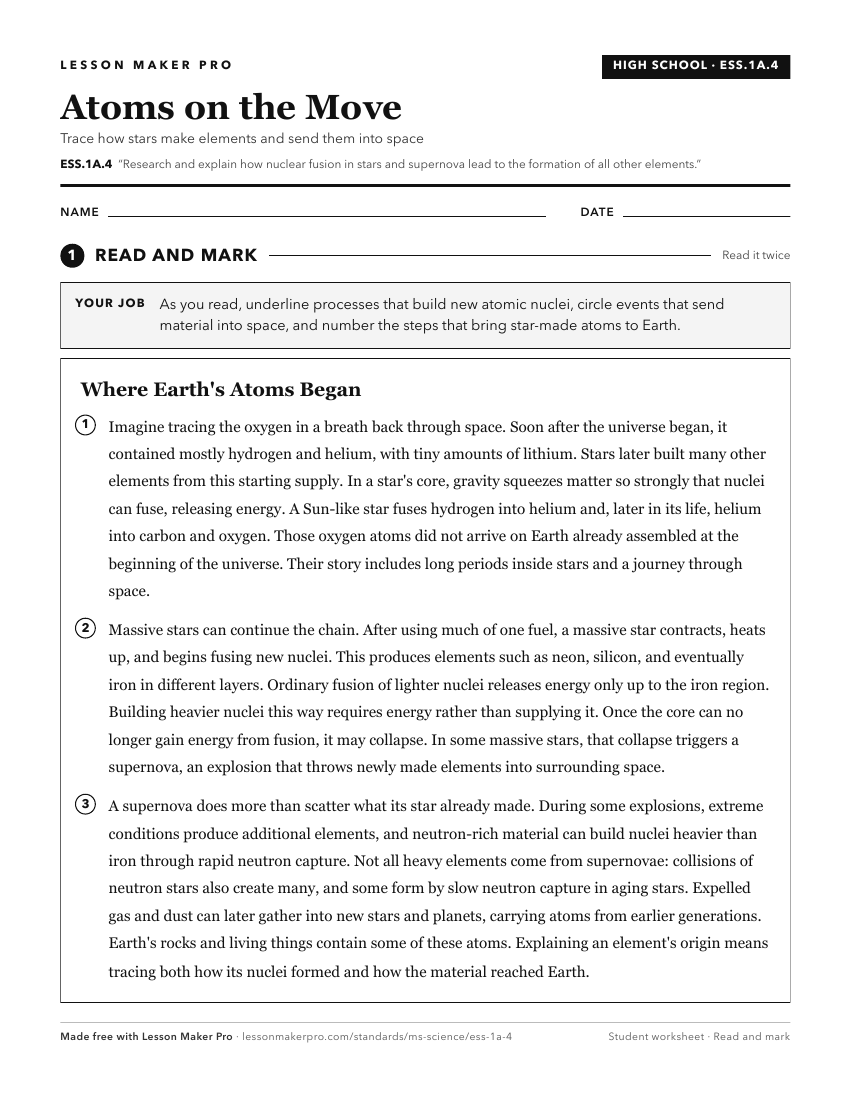
A ready-to-print activity worksheet aligned to ESS.1A.4, with an answer key for the teacher on its own page. No account needed.
PDF, US Letter, prints cleanly in black and white.
Download the worksheetKeep exploring
Related Standards
- ESS.1B.1
Read and evaluate scientific information for mechanisms/results (e.g., the solar nebular theory) to explain how the solar system was formed. Cite evidence and d...
- PHS.4.5
Research nuclear reactions and their uses in the modern world, exploring concepts such as fusion, fission, stars as reactors, nuclear energy, and chain reaction...
- PHY.6.1
Analyze and explain the concepts of nuclear physics.
- E.6.8.1
Obtain, evaluate, and summarize past and present theories and evidence to explain the formation and composition of the universe.
Turn this exact standard into a lesson
Grade, subject, topic, and the complete standard are prefilled. Create one free, no account needed.
Also for this standard:Make a WorksheetMake a QuizMake a Sub Lesson