Mississippi Science E.6.8.1
The Standard
- E.6.8
- Students will demonstrate an understanding of Earth’s place in the universe and the interactions of the solar system (sun, planets, their moons, comets, and asteroids) using evidence from multiple scientific resources to explain how these objects are held in orbit around the Sun because of its gravitational pull.
Obtain, evaluate, and summarize past and present theories and evidence to explain the formation and composition of the universe.
2026 Mississippi College- and Career-Readiness Standards for Science · Earth and the Universe
Teacher's field guide
What This Standard Means
What Students Need to Do
- Students read short accounts of the steady state and Big Bang models. They use galaxy redshift and leftover radiation to judge which model fits the evidence. They describe what the universe contains, including galaxies, gas, dark matter, and dark energy.
What Mastery Looks Like
- A student can explain why redshift and faint microwave radiation support a hot, expanding early universe over a steady state one. They can name hydrogen and helium as the main ingredients of ordinary matter and identify dark matter and dark energy as other major components.
Common Misconceptions
- Students may picture the Big Bang as a bomb exploding into empty space, rather than space itself expanding. They may think redshift means galaxies turn red, or that dark matter is black dust.
How to Assess It
- Exit ticket: Which model, steady state or a hot, expanding universe, better explains galaxy redshift and microwave radiation from every direction? Give one reason and name two things found in the universe.
Lesson moves
Ways to Teach It
Mark dots on a balloon, inflate it, and measure how the distances between dots change to model expanding space.
Read two short model cards, one for steady state and one for the Big Bang, then write which better explains microwave radiation across the sky.
Play evidence match: teams pair redshift, microwave radiation, and hydrogen abundance cards with predictions from a hot, expanding universe.
Display a galaxy spectrum beside a lab hydrogen spectrum, and ask students how astronomers identify hydrogen in distant galaxies.
Free download
Printable E.6.8.1 Worksheet
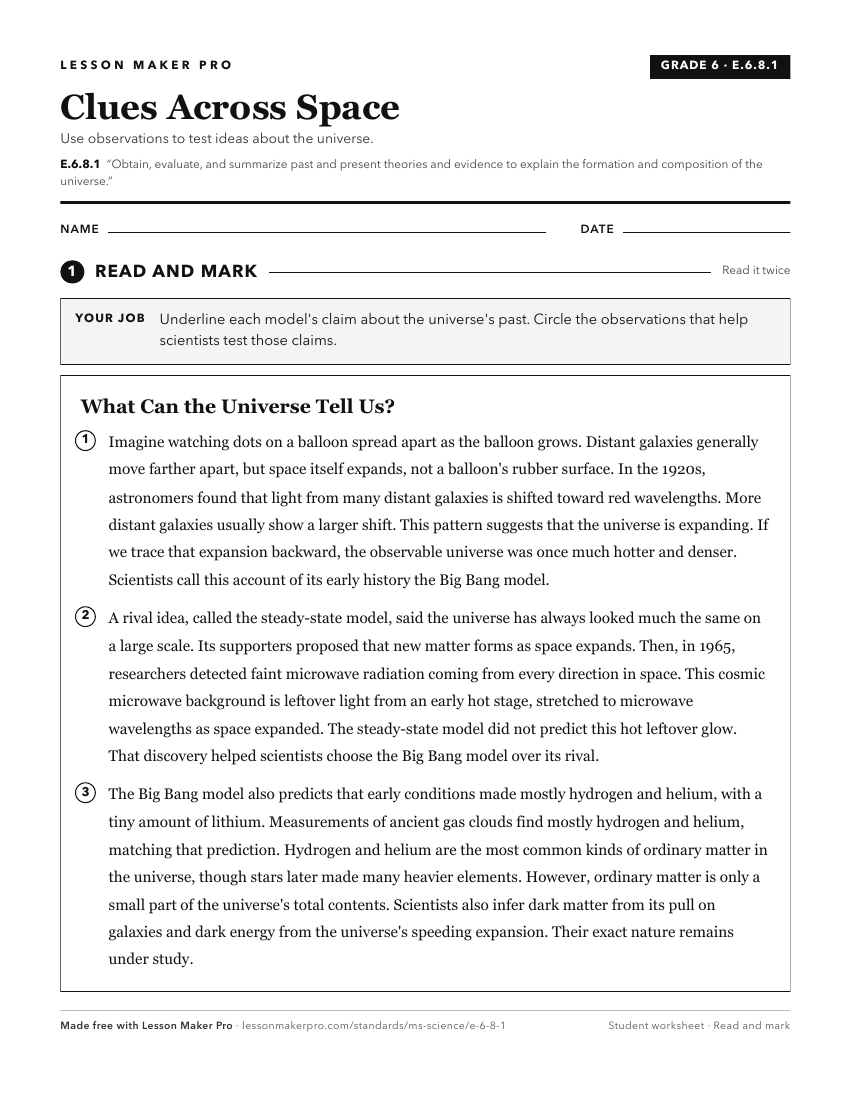
A ready-to-print activity worksheet aligned to E.6.8.1, with an answer key for the teacher on its own page. No account needed.
PDF, US Letter, prints cleanly in black and white.
Download the worksheetKeep exploring
Related Standards
- CHE.2.4
Research appropriate sources to evaluate the way absorption and emission spectra are used to study astronomy and the formation of the universe.
- ESS.1B.1
Read and evaluate scientific information for mechanisms/results (e.g., the solar nebular theory) to explain how the solar system was formed. Cite evidence and d...
- PHY.4.10
Enrichment: Research the ways absorption and emission spectra are used to study astronomy and the formation of the universe.
- ESS.1A.1
Describe the Big Bang theory and summarize observations (e.g., cosmic microwave background radiation, Hubble’s law, and redshift caused by the Doppler effect) a...
Turn this exact standard into a lesson
Grade, subject, topic, and the complete standard are prefilled. Create one free, no account needed.
Also for this standard:Make a WorksheetMake a QuizMake a Sub Lesson