Mississippi Science ESS.1A.1
The Standard
- ESS.1A
- Students will develop an understanding of the universe, its development, immense size, and composition.
Describe the Big Bang theory and summarize observations (e.g., cosmic microwave background radiation, Hubble’s law, and redshift caused by the Doppler effect) as evidence to support the formation and expansion of the universe.
2026 Mississippi College- and Career-Readiness Standards for Science · Earth in the Universe
Teacher's field guide
What This Standard Means
What Students Need to Do
- Students describe a universe that began hot and dense and has expanded over time. They use galaxy redshift, the link between distance and recession speed, and microwave radiation across the sky as evidence.
What Mastery Looks Like
- A student can explain why more distant galaxies generally show greater redshift. They can identify the cosmic microwave background as leftover radiation from the early universe.
Common Misconceptions
- Students may picture the Big Bang as an explosion into empty space from one spot. They may think redshift means a galaxy looks red, rather than its spectral lines shifting toward longer wavelengths.
How to Assess It
- Exit ticket: Two galaxies show different redshifts, and faint microwave radiation comes from every direction. Which galaxy is likely farther away, and what does the radiation tell us about the early universe?
Lesson moves
Ways to Teach It
Mark four dots on a balloon, measure gaps with string, inflate it, then measure the gaps again.
Ask: Why does microwave radiation from every direction fit a hot early universe better than light from one nearby star?
Give students cards with galaxy distances and redshifts; have them rank recession speeds and explain their choices.
Compare printed galaxy and lab hydrogen spectra, then mark the shifted lines astronomers use to estimate recession.
Free download
Printable ESS.1A.1 Worksheet
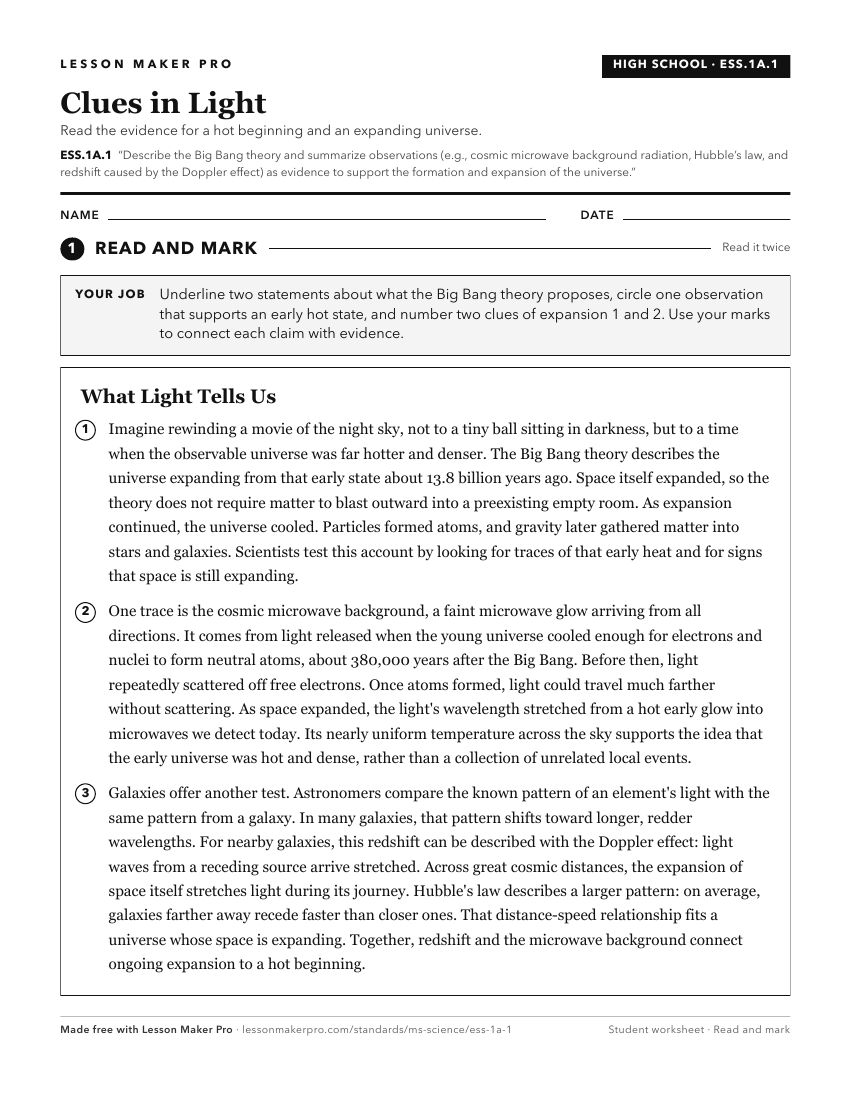
A ready-to-print activity worksheet aligned to ESS.1A.1, with an answer key for the teacher on its own page. No account needed.
PDF, US Letter, prints cleanly in black and white.
Download the worksheetKeep exploring
Related Standards
- ESS.1A
Students will develop an understanding of the universe, its development, immense size, and composition.
- CHE.2.4
Research appropriate sources to evaluate the way absorption and emission spectra are used to study astronomy and the formation of the universe.
- PHY.4.10
Enrichment: Research the ways absorption and emission spectra are used to study astronomy and the formation of the universe.
- E.6.8.1
Obtain, evaluate, and summarize past and present theories and evidence to explain the formation and composition of the universe.
Turn this exact standard into a lesson
Grade, subject, topic, and the complete standard are prefilled. Create one free, no account needed.
Also for this standard:Make a WorksheetMake a QuizMake a Sub Lesson