Mississippi Science CHE.2.4
The Standard
- CHE.2
- Students will demonstrate an understanding of the atomic structure and the historical developments leading to modern atomic theory.
Research appropriate sources to evaluate the way absorption and emission spectra are used to study astronomy and the formation of the universe.
2026 Mississippi College- and Career-Readiness Standards for Science · Atomic Theory
Teacher's field guide
What This Standard Means
What Students Need to Do
- Find reliable sources about light from stars and galaxies. Explain how dark absorption lines and bright emission lines help identify elements. Use shifts in those lines as evidence for cosmic expansion and clues to the early universe.
What Mastery Looks Like
- Given a spectrum and reference lines, students identify an element by matching line positions. They explain how redshift across many galaxies supports an expanding universe. They cite a science source and separate what astronomers observe from what they conclude.
Common Misconceptions
- Students may think dark lines mean an element is absent, rather than absorbing light at certain wavelengths. They may think redshift means a galaxy looks red, or that one spectrum reveals exactly how the universe began.
How to Assess It
- Give students printed hydrogen line references, a redshifted galaxy spectrum, and short explanations from NASA and an unsigned blog. Ask them to match a line, explain its shift, and choose which explanation to cite and why.
Lesson moves
Ways to Teach It
View an incandescent bulb and a fluorescent lamp through diffraction gratings; sketch their patterns, then compare them with printed absorption lines.
Compare a NASA explanation of galaxy redshift with an unsigned blog post; write which claims the evidence supports and which source you would cite.
Give pairs printed hydrogen, helium, and star spectra; have them match line positions and label dark and bright lines.
Use a Sloan Digital Sky Survey galaxy spectrum and a laboratory hydrogen spectrum; mark a shifted line and explain what it suggests.
Free download
Printable CHE.2.4 Worksheet
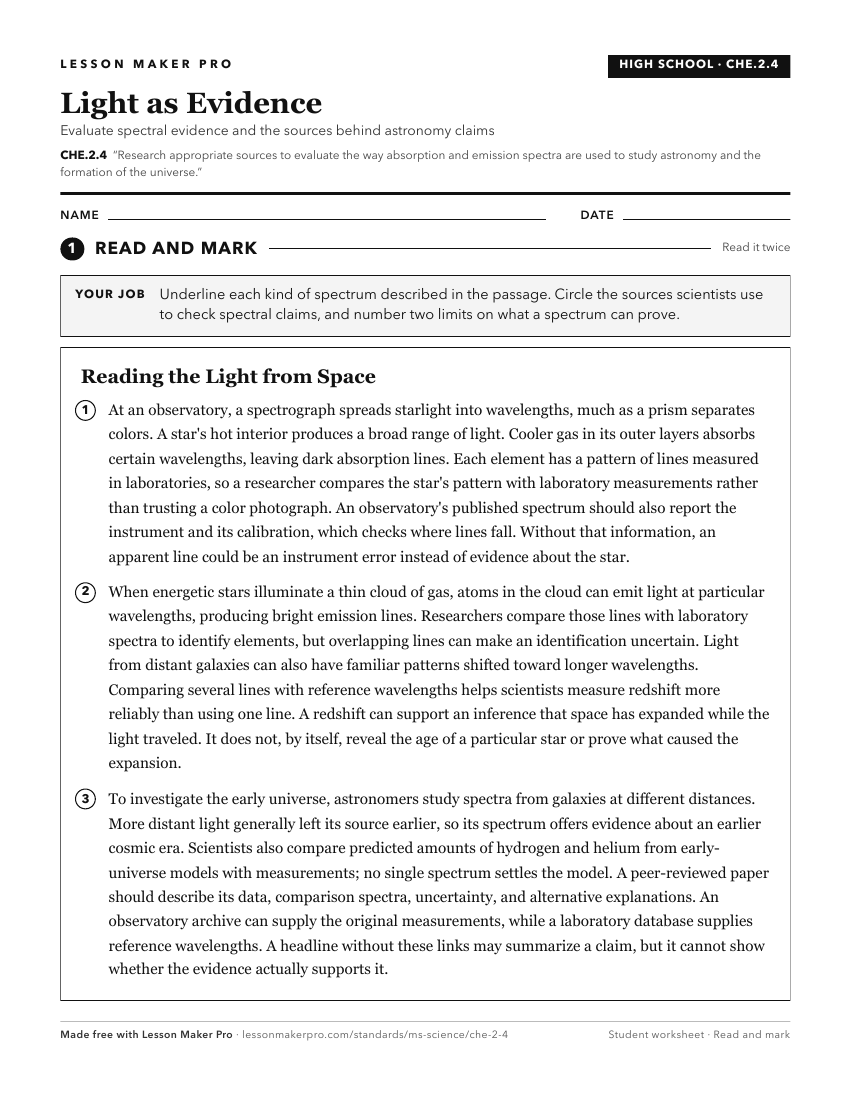
A ready-to-print activity worksheet aligned to CHE.2.4, with an answer key for the teacher on its own page. No account needed.
PDF, US Letter, prints cleanly in black and white.
Download the worksheetKeep exploring
Related Standards
- PHY.4.10
Enrichment: Research the ways absorption and emission spectra are used to study astronomy and the formation of the universe.
- CHE.2.3
Investigate absorption and emission spectra to interpret explanations of electrons at discrete energy levels using tools such as online simulations, spectromete...
- ESS.1A.1
Describe the Big Bang theory and summarize observations (e.g., cosmic microwave background radiation, Hubble’s law, and redshift caused by the Doppler effect) a...
- E.6.8.1
Obtain, evaluate, and summarize past and present theories and evidence to explain the formation and composition of the universe.
Turn this exact standard into a lesson
Grade, subject, topic, and the complete standard are prefilled. Create one free, no account needed.
Also for this standard:Make a WorksheetMake a QuizMake a Sub Lesson