Mississippi Science CHE.2.3
The Standard
- CHE.2
- Students will demonstrate an understanding of the atomic structure and the historical developments leading to modern atomic theory.
Investigate absorption and emission spectra to interpret explanations of electrons at discrete energy levels using tools such as online simulations, spectrometers, prisms, flame tests, and discharge tubes. Explore both laboratory experiments and real-world examples.
2026 Mississippi College- and Career-Readiness Standards for Science · Atomic Theory
Teacher's field guide
What This Standard Means
What Students Need to Do
- Students observe or model light from atoms and record the bright lines in an emission spectrum. They match dark absorption lines to the same wavelengths and connect both patterns to electrons moving between fixed energy levels.
What Mastery Looks Like
- Given an energy-level diagram, students show that absorption moves an electron up and emission moves it down. They explain why a larger energy change produces shorter-wavelength light and why elements have different line patterns.
Common Misconceptions
- Students may think electrons emit light when they move to a higher level. They may mistake spectral lines for electron paths or expect every atom to produce a full rainbow.
How to Assess It
- Show bright hydrogen emission lines at 486 and 656 nm beside dark absorption lines at those wavelengths. Ask which electron movement produces each pattern and which line represents the larger energy change.
Lesson moves
Ways to Teach It
Give pairs printed hydrogen emission and absorption strips; have them align matching lines with a ruler and label the electron movement for each.
Ask: Why does a hydrogen lamp show separate colored lines instead of a full rainbow? Have students explain using electron energy levels.
Give groups energy-level diagrams and red and blue photon cards; have them match cards to transitions and defend their choices.
Give students printed solar absorption and hydrogen emission spectra; have them mark matching lines to find evidence of hydrogen in the Sun's atmosphere.
Free download
Printable CHE.2.3 Worksheet
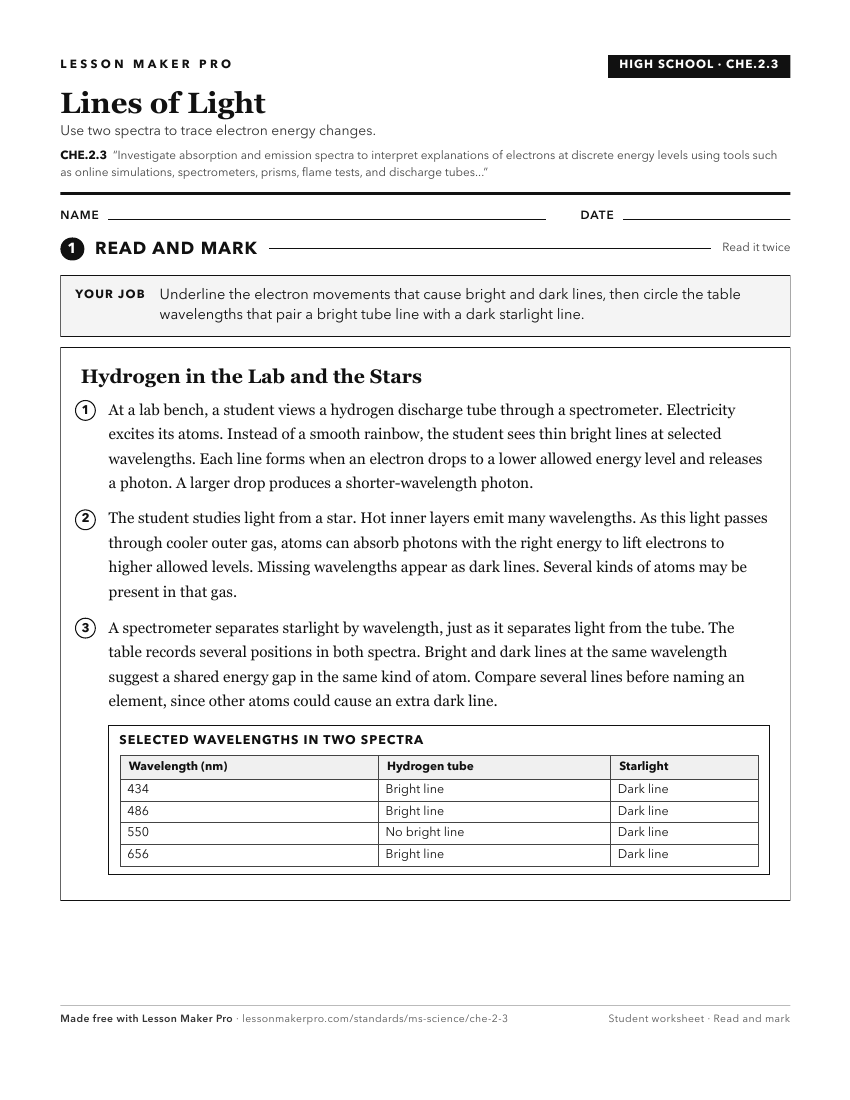
A ready-to-print activity worksheet aligned to CHE.2.3, with an answer key for the teacher on its own page. No account needed.
PDF, US Letter, prints cleanly in black and white.
Download the worksheetKeep exploring
Related Standards
- CHE.2.4
Research appropriate sources to evaluate the way absorption and emission spectra are used to study astronomy and the formation of the universe.
- PHY.4.10
Enrichment: Research the ways absorption and emission spectra are used to study astronomy and the formation of the universe.
- CHE.2.1
Investigate the historical progression leading to the modern atomic theory, including, but not limited to, work done by Dalton, Rutherford’s gold foil experimen...
- PHS.6.6
Research real-world applications to create models or visible representations of the electromagnetic spectrum, including visible light, infrared radiation, and u...
Turn this exact standard into a lesson
Grade, subject, topic, and the complete standard are prefilled. Create one free, no account needed.
Also for this standard:Make a WorksheetMake a QuizMake a Sub Lesson