Mississippi Science CHE.2.1
The Standard
- CHE.2
- Students will demonstrate an understanding of the atomic structure and the historical developments leading to modern atomic theory.
Investigate the historical progression leading to the modern atomic theory, including, but not limited to, work done by Dalton, Rutherford’s gold foil experiment, Thomson’s cathode ray experiment, Millikan’s oil drop experiment, and Bohr’s interpretation of bright line spectra.
2026 Mississippi College- and Career-Readiness Standards for Science · Atomic Theory
Teacher's field guide
What This Standard Means
What Students Need to Do
- Students trace how evidence changed ideas about atoms. They explain what fixed mass ratios, cathode rays, oil drops, gold foil, and bright line spectra showed.
What Mastery Looks Like
- Students can explain how fixed mass ratios supported Dalton’s atoms and how cathode rays revealed electrons. They link oil drops to electron charge and gold foil scattering to a small, dense, positive nucleus. They explain why bright line spectra led Bohr to propose fixed electron energy levels.
Common Misconceptions
- Students may say most particles bounced back in the gold foil experiment, when most passed through. They may say Millikan discovered the electron rather than measured its charge. Some treat Bohr’s electron paths as a complete picture of the atom.
How to Assess It
- Give students three cards labeled cathode rays, gold foil, and bright line spectra. Ask them to put the cards in order and write the new idea each result supported.
Lesson moves
Ways to Teach It
Give pairs index cards naming each scientist, observation, and model change; have them build a timeline and connect matching cards with string.
Ask pairs, 'Why did cathode ray evidence challenge Dalton’s model?' Have them cite one observation in a written answer.
Play four-corner review: label corners electron, nucleus, electron charge, and energy levels; read experiment results and have students move and explain their choices.
Show a photo of a neon sign beside its emission spectrum; ask students to connect the bright lines to electron energy changes.
Free download
Printable CHE.2.1 Worksheet
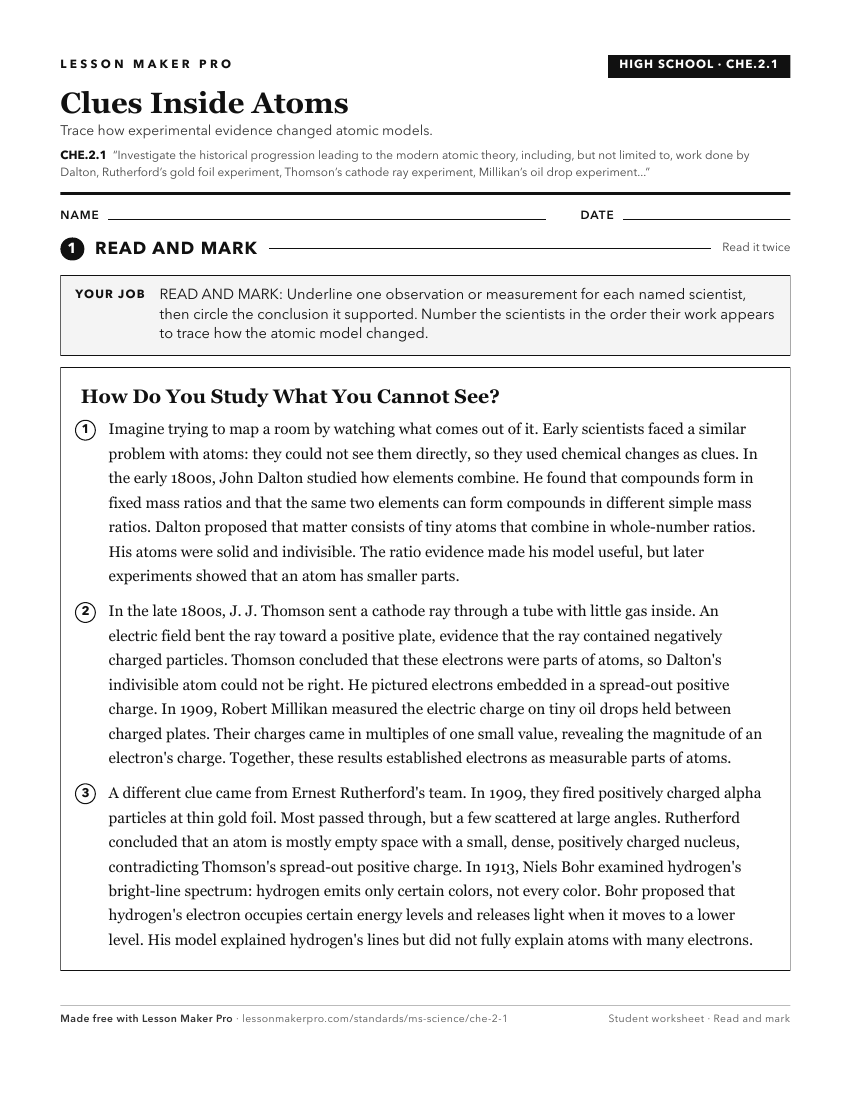
A ready-to-print activity worksheet aligned to CHE.2.1, with an answer key for the teacher on its own page. No account needed.
PDF, US Letter, prints cleanly in black and white.
Download the worksheetKeep exploring
Related Standards
- PHS.2
Students will demonstrate an understanding of both modern and historical theories of atomic structure.
- CHE.2.3
Investigate absorption and emission spectra to interpret explanations of electrons at discrete energy levels using tools such as online simulations, spectromete...
- CHE.2
Students will demonstrate an understanding of the atomic structure and the historical developments leading to modern atomic theory.
- PHS.2.1
Research and develop models (e.g., 3-D models, online simulations, or ball and stick) to investigate both modern and historical theories of atomic structure. Co...
Turn this exact standard into a lesson
Grade, subject, topic, and the complete standard are prefilled. Create one free, no account needed.
Also for this standard:Make a WorksheetMake a QuizMake a Sub Lesson