Mississippi Science PHS.2
Standard Cluster
Students will demonstrate an understanding of both modern and historical theories of atomic structure. Research and develop models (e.g., 3-D models, online simulations, or ball and stick) to investigate both modern and historical theories of atomic structure. Compare models and contributions of Dalton, Thomson, Rutherford, Bohr, and of modern atomic theory.
2026 Mississippi College- and Career-Readiness Standards for Science · Atomic Theory
Cluster contents
Standards in This Cluster
PHS.2 is a cluster heading. These are the individual standards under it.
Teacher's field guide
What This Cluster Means
What Students Need to Do
- Students use short readings to build models of the atom, from Dalton’s model to the electron-cloud model. They compare what each model shows and explain what evidence led scientists to revise earlier models.
What Mastery Looks Like
- Given five unlabeled diagrams, students can name and order the models. They can explain why evidence for a nucleus changed Thomson’s model and why the modern model does not show electrons on fixed paths.
Common Misconceptions
- Students often draw electrons as tiny planets on fixed paths, even in a modern model. They may think older models were useless, rather than explanations that changed when scientists found new evidence.
How to Assess It
- Give students five unlabeled atom sketches, one for each model. Ask them to name and order the models, then explain why the electron-cloud sketch has no fixed electron paths.
Lesson moves
Ways to Teach It
Use five paper circles, beads, pencil dots, and string to build Dalton, Thomson, Rutherford, Bohr, and electron-cloud models.
Read textbook summaries of Thomson’s and Rutherford’s experiments, then write why Rutherford rejected Thomson’s model.
Match five scientist cards with model sketches and evidence cards, then explain any pair that does not fit.
Examine a neon sign photo and explain how electron energy changes produce light, without claiming electrons travel in fixed rings.
Free download
Printable PHS.2 Worksheet
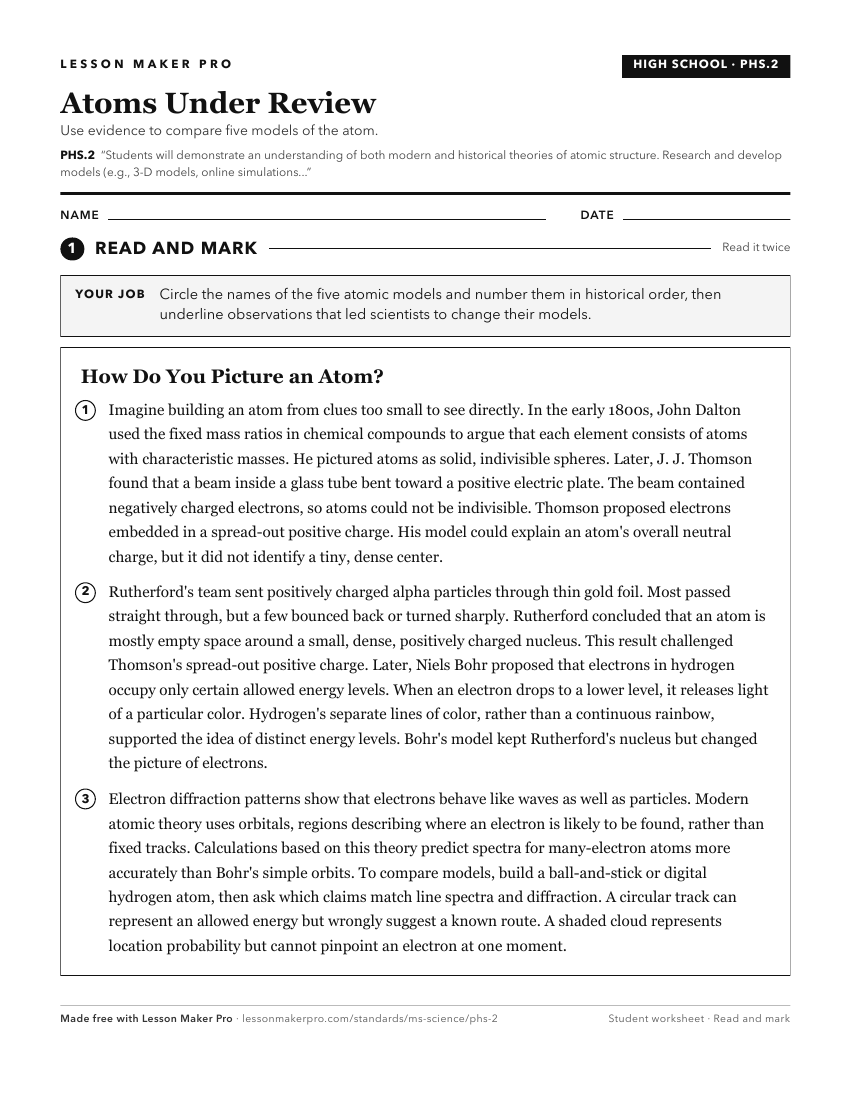
A ready-to-print activity worksheet aligned to PHS.2, with an answer key for the teacher on its own page. No account needed.
PDF, US Letter, prints cleanly in black and white.
Download the worksheetKeep exploring
Related Standards
- PHY.6
Students will demonstrate an understanding of the basic principles of nuclear energy.
- CHE.4
Students will demonstrate an understanding of the types of bonds and resulting atomic structures for the classification of chemical compounds.
- CHE.2
Students will demonstrate an understanding of the atomic structure and the historical developments leading to modern atomic theory.
Turn this cluster into a lesson
Grade, subject, topic, and the complete cluster are prefilled. Create one free, no account needed.
Also for this cluster:Make a WorksheetMake a QuizMake a Sub Lesson