Mississippi Science CHE.4
Standard Cluster
Students will demonstrate an understanding of the types of bonds and resulting atomic structures for the classification of chemical compounds. Develop and use models (e.g., Lewis dot, 3-D ball-stick, 3-D printing, or simulation programs such as PhET) to predict the type of bonding between atoms and the shape of simple compounds. Use models such as Lewis structures and ball and stick models to depict the valence electrons and their role in the formation of ionic and covalent bonds. Predict the ionic or covalent nature of different atoms based on electronegativity trends and/or position on the periodic table. Use models and oxidation numbers to predict the type of bond, shape of the compound, and the polarity of the compound. Use models of simple hydrocarbons to exemplify structural isomerism. Use mathematical and computational analysis to determine the empirical formula and the percent composition of compounds. Use scientific investigation to determine the percentage of composition for a substance (e.g., sugar in gum, water and/or unpopped kernels in popcorn, percent water in a hydrate). Compare results to justify conclusions based on experimental evidence. Plan and conduct controlled scientific investigations to produce mathematical evidence of the empirical composition of a compound.
2026 Mississippi College- and Career-Readiness Standards for Science · Bonding
Cluster contents
Standards in This Cluster
CHE.4 is a cluster heading. These are the individual standards under it.
- CHE.4.1
Develop and use models (e.g., Lewis dot, 3-D ball-stick, 3-D printing, or simulation programs such as PhET) to predict the type of bonding between atoms and the...
- CHE.4.2
Use models such as Lewis structures and ball and stick models to depict the valence electrons and their role in the formation of ionic and covalent bonds.
- CHE.4.3
Predict the ionic or covalent nature of different atoms based on electronegativity trends and/or position on the periodic table.
- CHE.4.4
Use models and oxidation numbers to predict the type of bond, shape of the compound, and the polarity of the compound.
- CHE.4.5
Use models of simple hydrocarbons to exemplify structural isomerism.
- CHE.4.6
Use mathematical and computational analysis to determine the empirical formula and the percent composition of compounds.
- CHE.4.7
Use scientific investigation to determine the percentage of composition for a substance (e.g., sugar in gum, water and/or unpopped kernels in popcorn, percent w...
- CHE.4.8
Plan and conduct controlled scientific investigations to produce mathematical evidence of the empirical composition of a compound.
Teacher's field guide
What This Cluster Means
What Students Need to Do
- Students use periodic table patterns and electronegativity to predict bond types. They draw electron-dot diagrams and build models to show bonding, shape, polarity, and different structures with the same formula. They use mass data to calculate empirical formulas and percent composition.
What Mastery Looks Like
- A student can show electron transfer in NaCl and shared electrons in H2O. They can explain why water is bent and polar, and build two different structures for C4H10. They can use measured masses to calculate percent composition and a simplest whole-number formula.
Common Misconceptions
- Students may draw an ionic bond as a shared pair of electrons or assume every covalent molecule is nonpolar. They may miss lone pairs when predicting shape. They may use mass percentages as mole ratios or assume one formula can have only one structure.
How to Assess It
- Exit ticket: Using H = 1 and O = 16, draw H2O's Lewis structure, label its bond type, shape, and polarity, and calculate oxygen's mass percentage.
Lesson moves
Ways to Teach It
Give students four carbon balls, ten hydrogen balls, and sticks; have them build and sketch both structures of C4H10.
Ask students to draw what happens to valence electrons in NaCl and H2O, then explain the difference to a partner.
Hand out NaCl, MgO, CO2, and H2O cards; students race to draw Lewis diagrams and sort the compounds by bond type.
Weigh popcorn kernels before and after popping them in a covered pan, then estimate water content from the mass lost.
Free download
Printable CHE.4 Worksheet
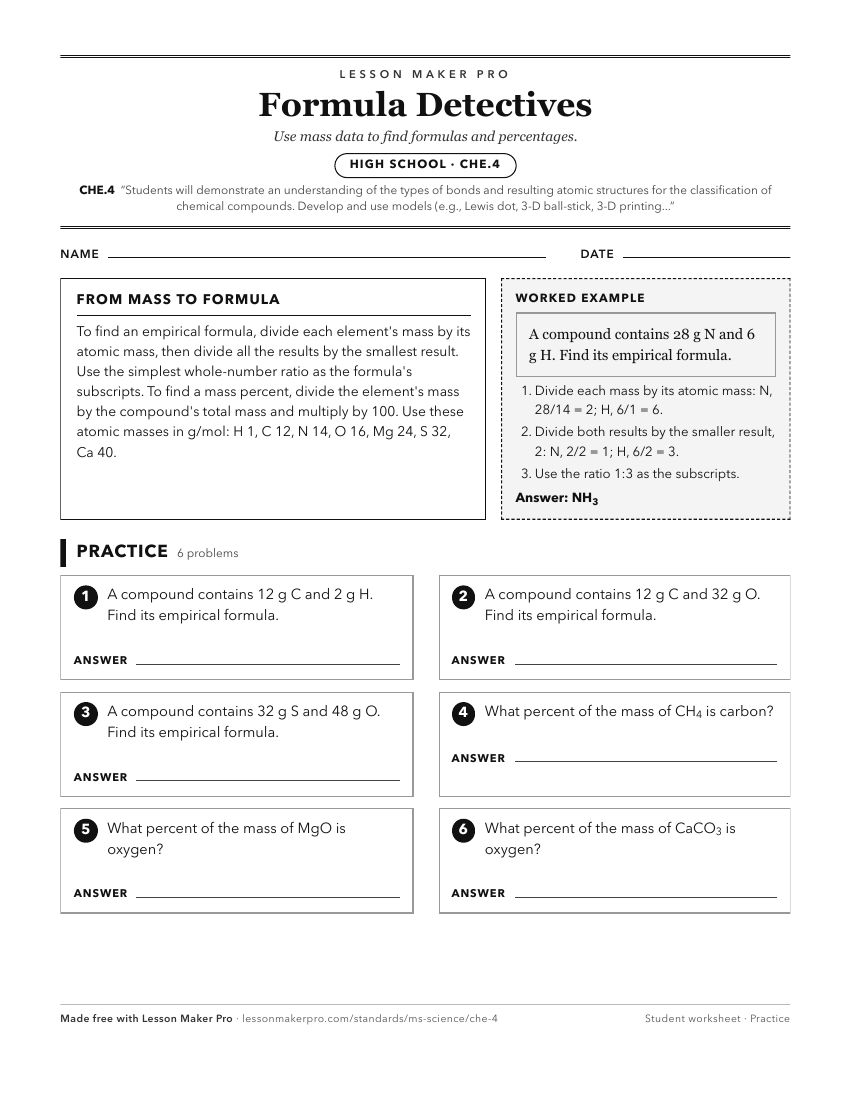
A ready-to-print activity worksheet aligned to CHE.4, with an answer key for the teacher on its own page. No account needed.
PDF, US Letter, prints cleanly in black and white.
Download the worksheetKeep exploring
Related Standards
- PHS.2
Students will demonstrate an understanding of both modern and historical theories of atomic structure.
- CHE.5
Students will investigate and understand the accepted nomenclature used to identify the name and chemical formulas of compounds.
- P.7.5D
Students will demonstrate an understanding of chemical formulas and common chemical substances to predict the types of reactions and possible outcomes of the re...
- CHE.6
Students will demonstrate an understanding of the types, causes, and effects of chemical reactions.
Turn this cluster into a lesson
Grade, subject, topic, and the complete cluster are prefilled. Create one free, no account needed.
Also for this cluster:Make a WorksheetMake a QuizMake a Sub Lesson