Mississippi Science CHE.4.1
The Standard
- CHE.4
- Students will demonstrate an understanding of the types of bonds and resulting atomic structures for the classification of chemical compounds.
Develop and use models (e.g., Lewis dot, 3-D ball-stick, 3-D printing, or simulation programs such as PhET) to predict the type of bonding between atoms and the shape of simple compounds.
2026 Mississippi College- and Career-Readiness Standards for Science · Bonding
Teacher's field guide
What This Standard Means
What Students Need to Do
- Students use Lewis dots to show whether atoms transfer or share electrons. They build 3-D models of simple molecules and use bonds and lone pairs to predict their shapes.
What Mastery Looks Like
- Students classify NaCl as ionic, Mg as metallic, and H2O and CO2 as covalent. Their diagrams show two lone pairs on water’s oxygen and double bonds in CO2. Their models show bent water and linear CO2.
Common Misconceptions
- Students may draw NaCl as a single molecule instead of part of an ionic lattice. They may make H2O linear because they leave out the lone pairs on oxygen. Some mistake shared electrons for transferred electrons.
How to Assess It
- Exit ticket: Classify NaCl and H2O by bond type. Draw H2O’s Lewis diagram, sketch its 3-D shape, and label what makes it bent.
Lesson moves
Ways to Teach It
Build H2O and CO2 with gumdrops and toothpicks; use two sticks for double bonds and pipe-cleaner loops for lone pairs.
Ask: Why is CO2 linear while H2O is bent? Have students support their answers with labeled Lewis diagrams.
Sort cards labeled NaCl, Mg, H2O, and CO2 by bond type; then sketch shapes for the molecules.
Place a salt packet beside a water bottle; ask students to sketch NaCl as an ionic lattice and H2O as a bent molecule.
Free download
Printable CHE.4.1 Worksheet
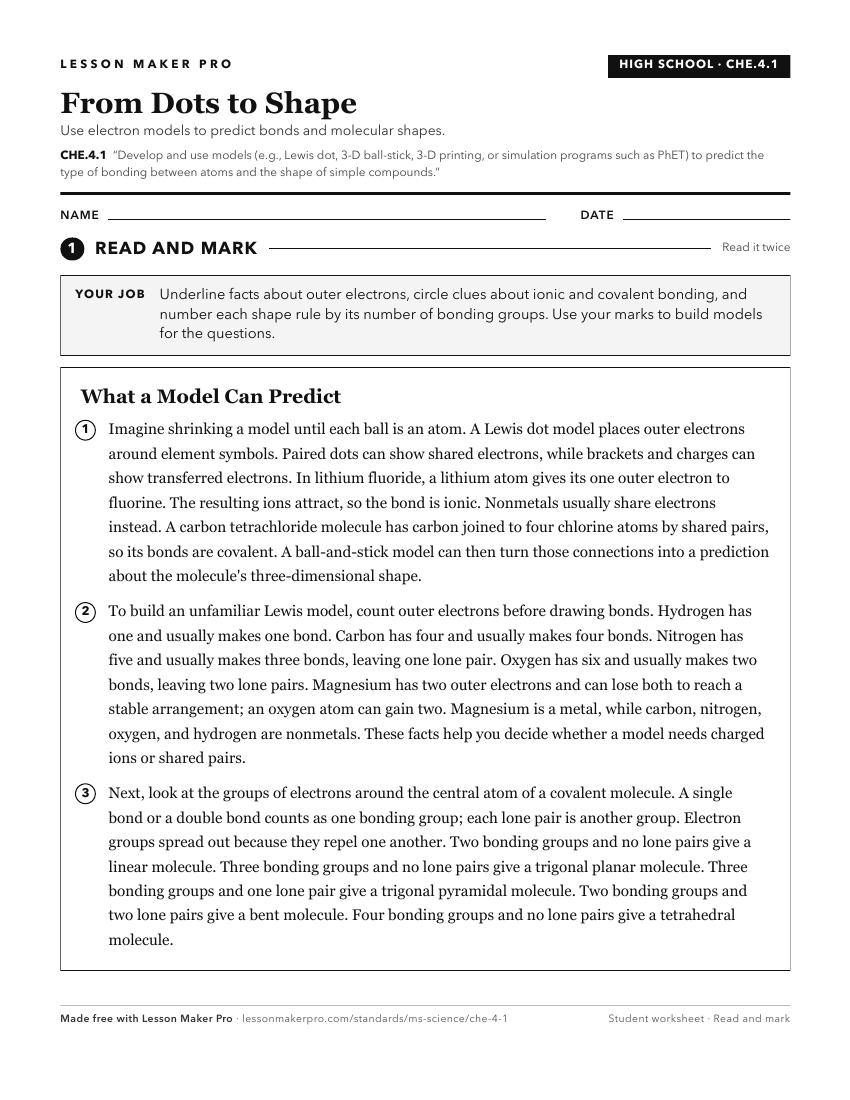
A ready-to-print activity worksheet aligned to CHE.4.1, with an answer key for the teacher on its own page. No account needed.
PDF, US Letter, prints cleanly in black and white.
Download the worksheetKeep exploring
Related Standards
- FB.2.1
Develop and use simple atomic models to describe the components of elements (e.g., relative position, charges of protons, neutrons, and electrons).
- P.7.5C.1
Develop and use models that explain the structure of an atom.
- CHE.4.2
Use models such as Lewis structures and ball and stick models to depict the valence electrons and their role in the formation of ionic and covalent bonds.
- CHE.4.4
Use models and oxidation numbers to predict the type of bond, shape of the compound, and the polarity of the compound.
Turn this exact standard into a lesson
Grade, subject, topic, and the complete standard are prefilled. Create one free, no account needed.
Also for this standard:Make a WorksheetMake a QuizMake a Sub Lesson