Mississippi Science P.7.5C.1
The Standard
- P.7.5C
- Students will demonstrate an understanding of the proper use of the periodic table to predict and identify elemental properties and how elements interact.
Develop and use models that explain the structure of an atom.
2026 Mississippi College- and Career-Readiness Standards for Science · Organization of Matter and Chemical Interactions
Teacher's field guide
What This Standard Means
What Students Need to Do
- Students build and draw atoms with protons and neutrons in the nucleus and electrons outside it. They use their models to explain where most of an atom's mass is and how its particles affect its charge.
What Mastery Looks Like
- A student can place and label each particle in an atom model. They can explain why an atom with equal numbers of protons and electrons has no overall charge.
Common Misconceptions
- Students may put electrons in the nucleus or think neutrons have a negative charge. Some draw the particles packed together, leaving no empty space in the atom.
How to Assess It
- Ask students to draw an atom with 3 protons, 4 neutrons, and 3 electrons. Have them circle the nucleus and explain why the atom has no overall charge.
Lesson moves
Ways to Teach It
Give pairs three colors of counters to build an atom with 3 protons, 4 neutrons, and 3 electrons, then label each part.
Show sketches with electrons inside and outside the nucleus; ask, 'Which model better shows an atom, and why?'
Give pairs cards with particle counts and three atom diagrams; have them match each card to the correct diagram.
Use a helium balloon and periodic table card to sketch a neutral helium atom with two protons in its nucleus and two electrons outside.
Free download
Printable P.7.5C.1 Worksheet
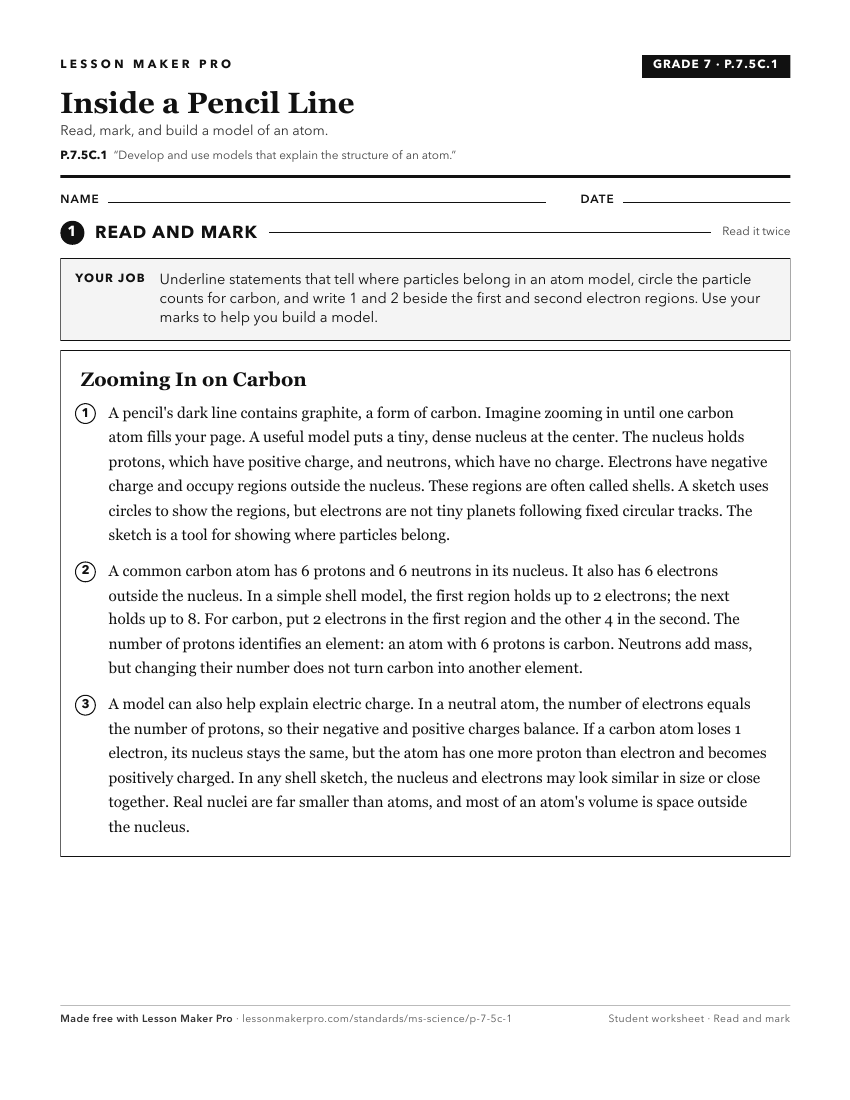
A ready-to-print activity worksheet aligned to P.7.5C.1, with an answer key for the teacher on its own page. No account needed.
PDF, US Letter, prints cleanly in black and white.
Download the worksheetKeep exploring
Related Standards
- CHE.4.1
Develop and use models (e.g., Lewis dot, 3-D ball-stick, 3-D printing, or simulation programs such as PhET) to predict the type of bonding between atoms and the...
- FB.2.1
Develop and use simple atomic models to describe the components of elements (e.g., relative position, charges of protons, neutrons, and electrons).
- BIO.1C.1
Develop and use models to explore how specialized structures within cells (e.g., nucleus, cytoskeleton, endoplasmic reticulum, ribosomes, Golgi apparatus, lysos...
- PHS.2.1
Research and develop models (e.g., 3-D models, online simulations, or ball and stick) to investigate both modern and historical theories of atomic structure. Co...
Turn this exact standard into a lesson
Grade, subject, topic, and the complete standard are prefilled. Create one free, no account needed.
Also for this standard:Make a WorksheetMake a QuizMake a Sub Lesson