Mississippi Science CHE.4.2
The Standard
- CHE.4
- Students will demonstrate an understanding of the types of bonds and resulting atomic structures for the classification of chemical compounds.
Use models such as Lewis structures and ball and stick models to depict the valence electrons and their role in the formation of ionic and covalent bonds.
2026 Mississippi College- and Career-Readiness Standards for Science · Bonding
Teacher's field guide
What This Standard Means
What Students Need to Do
- Students use the periodic table to find an atom's valence electrons. They draw Lewis structures to show electrons moving between atoms or being shared, then use ball-and-stick models to show which atoms are connected.
What Mastery Looks Like
- A student draws Na⁺ and Cl⁻ with eight dots around Cl, and H2O with two bonds and two lone pairs on oxygen. They explain that Na transfers an electron to Cl, while oxygen and hydrogen share electrons.
Common Misconceptions
- Students may draw all of an atom's electrons instead of just its valence electrons. They may show NaCl sharing electrons or leave oxygen's lone pairs out of H2O.
How to Assess It
- On an exit ticket, draw Lewis structures for NaCl and H2O. Mark the ion charges in NaCl and circle the shared electron pairs in H2O.
Lesson moves
Ways to Teach It
Give pairs Na and Cl cards with one and seven counters; move Na's counter to Cl, then draw the charged ions.
Show a clay-and-toothpick H2O model beside its Lewis drawing; ask, 'Which electrons does the Lewis drawing show that the model leaves out?'
Deal formula cards for NaCl, MgO, H2O, and Cl2; students race to draw Lewis structures and mark electrons transferred or shared.
Put table salt and water on the desk; students sketch NaCl ions and H2O molecules, then explain electron transfer versus sharing.
Free download
Printable CHE.4.2 Worksheet
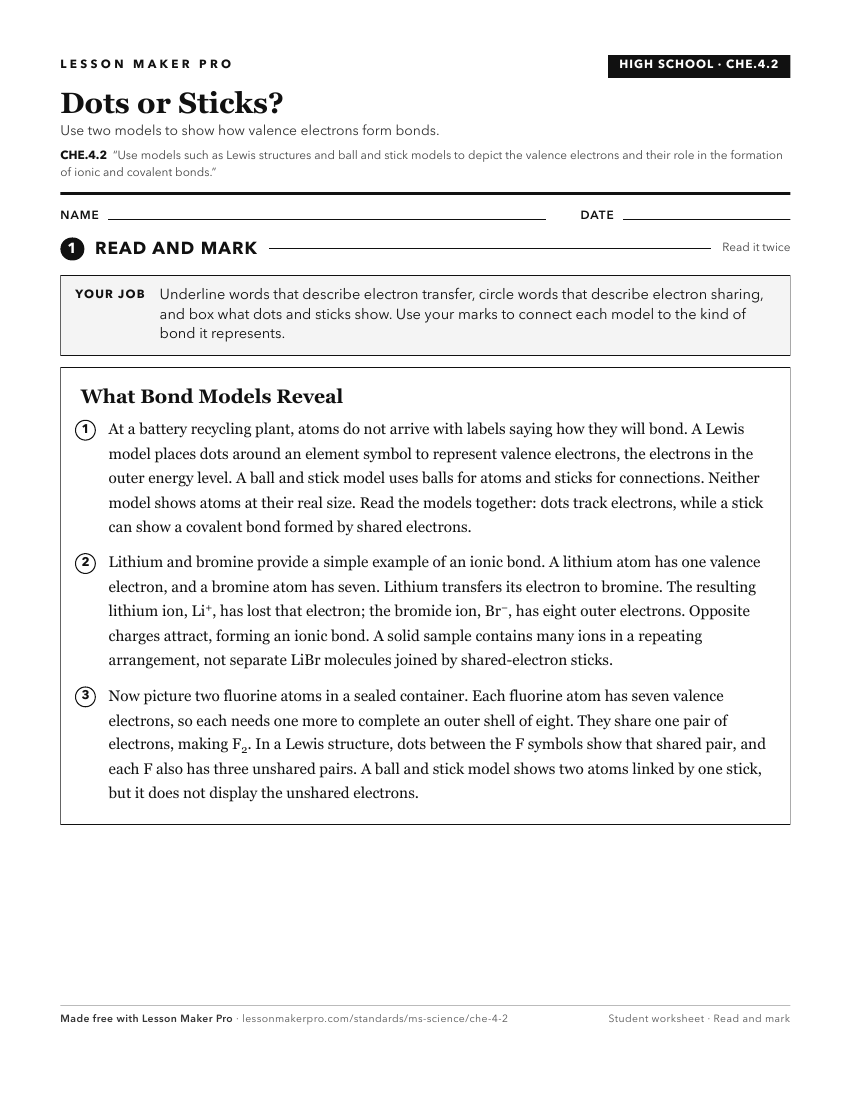
A ready-to-print activity worksheet aligned to CHE.4.2, with an answer key for the teacher on its own page. No account needed.
PDF, US Letter, prints cleanly in black and white.
Download the worksheetKeep exploring
Related Standards
- CHE.4.1
Develop and use models (e.g., Lewis dot, 3-D ball-stick, 3-D printing, or simulation programs such as PhET) to predict the type of bonding between atoms and the...
- P.7.5C.6
Using the periodic table, make predictions to explain how bonds (ionic and covalent) form between groups of elements (e.g., oxygen gas, ozone, water, table salt...
- CHE.4.4
Use models and oxidation numbers to predict the type of bond, shape of the compound, and the polarity of the compound.
- PHS.3.2
Using the periodic table and scientific methods, investigate the formation of compounds through ionic and covalent bonding.
Turn this exact standard into a lesson
Grade, subject, topic, and the complete standard are prefilled. Create one free, no account needed.
Also for this standard:Make a WorksheetMake a QuizMake a Sub Lesson