Mississippi Science PHS.3.2
The Standard
- PHS.3
- Students will analyze the organization of the periodic table of elements to predict atomic interactions.
Using the periodic table and scientific methods, investigate the formation of compounds through ionic and covalent bonding.
2026 Mississippi College- and Career-Readiness Standards for Science · Periodic Table
Teacher's field guide
What This Standard Means
What Students Need to Do
- Students use the periodic table to predict whether atoms form ions or share electrons when they bond. They draw simple compounds and use conductivity results as evidence about the particles in a solution.
What Mastery Looks Like
- A student predicts MgCl2 from magnesium's two outer electrons and chlorine's need for one. They sketch Mg²⁺ with two Cl⁻ ions, draw shared electron pairs in H2O, and explain why dissolved salt conducts better than dissolved sugar.
Common Misconceptions
- Students may call every bond covalent, even the bond between sodium and chlorine. Some write MgCl instead of MgCl2 because they miss that magnesium loses two electrons. Others expect sugar water to conduct like salt water because both solids dissolve.
How to Assess It
- Exit ticket: Use the periodic table to predict the formula and bond type for magnesium and chlorine. Draw where the outer electrons end up, then explain how bonding in water differs.
Lesson moves
Ways to Teach It
Predict, then test distilled water and separate salt and sugar solutions with a low-voltage conductivity tester; record which lights the bulb.
Show NaCl and H2O electron-dot diagrams; ask students to write where electrons are transferred or shared and why each bond holds.
Play a sorting race with NaCl, MgO, H2O, and CO2 cards; students label bond type and defend each choice using the periodic table.
Show a road-salt bag and a sugar packet; ask which would make a puddle conduct more current after dissolving, and why.
Free download
Printable PHS.3.2 Worksheet
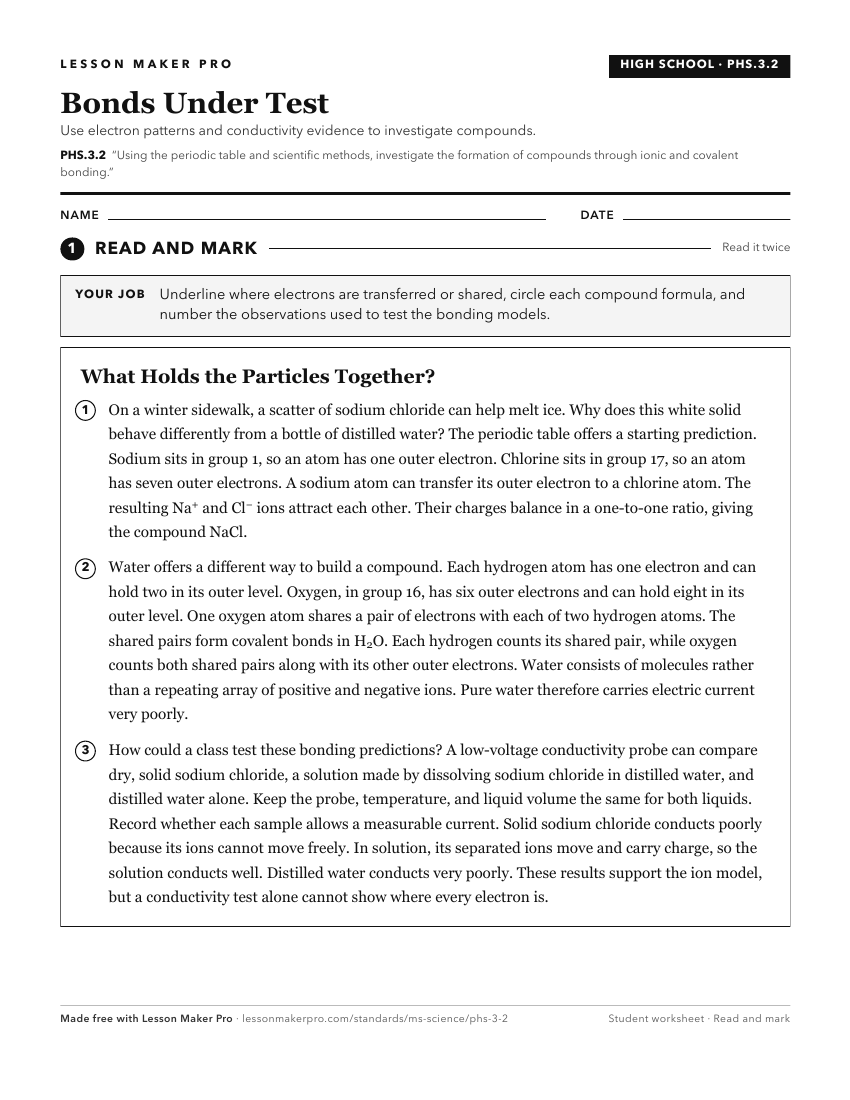
A ready-to-print activity worksheet aligned to PHS.3.2, with an answer key for the teacher on its own page. No account needed.
PDF, US Letter, prints cleanly in black and white.
Download the worksheetKeep exploring
Related Standards
- CHE.4.1
Develop and use models (e.g., Lewis dot, 3-D ball-stick, 3-D printing, or simulation programs such as PhET) to predict the type of bonding between atoms and the...
- CHE.4.2
Use models such as Lewis structures and ball and stick models to depict the valence electrons and their role in the formation of ionic and covalent bonds.
- P.7.5C.6
Using the periodic table, make predictions to explain how bonds (ionic and covalent) form between groups of elements (e.g., oxygen gas, ozone, water, table salt...
- FB.2.3
Relate chemical reactivity to an element’s position on the periodic table. Use this information to determine what type of bond will form between elements (ionic...
Turn this exact standard into a lesson
Grade, subject, topic, and the complete standard are prefilled. Create one free, no account needed.
Also for this standard:Make a WorksheetMake a QuizMake a Sub Lesson