Mississippi Science P.7.5C.6
The Standard
- P.7.5C
- Students will demonstrate an understanding of the proper use of the periodic table to predict and identify elemental properties and how elements interact.
Using the periodic table, make predictions to explain how bonds (ionic and covalent) form between groups of elements (e.g., oxygen gas, ozone, water, table salt, and methane).
2026 Mississippi College- and Career-Readiness Standards for Science · Organization of Matter and Chemical Interactions
Teacher's field guide
What This Standard Means
What Students Need to Do
- Use the periodic table to identify the elements in a formula as metals or nonmetals. Predict whether their atoms transfer or share electrons, then explain how the bond forms.
What Mastery Looks Like
- Given NaCl, H2O, O2, O3, and CH4, students identify ionic bonding in salt and covalent bonding in the others. They explain that sodium and chlorine form oppositely charged ions, while the nonmetals share electrons.
Common Misconceptions
- Some students think any substance with two different elements is ionic, so they mislabel water and methane. Others think oxygen cannot bond to itself, or that ionic bonds involve sharing electrons.
How to Assess It
- Give students a periodic table and ask: “Are the bonds in NaCl and O3 ionic or covalent? For each, name the table clue and say whether electrons transfer or are shared.”
Lesson moves
Ways to Teach It
Give pairs periodic tables and counters to model sodium transferring one electron to chlorine and two hydrogen atoms sharing with oxygen.
Ask partners: “Why does ozone have covalent bonds even though every atom is oxygen?” Have them point to evidence on the periodic table.
Play a five-card sort with O2, O3, H2O, NaCl, and CH4; teams place each under “transfer” or “share” and explain their choices.
Label a salt shaker NaCl and a cup of water H2O; ask students why one contains ions and the other contains molecules.
Free download
Printable P.7.5C.6 Worksheet
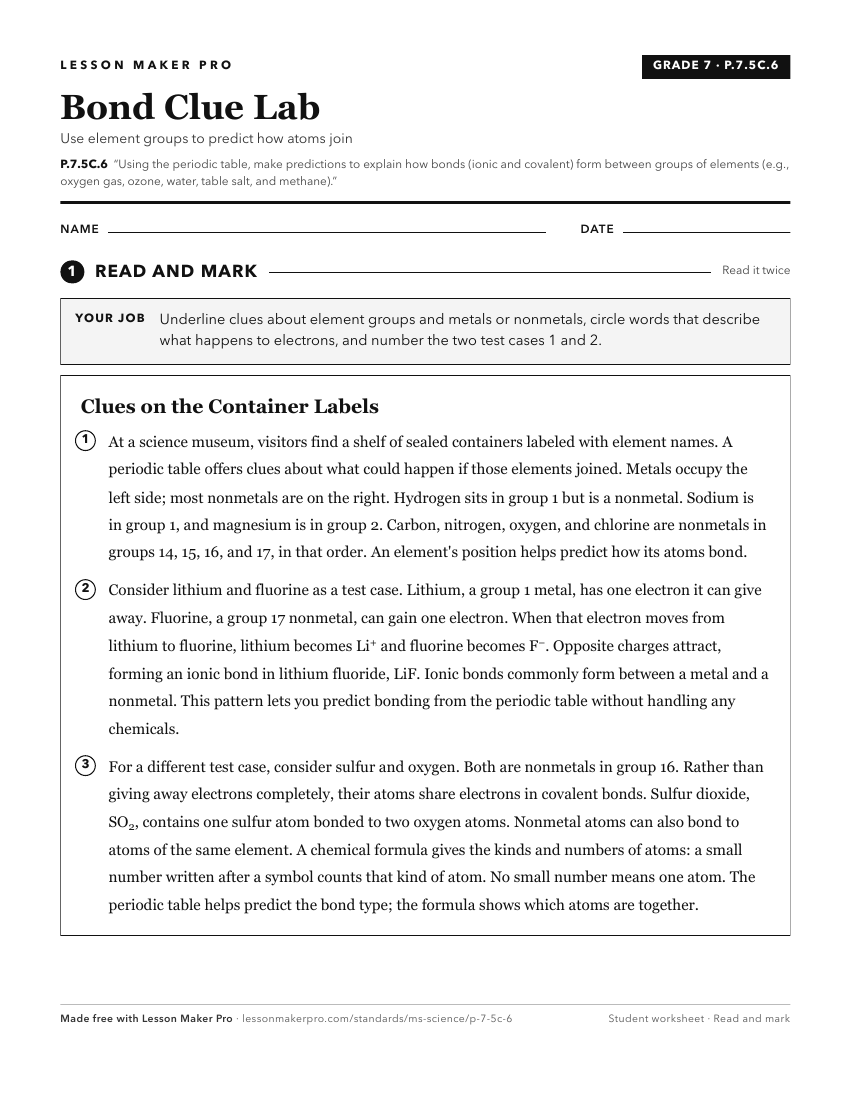
A ready-to-print activity worksheet aligned to P.7.5C.6, with an answer key for the teacher on its own page. No account needed.
PDF, US Letter, prints cleanly in black and white.
Download the worksheetKeep exploring
Related Standards
- P.7.5C.4
Predict the properties and interactions of elements using the periodic table (metals, non-metals, reactivity, and conductors).
- CHE.4.3
Predict the ionic or covalent nature of different atoms based on electronegativity trends and/or position on the periodic table.
- FB.2.3
Relate chemical reactivity to an element’s position on the periodic table. Use this information to determine what type of bond will form between elements (ionic...
- PHS.3.2
Using the periodic table and scientific methods, investigate the formation of compounds through ionic and covalent bonding.
Turn this exact standard into a lesson
Grade, subject, topic, and the complete standard are prefilled. Create one free, no account needed.
Also for this standard:Make a WorksheetMake a QuizMake a Sub Lesson