Mississippi Science P.7.5C.4
The Standard
- P.7.5C
- Students will demonstrate an understanding of the proper use of the periodic table to predict and identify elemental properties and how elements interact.
Predict the properties and interactions of elements using the periodic table (metals, non-metals, reactivity, and conductors).
2026 Mississippi College- and Career-Readiness Standards for Science · Organization of Matter and Chemical Interactions
Teacher's field guide
What This Standard Means
What Students Need to Do
- Students use an element’s place on the periodic table to tell whether it is a metal or nonmetal. They predict whether it conducts electricity and how readily it reacts with other substances.
What Mastery Looks Like
- Given sodium, copper, sulfur, and neon, a student identifies sodium and copper as likely conductors. They predict that sodium reacts with water and neon rarely reacts, using their columns as evidence.
Common Misconceptions
- Students may think elements in the same row have similar reactivity. They may assume all metals react like sodium, or that a good conductor must be highly reactive. They may think no nonmetal conducts, even though graphite, a form of carbon, does.
How to Assess It
- Give students a periodic table and ask: Of sodium, copper, sulfur, and neon, which likely conduct electricity? Which metal is more likely to react with water, and which element is least likely to react? Ask for one location clue for each answer.
Lesson moves
Ways to Teach It
Have pairs place sodium, copper, sulfur, and neon cards on a blank periodic table, then add conductor and reactivity labels.
Ask: Why does sodium react with water while neon does not? Have partners point to the columns that support their predictions.
Play element bingo with cards labeled with element names; call clues about conductivity, metal type, and reactivity.
Show a cutaway photo of a phone charging cable; ask students to use copper’s position to explain its use in wires.
Free download
Printable P.7.5C.4 Worksheet
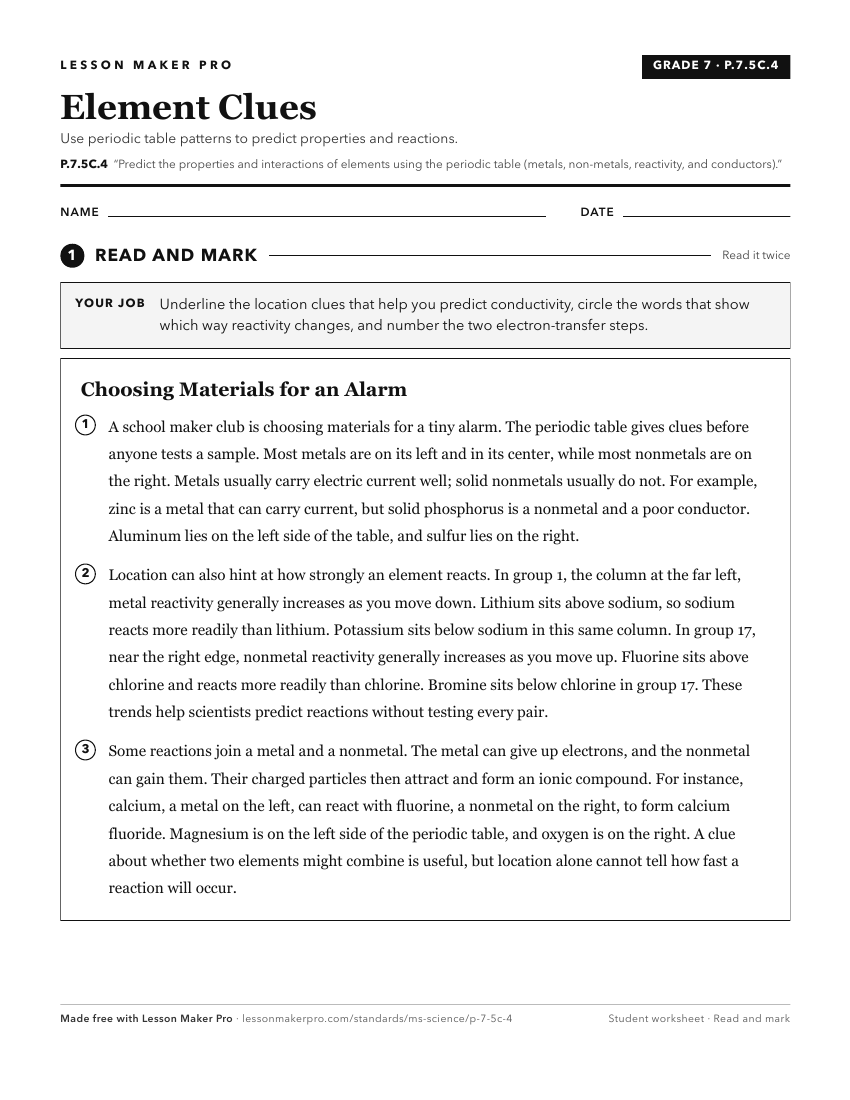
A ready-to-print activity worksheet aligned to P.7.5C.4, with an answer key for the teacher on its own page. No account needed.
PDF, US Letter, prints cleanly in black and white.
Download the worksheetKeep exploring
Related Standards
- CHE.4.3
Predict the ionic or covalent nature of different atoms based on electronegativity trends and/or position on the periodic table.
- CHE.3.2
Analyze properties of atoms and ions (e.g., metal/nonmetal/metalloid behavior, electrical/heat conductivity, electronegativity and electron affinity, ionization...
- PHS.3
Students will analyze the organization of the periodic table of elements to predict atomic interactions.
- P.7.5C
Students will demonstrate an understanding of the proper use of the periodic table to predict and identify elemental properties and how elements interact.
Turn this exact standard into a lesson
Grade, subject, topic, and the complete standard are prefilled. Create one free, no account needed.
Also for this standard:Make a WorksheetMake a QuizMake a Sub Lesson