Mississippi Science CHE.3.2
The Standard
- CHE.3
- Students will demonstrate an understanding of the periodic table as a systematic representation to predict properties of elements.
Analyze properties of atoms and ions (e.g., metal/nonmetal/metalloid behavior, electrical/heat conductivity, electronegativity and electron affinity, ionization energy, and atomic/ionic radii) using periodic trends of elements based on the periodic table.
2026 Mississippi College- and Career-Readiness Standards for Science · Periodic Table
Teacher's field guide
What This Standard Means
What Students Need to Do
- Students use the periodic table to predict atomic size, ionization energy, electronegativity, and electron affinity. They compare atoms with their ions to predict size changes. They use metal, nonmetal, and metalloid properties to predict heat and electrical conductivity.
What Mastery Looks Like
- Given sodium, magnesium, and chlorine, a student ranks their atomic radii and electronegativities and explains why. They predict that Na+ is smaller than Na and Cl− is larger than Cl. They distinguish electron affinity from attraction for electrons in a bond.
Common Misconceptions
- Students may think atoms get larger from left to right because atomic number rises. Some think losing an electron makes an ion bigger, or treat electron affinity and electronegativity as the same measurement. Others assume every nonmetal conducts poorly, overlooking graphite.
How to Assess It
- Exit ticket: Rank Na, Mg, and Cl by atomic radius and electronegativity. Then compare the sizes of Na and Na+, explaining your choices using electron shells or nuclear pull.
Lesson moves
Ways to Teach It
Test bare copper wire, a plastic spoon, and graphite pencil lead with a low-voltage conductivity tester; record which conduct.
Ask pairs: Why does chlorine attract bonding electrons more strongly than sodium, even though sodium has a larger atomic radius?
Give students Na, Na+, Cl, and Cl− cards; have them match each atom with its ion and explain the size change.
Show a phone charging cable; have students explain why its copper core carries current while its plastic jacket does not.
Free download
Printable CHE.3.2 Worksheet
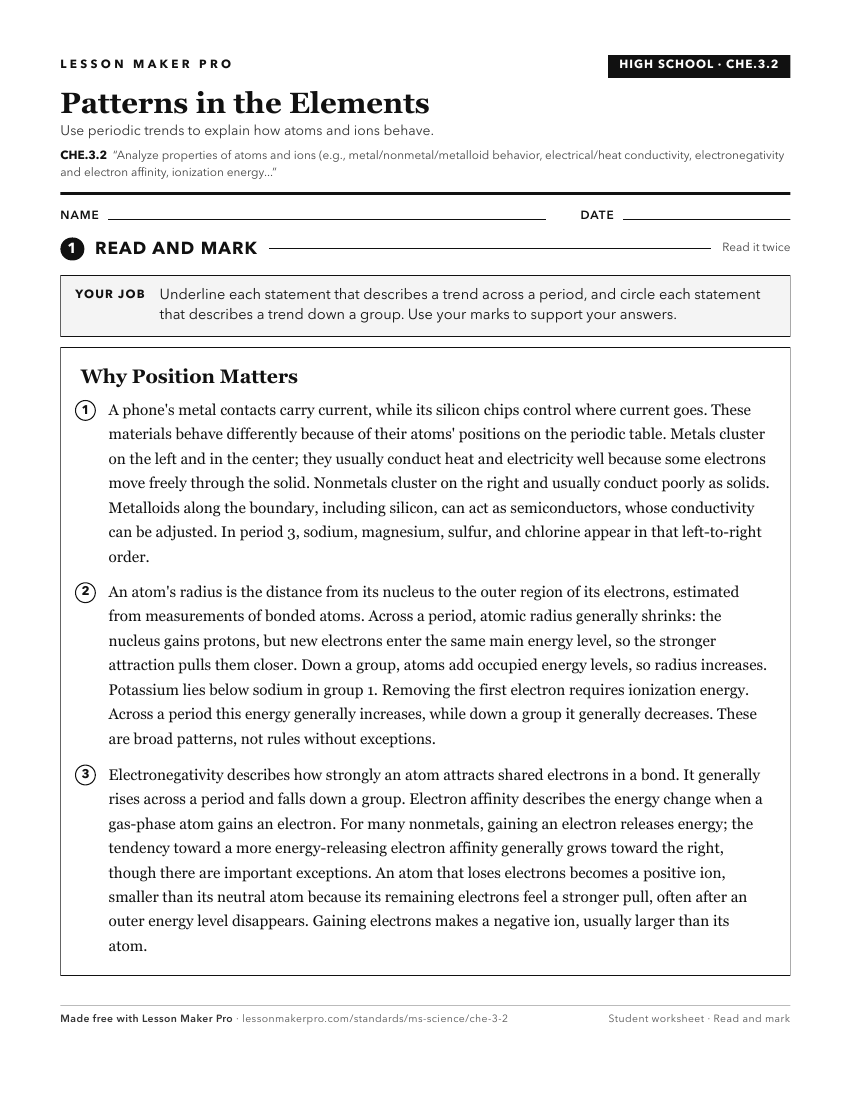
A ready-to-print activity worksheet aligned to CHE.3.2, with an answer key for the teacher on its own page. No account needed.
PDF, US Letter, prints cleanly in black and white.
Download the worksheetKeep exploring
Related Standards
- P.7.5C.4
Predict the properties and interactions of elements using the periodic table (metals, non-metals, reactivity, and conductors).
- CHE.4.3
Predict the ionic or covalent nature of different atoms based on electronegativity trends and/or position on the periodic table.
- CHE.3.3
Analyze the periodic table to identify quantum numbers (e.g., valence shell electrons, energy level, orbitals, sublevels, and oxidation numbers).
- PHS.3.1
Use contextual evidence to determine the organization of the periodic table, including metals, metalloids, and nonmetals; symbols; atomic number; atomic mass; c...
Turn this exact standard into a lesson
Grade, subject, topic, and the complete standard are prefilled. Create one free, no account needed.
Also for this standard:Make a WorksheetMake a QuizMake a Sub Lesson